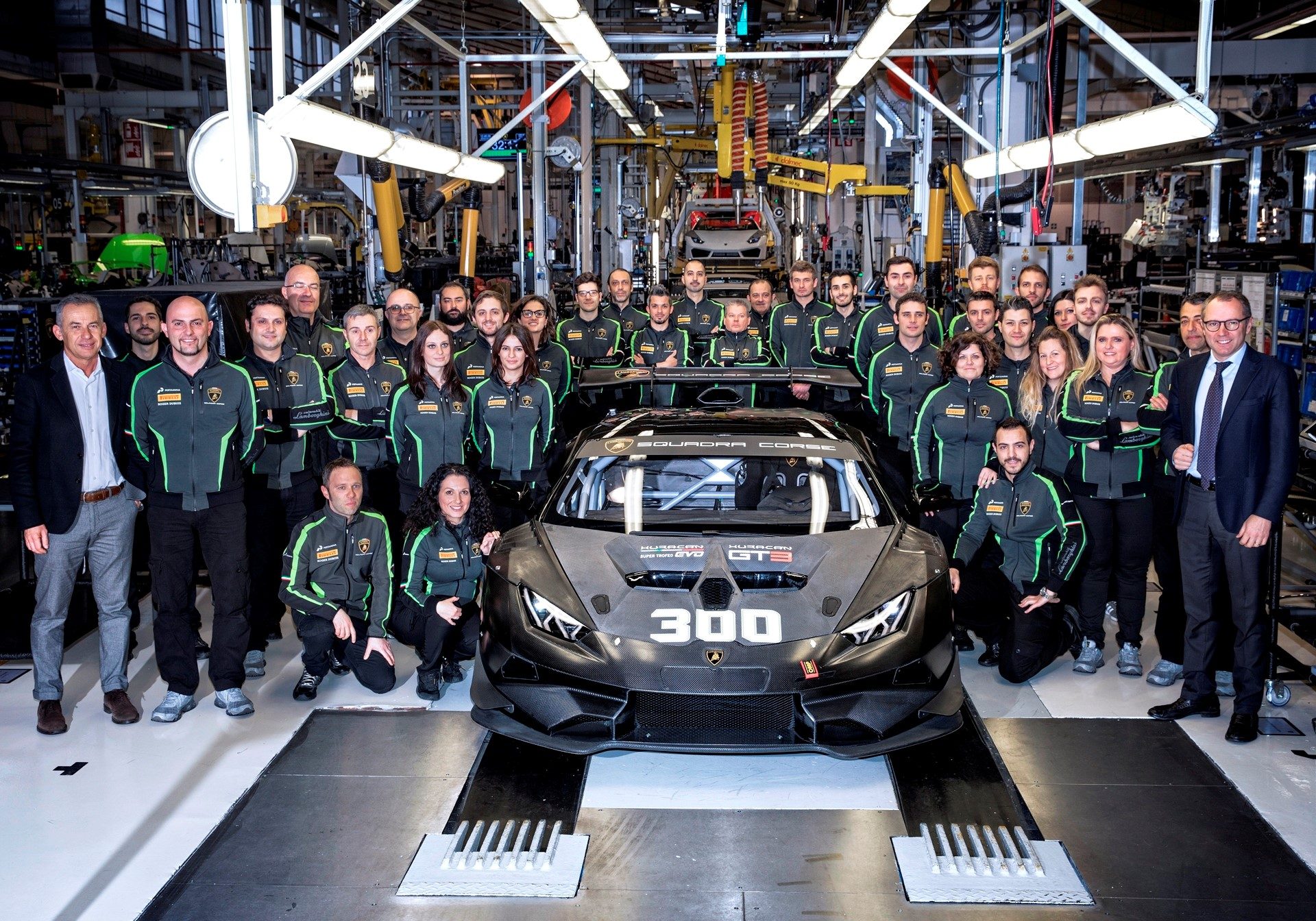
300 Racing Huracáns in 36 Months
Squadra Corse built every one on the same line as Lamborghini's road cars
On March 15, a Huracán Super Trofeo Evo became the 300th racing Huracán to leave the assembly line at Sant'Agata Bolognese, splitting the total between Super Trofeo one-make cars and GT3 endurance racers built since 2015.
The production logic behind the shared line
Maurizio Reggiani, then Lamborghini's Chief Technical Officer, framed the logic plainly: building racing cars using series production methods reduces production times and guarantees the highest quality control standards, which for a race car translates directly into on-track reliability.
The Super Trofeo Evo's racing hardware
The Super Trofeo Evo is powered by a naturally aspirated 5.2-liter V10 paired with a sequential racing gearbox and rear-wheel drive, sitting in a chassis with a full FIA-spec roll cage, racing suspension, and motorsport electronics.
Cross-pollination between road and race
Engineers and technicians on the shared line accumulate expertise across both road and race applications simultaneously, a kind of cross-pollination that compounds over years and model generations.
One roof, one quality standard
Lamborghini's integrated philosophy keeps race cars and road cars on a single assembly line: everything under one roof, quality controlled at every stage, with each element strengthening the others.
A distinct era in Lamborghini motorsport
The naturally aspirated V10 race cars already represent a distinct era in Lamborghini's motorsport history, one where the factory proved it could compete at the highest levels of GT racing while keeping every car's birth certificate stamped Sant'Agata Bolognese.
Squadra Corse technicians on the factory floor
Squadra Corse technicians shadow each racing Huracán through every assembly station, but the production line itself is shared with the road car.
The feedback loop that benefits street cars
Racing failures resolved by engineers who also work on the street car line propagate fixes back into road car quality without a formal technology transfer program.
Racing output as a share of factory throughput
The racing program's output of roughly 100 cars per year represents a meaningful fraction of total factory throughput, given that Lamborghini delivered 3,815 road cars in 2017.
How rivals approach customer racing
Ferrari's Corse Clienti and Porsche's motorsport division both produce customer racing cars at significant volume, but neither manufacturer has publicly emphasized an integrated, shared production line to the same degree.
Three hundred cars, one factory, one line
A large production run means a healthy parts supply chain, a broad knowledge base among race support teams worldwide, and strong residual interest in the secondary market.