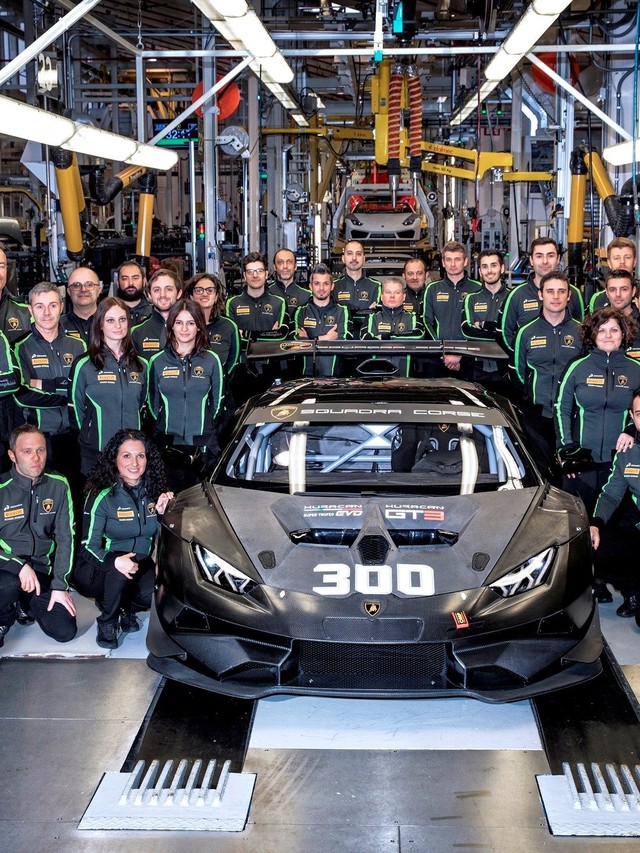
The 300th Car Rolled Off a Very Specific Line
On March 15, a Huracán Super Trofeo Evo became the 300th racing Huracán to leave the assembly line at Sant’Agata Bolognese. Lamborghini Squadra Corse reached that figure in 36 months, splitting the total between Super Trofeo one-make cars and GT3 endurance racers built since 2015. The 300th car itself is destined for the Lamborghini Super Trofeo series, which runs continental championships in Europe, Asia, and North America starting in April.
The number is impressive on its own, but the detail that makes it genuinely interesting sits underneath the headline. Every one of those 300 race cars was assembled on the same production line as the road-going Huracán. Not in a separate skunkworks facility. Not outsourced to a specialist constructor. The same stations, the same factory floor, the same Sant’Agata infrastructure that builds street cars. Squadra Corse technicians shadow each racing Huracán through every assembly station, but the line itself is shared. That arrangement is unusual in the supercar world, and it reveals more about Lamborghini’s motorsport philosophy than any podium count ever could.
Why Building Race Cars Next to Road Cars Changes the Equation
Most manufacturer motorsport programs farm out race car construction to external partners. Chassis specialists, homologation engineers, and independent racing shops typically handle the conversion from road platform to competition machine. Lamborghini says Squadra Corse manages the entire process in-house, from initial design through final assembly.
Maurizio Reggiani, then Lamborghini’s Chief Technical Officer, framed the logic plainly: building racing cars using series production methods reduces production times and guarantees the highest quality control standards, which for a race car translates directly into on-track reliability. That sounds like corporate boilerplate until you consider what it means in practice. When the same technicians who install a V10 into a road Huracán also install one into a GT3 car, every tolerance issue, every supplier inconsistency, every assembly shortcut gets caught by people who see the same components in two different contexts every working day.
The feedback loop runs both directions. Racing stresses expose weaknesses in components that road use might never reveal for tens of thousands of miles. When those failure modes surface on track and get resolved by engineers who also work on the street car line, the fix propagates back into road car quality without a formal “technology transfer” program. The transfer is structural, baked into the workflow rather than packaged as a marketing initiative. For teams running these cars in competition, the reliability argument is concrete. A GT3 car that breaks on the grid costs its customer team a race entry fee, travel expenses, and potentially a championship position. Lamborghini says the Huracán GT3 won 10 international titles and the Daytona 24 Hours in just two racing seasons from 70 produced units. Winning at Daytona requires a car that survives 24 hours of continuous abuse. Reliability at that level is engineering, not luck.
The Numbers Behind the Milestone
Breaking down the 300-car total reveals the scale of each program. Lamborghini says 180 Huracán Super Trofeos were built from 2015 through early 2018, with approximately 70 Super Trofeo Evo units planned for production by the end of 2018. The GT3 program, which began production in 2016, accounted for 70 units by March 2018.
For context, Lamborghini delivered 3,815 road cars in 2017, its seventh consecutive annual production record. The racing program’s output, roughly 100 cars per year at this pace, represents a meaningful fraction of total factory throughput. A motorsport department producing at that rate on a shared line is genuinely unusual for a company of Lamborghini’s size.
The Super Trofeo Evo arriving in April replaced the earlier Super Trofeo model for all three continental one-make championships. Powered by a naturally aspirated 5.2-liter V10 paired with a sequential racing gearbox and rear-wheel drive, the car sits in a chassis featuring a full FIA-spec roll cage, racing suspension, and motorsport electronics. Every interior surface is stripped to essentials: a driver-focused cockpit with no concessions to road comfort. Yet this purpose-built machine shares its birthplace with the road car whose name it carries, and that shared origin is precisely the point.
How This Compares to Rival Motorsport Operations
Ferrari’s Corse Clienti and Porsche’s motorsport division both produce customer racing cars at significant volume, but neither manufacturer has publicly emphasized an integrated, shared production line to the same degree. Ferrari’s GT racing program leverages Maranello’s engineering resources, and Porsche’s 911 GT3 Cup cars benefit from the 911’s decades of evolutionary refinement. Both programs are formidable. The distinction Lamborghini draws is organizational: Squadra Corse claims to control the entire design-to-delivery pipeline without outsourcing core assembly work.
Whether that organizational model produces a measurably better race car is difficult to prove from production numbers alone. What it clearly produces is consistency. When every car comes from the same line, with the same tooling, under the same quality management system, the variation between chassis number 1 and chassis number 300 should be minimal. For gentleman drivers buying a GT3 car to race on weekends, that consistency matters as much as outright pace. A predictable car is a safe car, and a safe car is one its owner will actually push to the limit. The shared-line model also consolidates institutional knowledge: engineers and technicians accumulate expertise across both road and race applications simultaneously, a kind of cross-pollination that compounds over years and model generations.
Certifying the Humans, Not Just the Hardware
Alongside the 300-car milestone, Squadra Corse extended its TÜV ISO 9001 certification, originally obtained in 2017 for development, manufacturing, and servicing of racing cars. The expanded scope now covers the development and delivery of selection and training programs for racing drivers.
ISO 9001 certification for a driver development program is unusual in motorsport. It means an independent auditor evaluated the processes by which Squadra Corse identifies, selects, and trains young racing talent and found them repeatable, documented, and quality-controlled to the same standard applied to manufacturing. Giorgio Sanna, Lamborghini’s Head of Motorsport, pointed to the TÜV approval as a guarantee of quality for participants in the academy programs.
The practical implication for buyers of Super Trofeo and GT3 cars is indirect but real. A well-trained field of competitors in the one-make series makes for better racing, which makes the championship more attractive, which sustains demand for the cars themselves. The entire ecosystem, from factory floor to driver academy to race grid, reinforces itself. It is another expression of the same integrated philosophy that puts race cars and road cars on a single assembly line: keep everything under one roof, control the quality at every stage, and let each element strengthen the others.
What This Milestone Signals for Lamborghini’s Racing Future
Lamborghini confirmed nothing about future race car production targets or successor platforms in this announcement. What the 300-car milestone does establish is a proven manufacturing and organizational template. When the time comes to build the next generation of customer race cars, Squadra Corse will carry forward a production methodology that delivered 300 cars in three years with a Daytona win and 10 international titles as validation.
For current Huracán Super Trofeo and GT3 owners and operators, the 300-car figure carries a different kind of significance. A large production run means a healthy parts supply chain, a broad knowledge base among race support teams worldwide, and strong residual interest in the secondary market. The naturally aspirated V10 race cars already represent a distinct era in Lamborghini’s motorsport history, one where the factory proved it could compete at the highest levels of GT racing while keeping every car’s birth certificate stamped Sant’Agata Bolognese. Three hundred cars, one assembly line, one factory. That is the story Squadra Corse is really telling.
Gallery


