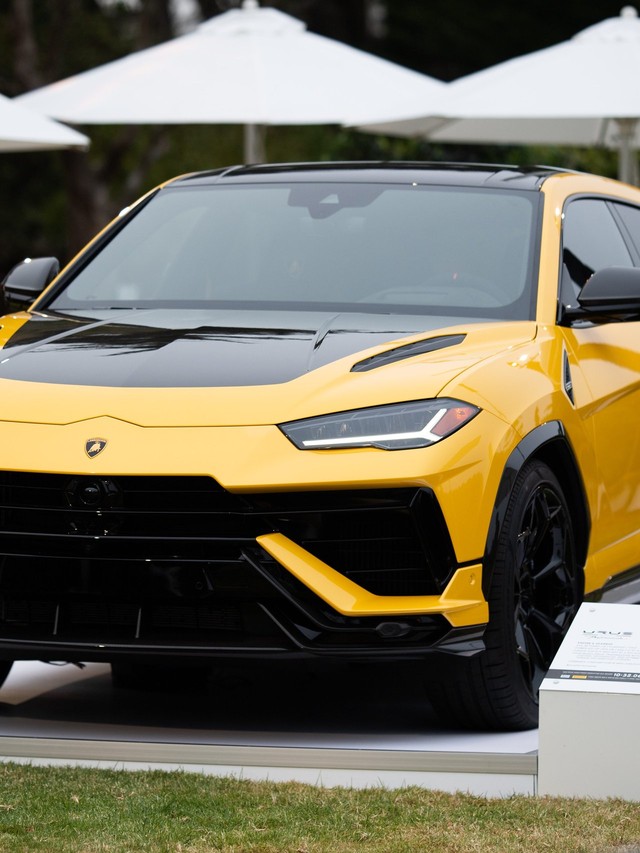
A Billion Euros and a Bet on the Urus
Lamborghini crossed the billion-Euro turnover threshold for the first time in its history during Fiscal Year 2017, pushing revenue to 1,009 million Euro, an 11% jump over the prior year, while delivering 3,815 cars worldwide. Both figures were records. Both were almost beside the point.
The real story buried inside those numbers was what Lamborghini was spending while it earned. The company doubled the physical footprint of its Sant’Agata Bolognese headquarters from 80,000 to 160,000 square meters, installed new production systems it branded Manifattura Lamborghini, hired 500 additional workers, and expanded total headcount from 1,415 to nearly 1,600. All of this was preparation for a single vehicle: the Urus Super SUV, unveiled in December 2017 with market deliveries slated for spring 2018.
Stefano Domenicali, then Chairman and CEO, described the simultaneous effort of launching new supercars while doubling factory capacity as an “unprecedented double challenge.” That framing was corporate understatement. What Lamborghini actually did in 2017 was commit to becoming a fundamentally different company, one that would sell more SUVs than supercars and then use the profits to fund everything that came after.
The Supercar Core That Funded the Expansion
While the factory expansion consumed capital and executive attention, Lamborghini’s existing lineup was doing the heavy lifting on the revenue side. The V10 Huracán delivered 2,642 units in 2017, a 12% increase over the prior year, while the V12 Aventador contributed 1,173 units with 6% growth. Both model lines posted record sales.
Four new variants landed during the year. The Aventador S Coupé and Roadster refreshed the V12 flagship, and the Huracán Performante, with its Aerodinamica Lamborghini Attiva active aero system, proved wildly popular on both road and track, collecting lap records at circuits around the world. These were not placeholder models designed to keep showrooms warm while the Urus tooled up. They were genuine performance statements that reinforced the brand’s credibility at the exact moment Lamborghini was asking purists to accept an SUV with a raging bull on the hood.
Regionally, the sales distribution looked healthy and balanced. Each of Lamborghini’s three global regions accounted for roughly one third of total volume: EMEA posted 1,477 units (up 18%), the Americas contributed 1,338 (up 4%), and Asia Pacific reached 1,000 (up 9%). The United States remained the single largest national market at 1,095 units, followed by Japan at 411 and the UK at 353. Every major market set a national sales record. For a company about to nearly triple its annual output capacity, that kind of geographic diversification was not a vanity metric. It was insurance.
Doubling Down: The Factory Gamble That Reshaped Lamborghini
The scale of Lamborghini’s 2017 infrastructure investment is easy to gloss over in hindsight, but it deserves a closer look. Doubling production capacity to more than 7,000 units per year meant Lamborghini was projecting that a single model, the Urus, would eventually outsell the Aventador and Huracán combined. For a brand that built its mythology on exclusivity and low volume, that was a genuinely radical bet.
Consider the trajectory. In 2010, Lamborghini delivered 1,302 cars total. By 2017, that figure had nearly tripled. The Urus was designed to triple it again. The company was not simply adding a model; it was rebuilding its entire economic foundation around a vehicle that shared more DNA with the Volkswagen Group’s MLB Evo platform than with any mid-engine supercar from Sant’Agata.
Porsche had already proven the template. The Cayenne rescued Porsche from financial fragility in the early 2000s and funded the development of everything from the 918 Spyder to the Taycan. Ferrari took a more cautious path, waiting until 2022 to reveal the Purosangue and capping its production to protect brand perception. Lamborghini chose the aggressive middle ground: launch early, build volume, but position the Urus as a “Super SUV” with performance credentials that justified the badge. Whether that positioning held up in the eyes of enthusiasts remained an open question in early 2018. The financial results would answer it decisively.
From 3,815 to 10,747: What 2017’s Foundation Actually Built
The payoff from Lamborghini’s 2017 strategy is now a matter of public record. In 2025, Lamborghini delivered 10,747 vehicles worldwide, its fifth consecutive annual sales record. Revenue reached €3.20 billion, according to one report, roughly tripling the 2017 turnover figure. The Urus became exactly what Lamborghini planned: the company’s highest-volume nameplate, generating the cash flow to develop an entirely new generation of hybrid supercars.
According to Car and Driver, Lamborghini first broke the 10,000-unit barrier in 2023, a milestone that would have seemed fantastical to anyone reading the 2017 annual report. One source attributes the most recent growth to the Revuelto, Lamborghini’s first hybrid supercar, with customer deliveries of the Temerario (the second hybrid) reportedly beginning in early 2026. A plug-in hybrid powertrain joined the Urus lineup in 2025, completing the electrification of the entire range.
The compound annual growth rate for deliveries between 2017 and 2025 sits at approximately 13 to 14 percent, according to one analysis. Revenue growth outpaced unit growth, suggesting that Lamborghini’s customers are spending more per car, not less, even as volume climbs. The Ad Personam customization program now touches 94% of deliveries, per the same report, meaning nearly every Lamborghini leaves the factory with at least one bespoke element. Volume did not kill exclusivity. It funded personalization.
For anyone who worried in 2017 that the Urus would dilute the brand, the practical answer is that it did the opposite. It gave Lamborghini the financial muscle to develop the Revuelto’s hybrid V12 architecture, to invest in the Temerario’s twin-turbo V8 hybrid system, and to keep pushing the performance envelope rather than retreating to cost-cutting. The Urus was not a concession. It was the funding mechanism for everything enthusiasts care about.
The Exclusivity Question: Can a 10,000-Unit Brand Still Feel Special?
Lamborghini’s growth trajectory raises a question every supercar brand eventually confronts: where is the ceiling? Ferrari, which reported 13,752 deliveries in 2024 (its own record), operates at higher volume but also commands higher average transaction prices and a market capitalization that dwarfs its parent company’s expectations. One report indicates McLaren targeted 6,000 global sales in 2025, while Aston Martin was projected at approximately 5,500 vehicles.
Lamborghini sits in interesting territory. It produces more cars than McLaren or Aston Martin but fewer than Ferrari, and its product mix of two mid-engine supercars plus a high-performance SUV gives it a broader addressable market than any of those competitors except Ferrari. The risk is that familiarity breeds indifference. A Huracán parked outside a Miami steakhouse in 2014 turned heads. A Urus in the same spot in 2025 barely registers.
The company appears aware of this tension. Car and Driver reported that Lamborghini’s sales and marketing chief, Federico Foschini, indicated the brand is planning “crazier” special models following the success of the Huracán Sterrato, while also looking to increase customization without expanding total sales figures. That is a meaningful strategic signal: grow revenue per unit, not units per year. It mirrors the playbook Porsche refined with GT3 and GT2 variants, and it works precisely because the base volume, funded by the SUV, gives the company room to experiment with low-run specials that collectors will fight over.
For prospective buyers, the practical takeaway is straightforward. If you want a Lamborghini that holds its value and carries some scarcity, the limited-edition and special-series models are where the smart money goes. The core lineup of Revuelto, Temerario, and Urus SE will be more accessible than any previous generation of Lamborghinis, which is good news for enthusiasts who actually want to drive these cars rather than warehouse them.
The Terzo Millennio’s Quiet Legacy
One footnote from 2017 deserves a second look. Alongside the Urus reveal and the supercar refreshes, Lamborghini showed the Terzo Millennio concept, a collaboration with MIT that explored supercapacitor energy storage, self-healing carbon fiber body structures, and electric propulsion. At the time, it read like a pure thought exercise, the kind of concept car that generates press coverage and then evaporates.
The reality turned out to be more complicated. Lamborghini did pursue hybridization aggressively, and the Revuelto’s supercapacitor-assisted system echoes at least the spirit of the Terzo Millennio’s energy storage research. But the concept’s more radical ambitions, particularly a fully electric Lamborghini supercar, appear to have hit a wall. Jalopnik reported that Lamborghini shelved its first planned electric car after CEO Stephan Winkelmann concluded the target market was “close to zero.” The Terzo Millennio envisioned a future that Lamborghini’s own customers, it turns out, do not want.
That pivot is itself a product of the financial strength 2017 built. A company delivering 1,302 cars a year cannot afford to ignore any potential market segment. It 10,747 can afford to listen to its customers and say no to a technology path that does not fit. Lamborghini’s hybrid strategy, born from the research directions the Terzo Millennio explored, gives the brand a credible emissions-reduction story without abandoning internal combustion. Whether that position remains tenable in a decade depends on regulation more than customer preference, but for now, it is a luxury that only financial health can buy.
Looking back at 2017, the billion-Euro milestone and the record sales figures were symptoms, not causes. The cause was a strategic decision to double the size of the company, build an SUV that purists questioned, and use the proceeds to fund a new generation of supercars. Every Revuelto rolling off the line today, every Temerario waiting for its delivery slot, exists because Lamborghini made that bet eight years ago and got it right.
Gallery


