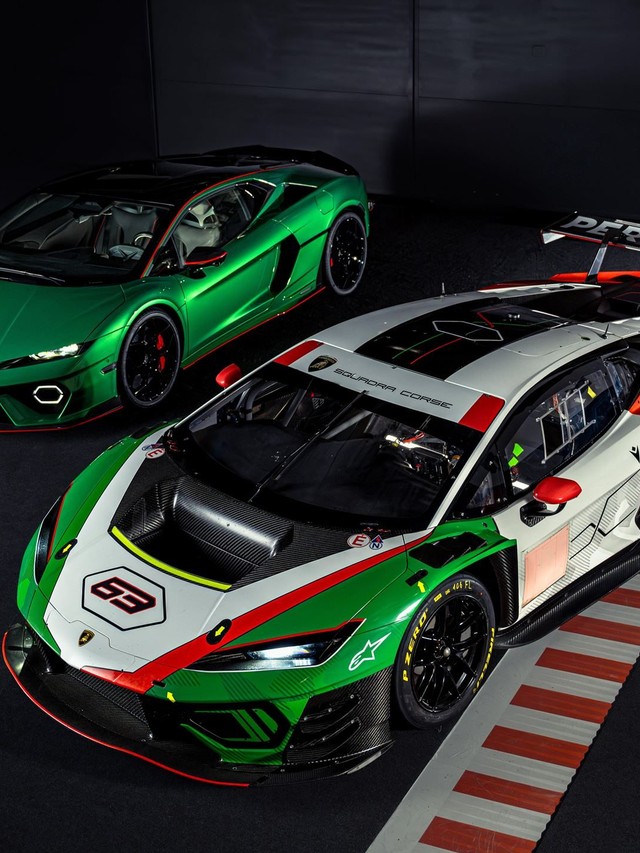
The Engineering Paradox: Hybrid Road Car to Pure V8 Race Machine
Lamborghini’s newest GT3 challenger is, in one critical respect, less complex than the road car it derives from. The Temerario GT3 retains the road-going Temerario’s 4.0-liter twin-turbo V8 but jettisons all three electric motors and the plug-in hybrid architecture that Lamborghini says produces a combined 920 PS in the street car. FIA GT3 regulations mandate a non-hybrid powertrain for competition vehicles, forcing Squadra Corse to perform what amounts to a deliberate technological regression: stripping out the electrified components that define the road car’s identity.
This is not a simple case of unplugging some batteries. Removing the hybrid system changes the engine’s thermal management requirements, its power delivery curve, and its relationship with the turbochargers. According to one report, the GT3 racer’s V8 features redesigned, smaller turbochargers compared to the road car, a consequence of the engine needing to manage heat and boost without the electric motors that supplement low-end torque on the street version. The engine has reportedly been recalibrated to deliver maximum performance across a broader rev range suited to sustained racing conditions.
The road car’s twin-turbo V8 features a 10,000 rpm redline, a remarkable figure for a forced-induction engine made possible by titanium connecting rods and a flat-plane crank. Whether the GT3 variant retains that stratospheric ceiling under Balance of Performance (BoP) constraints remains one of several details Lamborghini has not publicly confirmed. What is clear: the GT3’s powertrain is optimized not for peak headline numbers but for the kind of repeatable, consistent output that wins endurance races over 12 and 24 hours. For context, one source estimates the GT3 produces approximately 550 horsepower after BoP adjustments, a dramatic reduction from the road car’s output but entirely typical for the class.
For anyone who followed the Huracán GT3’s decade-long career, the shift from a naturally aspirated V10 to a turbocharged V8 represents the most fundamental powertrain change in Lamborghini’s GT3 history. Teams accustomed to the Huracán’s linear power delivery will need to adapt to turbo lag management, different braking characteristics from altered weight distribution, and an entirely new torque curve.
Design Evolution: Road Car DNA Translated to Track Dominance
Lamborghini states the Temerario GT3 is a product of collaboration between Squadra Corse and Centro Stile, the brand’s in-house design department. That partnership is worth noting because it reflects a broader industry trend: GT3 cars are no longer purely engineering exercises. They are brand ambassadors that need to look unmistakably like their road-going siblings while meeting strict aerodynamic and safety regulations.
Mitja Borkert, Lamborghini’s Director of Design, has emphasized that the road car was conceived from its earliest sketches with adaptability and future racing potential as core considerations. In practice, this means the Temerario’s proportions, its sharp surfacing, and its aggressive stance were designed to survive the transition to a full aero package without losing visual coherence. Looking at the two cars side by side, the GT3 clearly wears a massive rear wing, front splitter, canards, and extensively vented bodywork, yet the family resemblance is immediate. The Y-shaped daytime running lights from the road car carry over, and the overall silhouette remains recognizably Temerario.
The GT3’s bodywork is constructed from lightweight composites, with quick-release front and rear sections and modular underbody panels designed to facilitate rapid servicing during race weekends. This is a practical necessity for endurance racing, where a damaged front end needs to be swapped in minutes, not hours. The visible roll cage and extensive carbon fiber components inside the cockpit underscore how completely the interior has been stripped. Gone are the road car’s refined interfaces and creature comforts, replaced by FIA-compliant safety systems, a racing seat, and bespoke controls tailored for endurance driving demands.
One detail visible on the GT3’s livery deserves mention: the number 63 on its flanks, a nod to Lamborghini’s founding year of 1963. It is a small touch, but for a brand that has historically been perceived as younger in motorsport than Ferrari or Porsche, these heritage references signal that Lamborghini is increasingly comfortable weaving its history into its racing identity.

Lamborghini’s Evolving Motorsport Strategy
Ferruccio Lamborghini founded the company in 1963 with a famously clear directive: build grand touring cars, not race cars. For decades, Lamborghini’s motorsport involvement was sporadic and often driven by private entrants rather than factory programs. That philosophy has been systematically dismantled over the past 15 years. Lamborghini initiated its one-make Super Trofeo series in 2009 with the Gallardo, and the program has expanded steadily since. CEO Stephan Winkelmann has indicated that racing is now a core component of the brand’s identity, a statement that would have been unthinkable from Sant’Agata Bolognese a generation ago.
The Temerario GT3 arrives as the successor to the Huracán GT3, a car that served as Lamborghini’s primary GT3 weapon for a full decade. Road & Track noted that during that span, eleven other brands introduced entirely new GT3 platforms while Lamborghini continued updating the same basic Huracán chassis. The Temerario GT3 is, in that context, overdue. But it also represents a significant escalation in ambition. One report describes it as the first competition car to be fully conceived, engineered, and produced in-house at Lamborghini’s Sant’Agata Bolognese factory, a distinction that separates it from earlier programs where external partners played larger roles.
Lamborghini now fields the SC63 in the LMDh prototype class alongside the GT3 program, giving the brand a presence across the two most prominent categories in global sportscar racing. For enthusiasts, this two-pronged approach mirrors what Ferrari and Porsche have done for years, and it signals that Lamborghini views motorsport not as a marketing exercise but as an engineering laboratory and competitive proving ground.

What the Temerario GT3 Means for Customer Racing
GT3 racing is, at its core, a customer racing category. The cars are sold to private teams who campaign them in series like IMSA, the World Endurance Championship, and various national GT championships. The Temerario GT3 made its competitive debut at the 2026 12 Hours of Sebring, where it finished 10th in the GTD Pro class. One report indicates the car is campaigned by Canadian team Pfaff Motorsports in IMSA, a well-regarded squad that previously ran Porsche machinery.
For prospective customer teams evaluating the Temerario GT3, several practical questions remain unanswered. Lamborghini has not publicly disclosed the purchase price for customer cars, the scope of its factory support program, or the specific spare parts and engineering assistance packages available. These details matter enormously in a class where the annual operating cost of a competitive GT3 program can approach seven figures. Teams making the switch from the Huracán GT3 EVO2 will want to understand parts commonality, training support for the new turbocharged powertrain, and how Lamborghini plans to handle the BoP process with series organizers.
The car is designed to be compatible with various tire manufacturers and GT3 regulations globally, which suggests Lamborghini is targeting the broadest possible customer base rather than optimizing for a single championship. This flexibility is critical: a GT3 car that works well only on one tire compound or in one regulatory framework limits its market. The modular bodywork and quick-release panels are designed with the realities of customer racing in mind, where teams often operate with smaller crews than factory efforts and need to minimize downtime.
On forums like Lamborghini-Talk, the buzz around the Temerario extends beyond racing. Aftermarket companies are already seeking road-going Temerarios to scan for exhaust and performance part development, and prospective owners report being in active discussions with dealers about build slots. The enthusiasm suggests Lamborghini has successfully built anticipation across both its road car and racing audiences, something the brand struggled with during the later years of the Huracán’s lifecycle when the platform felt increasingly long in the tooth.

Temerario Road Car vs. GT3: Key Specifications
The divergence between the road-going Temerario and its GT3 counterpart illustrates how dramatically FIA regulations reshape a modern supercar for competition. Here is what we know, and what remains unconfirmed:
| Specification | Temerario (Road) | Temerario GT3 |
|---|---|---|
| Engine | 4.0L Twin-Turbo V8 | 4.0L Twin-Turbo V8 |
| Hybrid System | Three electric motors | None (FIA GT3 prohibited) |
| Combined Output | 920 PS (Lamborghini stated) | ~550 hp (estimated, BoP dependent) |
| Redline | 10,000 rpm | Not confirmed |
| Gearbox | Eight-speed dual-clutch | Racing sequential (details TBC) |
| Top Speed | Over 340 km/h (Lamborghini stated) | N/A (circuit dependent) |
| Bodywork | Production composite | Lightweight composites, quick-release panels |
| Interior | Road-focused with refined interfaces | Stripped, FIA-compliant safety systems |
| Turbochargers | Standard specification | Reportedly smaller, redesigned |
Several critical details about the GT3 remain unconfirmed by Lamborghini: the exact power output before and after BoP adjustments, the car’s dry weight, specific aerodynamic downforce figures, and the customer purchase price. These gaps are not unusual for a GT3 car in its debut season, as manufacturers typically refine BoP data through competition before publishing definitive specifications.
What is already clear is that the Temerario platform gives Lamborghini a modern, purpose-built foundation for its next decade of GT racing. The Huracán GT3 proved the brand could compete at the highest level of customer motorsport. The Temerario GT3 now needs to prove it can win consistently against the latest machinery from Ferrari, Porsche, McLaren, and Mercedes-AMG in what has become the most competitive GT3 era in the category’s history.
Gallery