Record Revenue, Fewer Deliveries, and a Market in Retreat
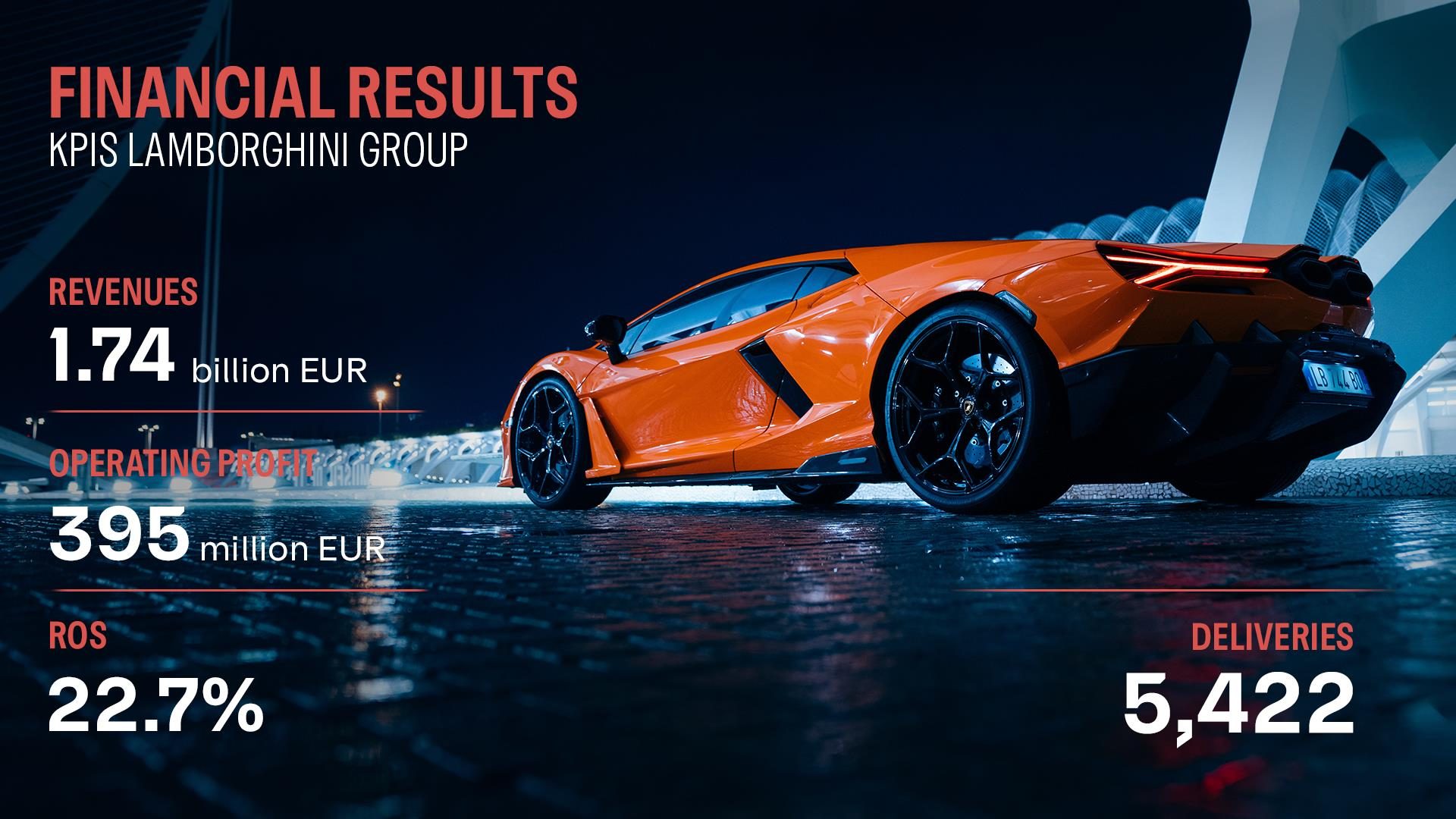
Automobili Lamborghini closed the first half of 2026 with €1.74 billion in revenue, a 7.4% jump over the same period in 2025 and the highest half-year figure in the company’s history. Operating profit reached €395 million at a 22.7% margin. The counterintuitive detail: Lamborghini delivered 5,422 vehicles, down 4.6% year on year.
That gap between rising revenue and falling volume is the defining number of this report, and it reveals the logic behind everything Lamborghini has done over the past three years. The broader luxury segment the company competes in contracted by 7.7% during the period, battered by U.S. tariffs introduced in 2025, adverse currency movements, softness in the Chinese luxury market, and continued instability in the Middle East and Europe. Growing revenue while shipping fewer cars into that environment points to one thing: each car leaving Sant’Agata Bolognese carried a higher average transaction value than before.
Chairman and CEO Stephan Winkelmann framed it in terms of brand protection, stating that the company’s strength stems from a business model built on exclusivity and brand value. CFO Paolo Poma acknowledged the tariff and exchange-rate headwinds directly, noting they affected performance without compromising Lamborghini’s positioning among luxury sector leaders. The language is corporate, but the math underneath is sharp: Lamborghini extracted more revenue per unit in a shrinking market, and that kind of pricing discipline is difficult to fake.

Stephan Winkelmann, CEO of Lamborghini, stands confidently in the factory, flanked by two Revuelto supercars. Image: Automobili Lamborghini.
Three Hybrid Families, One Fully Electrified Lineup
The revenue record did not arrive by accident. It reflects the first half-year in which all three of Lamborghini’s product families contributed deliveries as hybrids, completing a transition the company mapped out years ago under its Direzione Cor Tauri electrification roadmap.
The Revuelto pairs a 6.5-liter naturally aspirated V12 with three electric motors for a combined 1,015 CV. The Urus SE plugs a 25.9 kWh battery and electric motor into the familiar 4.0-liter twin-turbo V8, reaching 800 CV and 950 Nm. And the Temerario, which began deliveries in Q1, brings an all-new 4.0-liter twin-turbo V8 with three electric motors, producing over 920 CV and capable of spinning to 10,000 rpm. Every car in the current catalog now carries a plug.
Lamborghini confirms continued strong demand for the Revuelto and Urus SE. Multiple reports confirm the Urus SE sold out for the entirety of 2025, and the Revuelto’s order book is reportedly filled through at least 2026. Overall waiting time across the range sits at approximately one year. For buyers, that backlog functions as a built-in exclusivity mechanism: Lamborghini can afford to hold prices because the queue itself signals desirability. The skeptics who predicted hybridization would dilute the brand’s appeal can look at the revenue line and draw their own conclusions.

The blue Lamborghini Revuelto stands out against the dramatic backdrop of a mountain road at sunset. Image: Automobili Lamborghini.
The Exclusivity Playbook in Practice
Selling fewer cars for more money sounds simple. Executing it while competitors scramble to protect volume is something else entirely. Independent reports indicate Lamborghini contributes approximately 8% of the Volkswagen Group’s total profit despite representing less than 1% of its overall turnover. That ratio tells you everything about the margins Sant’Agata commands.
According to one report, Lamborghini’s profitability stems from the combination of product margins, pricing discipline, and controlled growth. When the relevant market segment contracts by 7.7%, a volume-dependent manufacturer scrambles to incentivize sales. Lamborghini instead lets the order book absorb the pressure, maintaining price integrity and margin. Recent reports from multiple publications note Lamborghini exceeding €3 billion in annual revenue, and the H1 2026 pace suggests the company is tracking toward another strong full year.
For enthusiasts, the practical implication is clear: if you are waiting for Lamborghini to discount anything or expand production to shorten wait times, the financial incentive to do so simply does not exist. The brand makes more money by making you wait. Speccing a Revuelto or Temerario through Lamborghini’s Ad Personam program, where buyers choose bespoke paint, trim, and material combinations, almost certainly contributes to higher per-unit revenue. Lamborghini does not break out personalization revenue separately, but the pattern mirrors what works across the ultra-luxury segment: the base car is the entry point, and the real margin lives in the options list.

The main entrance of the Lamborghini factory building stands under a clear sky, showcasing the iconic logo. Image: Automobili Lamborghini.
Where Competitors Stumbled
These results land at a moment when several rivals face pointed questions about their own electrification strategies. Ferrari continues to pursue a full-EV path alongside its hybrid and combustion models, a bet that carries both opportunity and risk in a market where, as Autoblog reported, Winkelmann himself stated that customers do not currently see EVs as an alternative. Lamborghini’s decision to go hybrid-only, without committing to a pure battery-electric production car, looks increasingly well-timed.
The Chinese luxury market, which several European manufacturers leaned on heavily during the growth years, contracted during the first half. Lamborghini cites this as a headwind, but the company’s relatively small exposure to China compared to brands like Porsche, which derives a larger share of volume from the region, limits the damage. Geographic diversification, with EMEA as its largest delivery region, provides a buffer that volume-dependent competitors lack.
As CarBuzz noted, Lamborghini will not abandon its combustion engines anytime soon. The hybrid architecture lets the company meet tightening emissions regulations while preserving the character of its V12 and V8 powertrains. Financial results like these give Sant’Agata the runway to be patient about full electrification rather than rushing into it under margin pressure.
What Comes Next: Urus SE Performante and Beyond
Lamborghini says the second half of 2026 opened with the launch of the Urus SE Performante, delivering 812 CV and 1,000 Nm from its plug-in hybrid V8 powertrain. Positioned at the top of the Urus family, it adds another high-margin variant to the lineup at a moment when the financial engine clearly does not need rescuing but benefits from fresh product cadence.
The broader question for Lamborghini watchers is what this financial strength funds. One competitor report indicates Lamborghini is self-financing its largest-ever investment plan. Autoblog reported that the Lanzador concept, originally envisioned as Lamborghini’s first pure EV, may instead debut as a plug-in hybrid 2+2 grand tourer. A 22.7% operating margin buys the freedom to make that call on product terms rather than regulatory panic.
For current and prospective owners, the takeaway ties back to the same thesis running through every line of this report. Lamborghini’s financial health protects residual values, ensures continued investment in motorsport programs like the Temerario-based GT3, and removes any near-term pressure to dilute the brand through volume expansion. The order book stays controlled. The margins stay fat. And the waiting list, for better or worse, stays long.

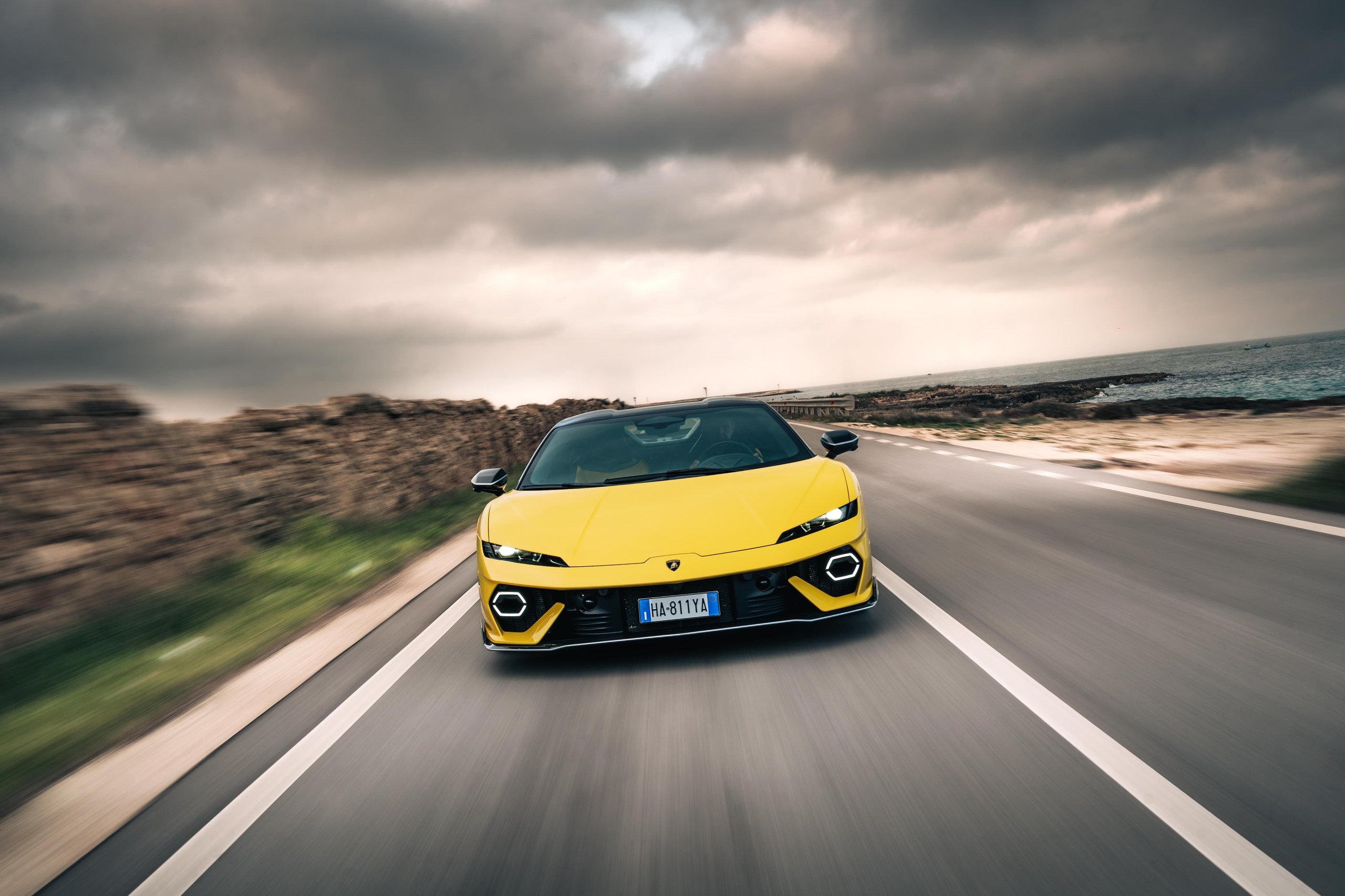
A powerful yellow Lamborghini Urus Performante races on the track as the sun sets in a dramatic sky. Image: Automobili Lamborghini.
Gallery