A Lap Record for a Car Nobody Can Buy Yet
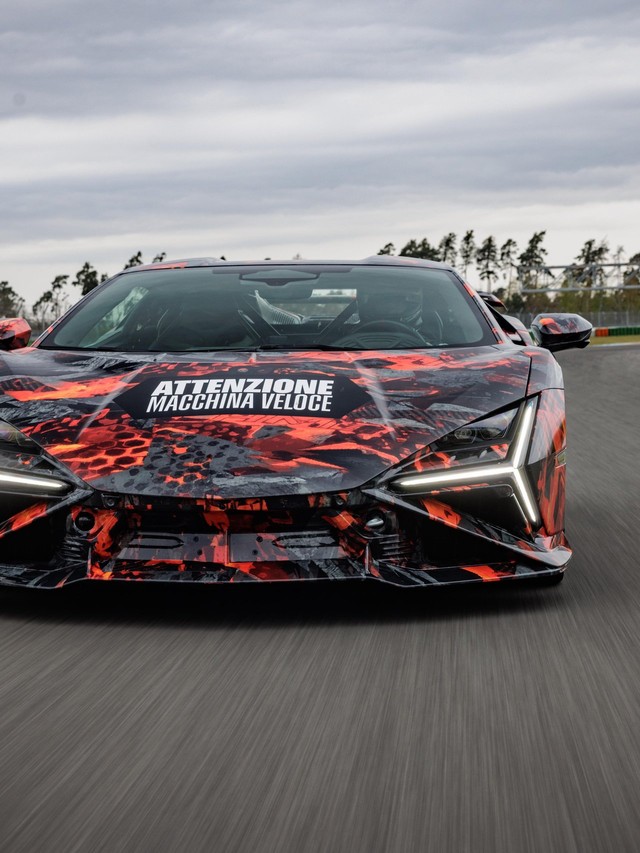
Lamborghini’s still-unrevealed Revuelto SV posted a 1:41.6 at the Hockenheimring with factory driver Marco Mapelli behind the wheel, a time the company claims as the fastest production car lap ever recorded at the German circuit. The car remains wrapped in black-and-red camouflage. Its power figure, curb weight, and pricing are all unknown. Its world premiere is scheduled for August 14 at The Quail during Monterey Car Week.
That sequence is the story: Lamborghini dropped a lap record for a car whose spec sheet does not yet exist in public. No horsepower number, no torque curve, no weight savings over the standard Revuelto. Just a time, a driver, and a date circled on the calendar. It is an unusually confident piece of stagecraft, one that tells you exactly how Sant’Agata Bolognese wants this conversation to unfold. Proof first, explanations later.
“The Revuelto SV has reached a level of performance we had never experienced before at Lamborghini,” Mapelli said after the run.
That quote from a man who regularly drives Squadra Corse race cars carries more weight than the typical factory-driver endorsement. Mapelli knows the Aventador SVJ intimately, knows the standard Revuelto, and knows what the hybrid V12 platform can do when pushed to its structural limits. When he says “never experienced before,” the implication is a step change, not an incremental tune.
Why the Hockenheimring, and Why It Matters
Lamborghini describes the Hockenheimring as an internationally recognized benchmark for dynamic capabilities, and the characterization is fair. The circuit’s layout combines sustained high-speed sections with heavy braking zones and tight technical corners, demanding competence across the entire performance envelope rather than rewarding a single strength. A car that excels only in straight-line speed or only in low-speed grip will not post a competitive time here.
The choice of venue is deliberate. The Nurburgring Nordschleife tends to dominate lap-record headlines, but its 12.9-mile length amplifies variables like weather, traffic windows, and tire degradation in ways that can obscure a car’s fundamental balance. Hockenheim’s shorter Grand Prix layout compresses the test into roughly 100 seconds where chassis tuning, aerodynamic efficiency, and powertrain response are laid bare. For a manufacturer trying to prove that its hybrid architecture works under sustained duress, this is a more revealing stage, and a harder place to hide weaknesses.
One caveat worth noting: Motor1.com pointed out that the Mercedes-AMG One previously recorded a 1:38.5 at Hockenheimring on the Grand Prix layout, which raises a question about how Lamborghini defines its claim. The company’s wording specifies “production car,” and the AMG One’s Formula 1-derived powertrain and extremely limited production run may place it in a different competitive class in Lamborghini’s reckoning. The distinction matters, and Lamborghini will likely need to clarify it once the full reveal happens.

The Lamborghini Revuelto SV prototype, in its black and red camouflage, navigates a turn on the track with the control tower in view. Image: Automobili Lamborghini.
What the SV Badge Actually Means
Super Veloce is one of the most loaded designations in Lamborghini’s vocabulary. The lineage traces back to the 1971 Miura SV, which refined Marcello Gandini’s mid-engine masterpiece with a wider rear track, revised suspension geometry, and a retuned 3.9-liter V12. The badge reappeared on the Diablo SV in 1995, the Murcielago LP 670-4 SV in 2009, and most recently on the Aventador SV and SVJ. In every case, the pattern held: meaningful weight reduction, aerodynamic aggression, and a recalibration of the chassis toward the driver who wants the car’s full, unfiltered capability.
The Aventador SVJ’s Nurburgring record in 2018 became a defining moment for that generation. Lamborghini used it to close the Aventador’s competitive argument against the Ferrari 812 Competizione and the McLaren 765LT. The Revuelto SV’s Hockenheimring run follows the same playbook, but with higher stakes: this is the first SV to carry a hybrid powertrain, and the record needs to prove that electrification enhances rather than dilutes the badge’s meaning. Leading with a stopwatch rather than a spec sheet is Lamborghini’s way of making that case before skeptics can frame the question.
For prospective buyers, the SV designation traditionally signals the version of the car that will hold its collector value most aggressively. Reports indicate the standard Revuelto was already sold out until at least 2026 before its unveiling. Expect the SV allocation to be tighter still, and expect the waiting list to fill before the paint-to-sample options are even published.
Hybrid V12 on Track: What the Architecture Suggests
Lamborghini has released no power or weight figures for the Revuelto SV, and speculating on specific numbers without evidence would be irresponsible. What can be discussed is the platform’s known architecture and how it could be optimized for this kind of result.
The standard Revuelto pairs a naturally aspirated 6.5-liter V12 with three electric motors and an eight-speed dual-clutch gearbox, producing a combined 1,001 horsepower. The car is built around a carbon-fiber monofuselage that, as Car and Driver documented in its instrumented test, significantly increases structural rigidity and carbon-fiber usage compared to the Aventador. The front subframe uses forged carbon fiber, replacing the Aventador’s aluminum construction.
For an SV variant, the traditional levers are weight reduction, aerodynamic downforce, and suspension recalibration. The camouflaged prototype visible in official imagery shows a prominent fixed rear wing, aggressive front splitter geometry, and what appear to be revised air intakes, all consistent with a car engineered to generate substantially more downforce than the standard Revuelto. Higher downforce translates directly to higher cornering speeds at Hockenheim’s technical sections, which is where lap time is won or lost on a circuit that punishes any gap in chassis composure.
The hybrid system offers an additional variable that previous SV models never had: instant electric torque at corner exit. The three-motor layout, one on each front wheel and one integrated with the gearbox, provides torque vectoring that can rotate the car under power. If Lamborghini’s engineers retuned the energy management strategy for sustained track use, prioritizing electric boost at corner exits and under braking, the performance gains could be substantial without any increase in the V12’s peak output. That possibility is what makes the proof-first approach so pointed: the record suggests the gains came from the entire system working in concert, not from a single headline number.

The Lamborghini Revuelto SV prototype, cloaked in a distinctive black and red camouflage, approaches head-on at the racetrack. Image: Automobili Lamborghini.
The Competitive Picture: Where This Puts Lamborghini
The Revuelto SV’s 1:41.6 lands in a competitive landscape where Ferrari’s SF90 XX Stradale is the most obvious benchmark. One initial analysis suggests the Revuelto SV’s time could be roughly two seconds faster than the SF90 XX Stradale and approximately six seconds quicker than the Aventador SVJ at the same circuit, though these comparative figures come from a single source and should be treated with appropriate caution until independently verified.
If those gaps hold up, the implications are significant. A two-second margin over Ferrari’s most extreme hybrid track car would represent a meaningful advantage, not a statistical tie within measurement error. A six-second improvement over the Aventador SVJ would demonstrate that the generational leap from the Aventador platform to the Revuelto architecture delivers real, measurable dividends when pushed to the limit.
Lamborghini’s approach also contrasts with Ferrari’s strategy. Maranello tends to reveal full specifications and then validate them through media drives and independent testing. Sant’Agata chose to lead with proof and withhold the numbers, forcing the conversation to center on what the car actually did rather than what its data sheet promises. You cannot argue with a stopwatch, and that is precisely the point of dropping the record before the reveal.
For Lamborghini owners and enthusiasts who follow the brand’s competitive standing, this record is the clearest signal yet that the Revuelto platform was designed with significant headroom for exactly this kind of escalation. The standard car already produces over 1,000 horsepower. The SV appears to extract its gains from the chassis, aero, and energy management side of the equation, a more sophisticated engineering story than simply adding power, and one that reinforces the argument that the hybrid architecture is a performance tool rather than a regulatory concession.

The Lamborghini Revuelto SV prototype, in its black and red camouflage, accelerates away on the track past the grandstands. Image: Automobili Lamborghini.
The Pre-Reveal Record: Marketing or Conviction?
Dropping a lap record eight days before the car’s world premiere is a calculated move, and it is worth examining why Lamborghini chose this sequence rather than the conventional reveal-then-validate approach.
The most straightforward reading: Lamborghini wants the Revuelto SV to arrive at The Quail with its performance credentials already established. When the covers come off on August 14, the audience will already know this car is the fastest production car around Hockenheim. The spec sheet, when it finally appears, will be received as an explanation of a result rather than a set of promises to be tested later. That inversion is the entire thesis of this launch strategy.
Stephan Winkelmann framed it in characteristically measured terms, calling the car an expression of Lamborghini’s vision and describing the record as proof that “innovation, technology and engineering expertise can be translated into tangible, measurable results.” Read between the lines, and the CEO is making a pointed argument about what hybrid performance means for Lamborghini: not compromise, not regulatory compliance, but a tool for achieving things the previous generation could not.
The timing also positions the Revuelto SV as the headline act of a packed Monterey Car Week presence. Lamborghini confirmed the event will also feature the U.S. debut of the Urus SE Performante and the global presentation of the Revuelto Miura 60 Homage, celebrating the Miura and 55 years of the Miura SV. Placing the SV’s record announcement ahead of that lineup ensures it dominates the news cycle rather than competing with the brand’s own heritage celebrations for attention.

A driver, helmeted and ready, sits in the cockpit of the Lamborghini Revuelto SV prototype as a team member assists. Image: Automobili Lamborghini.
What Buyers and Enthusiasts Should Watch For on August 14
The Revuelto SV’s full reveal at The Quail will need to answer several questions that the lap record, by design, left open. Power and weight figures are the obvious ones, but the more revealing details will be the specific aerodynamic changes, the energy management strategy for track use, and whether Lamborghini offers a dedicated track package similar to the Aventador SVJ’s ALA 2.0 active aerodynamics system.
Pricing is another unknown. Lamborghini has said nothing about cost, and without confirmed specs, any estimate would be speculation. What the source material does confirm is that the SV sits at the absolute pinnacle of the Revuelto family, above the recently revealed Fenomeno limited edition, which Car and Driver reported produces 823 horsepower from its V12 alone. The SV’s positioning above that car, combined with the traditional scarcity of SV production runs, points toward a significant premium over the standard Revuelto’s base price.
For anyone on a Revuelto waiting list who has been holding out for the SV, the Hockenheimring result validates the wait. Lamborghini chose to make its case with a stopwatch rather than a press conference, letting the record speak before the specifications could be debated. The full picture arrives in eight days. The argument, apparently, is already settled.

The Lamborghini Revuelto SV prototype, in its black and red camouflage, races down the track with trees blurring past. Image: Automobili Lamborghini.
Gallery


