Forty Years Since Lamborghini Defined a Segment That Didn’t Exist
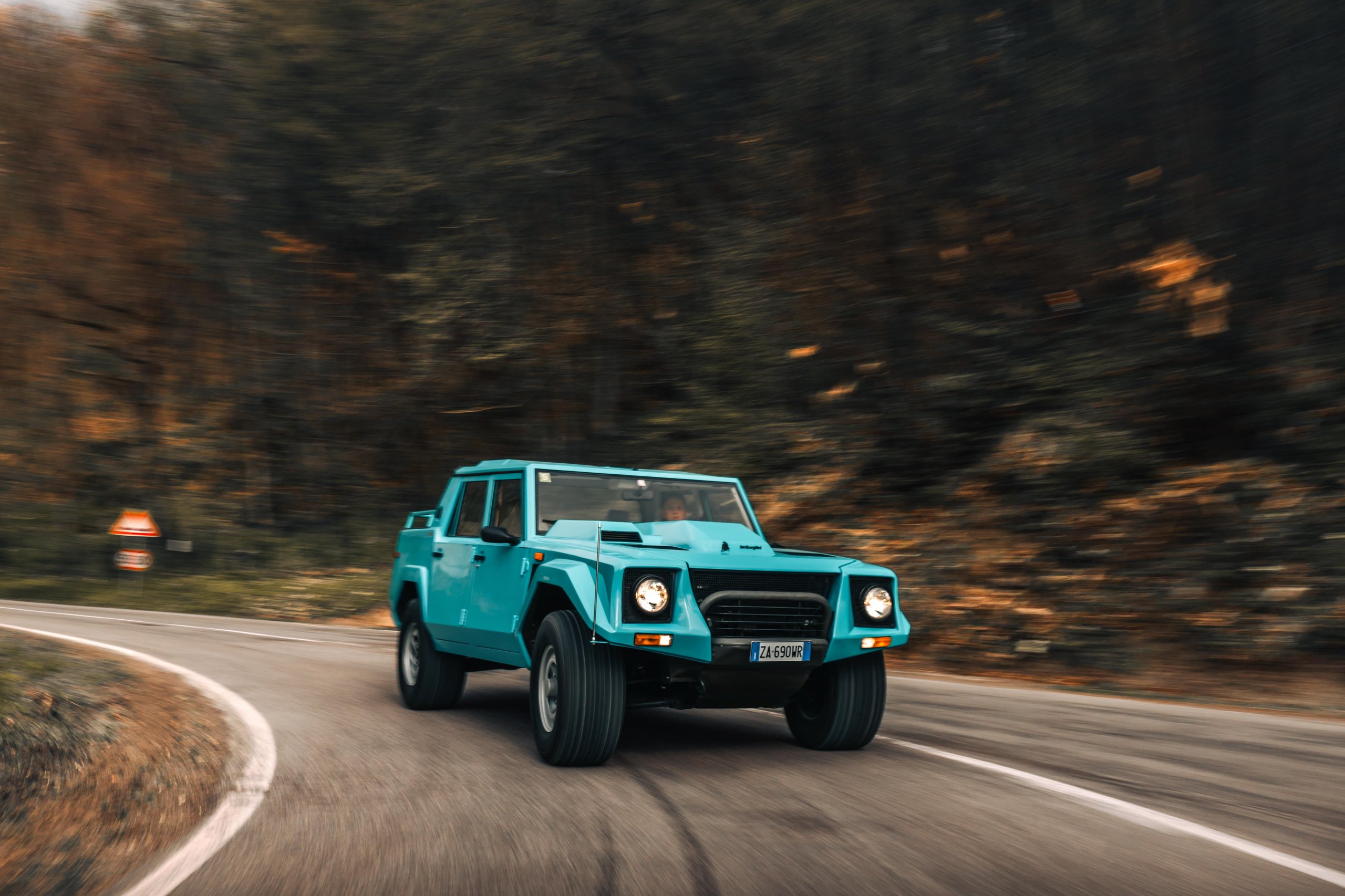
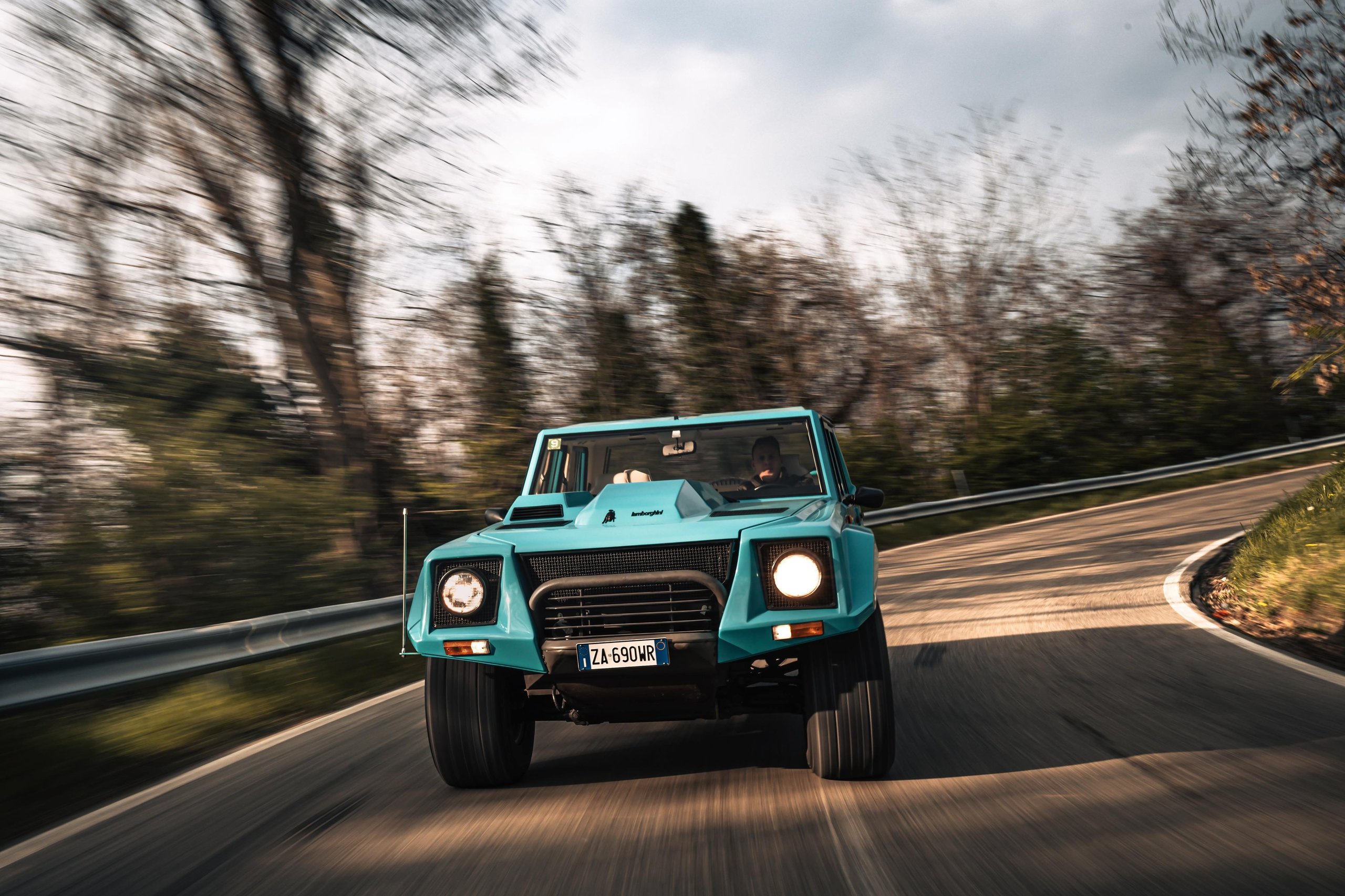
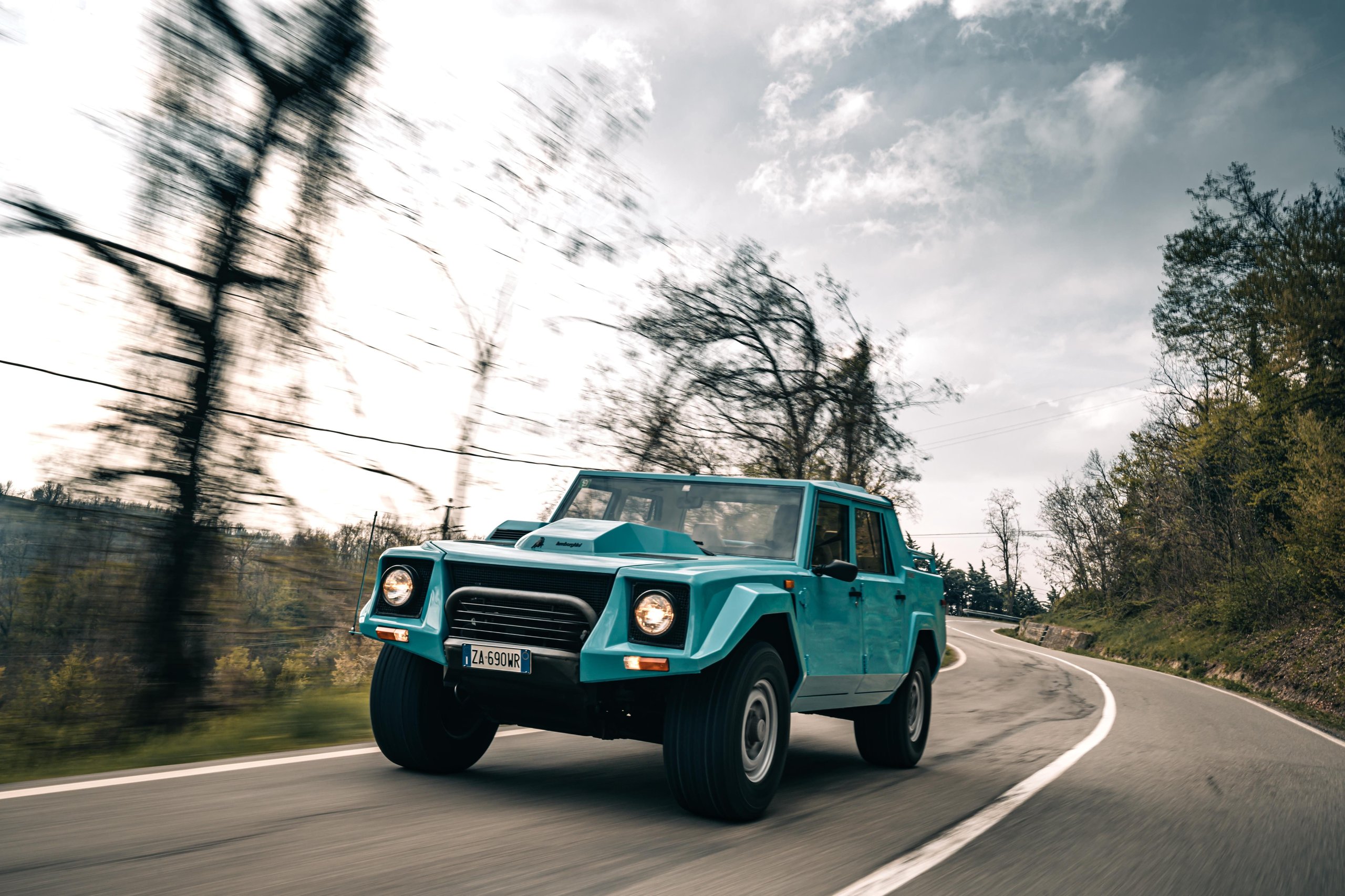
Lamborghini is marking the 40th anniversary of the LM002, the angular, Countach-engined off-roader that debuted at the Brussels Motor Show in January 1986 and earned the nickname that still follows it: the “Rambo Lambo.” A dedicated installation opens June 9 at the Lamborghini Museum in Sant’Agata Bolognese, and Polo Storico, the company’s heritage division, continues to support surviving examples with newly re-produced original-spec Pirelli Scorpion BK tires.
The anniversary deserves more than a passing nod. Before the LM002, no manufacturer had tried to combine a supercar powertrain with genuine off-road hardware and a luxury interior. The Mercedes G-Wagen existed, the Range Rover existed, but nothing on the market dropped a 450 CV V12 into a body engineered to ford rivers and climb 120-percent gradients while its occupants sat on hand-stitched leather. Lamborghini positions the LM002 as the direct ancestor of the Urus, and the lineage runs deeper than marketing convenience. The philosophical leap the company made in 1986, that a Lamborghini could be something other than a low-slung supercar, is the same leap that turned the Urus into the brand’s best-selling model.
From a Failed Military Bid to a Countach V12 in the Desert
The LM002’s origin story reads like a screenplay that kept getting rewritten. Lamborghini says the project began with the Cheetah prototype, unveiled at the 1977 Geneva Motor Show and developed in collaboration with American firm Mobility Technology International. The Cheetah was conceived to win military contracts, particularly from the U.S. armed forces and Middle Eastern governments. It used a rear-mid-mounted 5.9-liter Chrysler V8 producing 183 CV, paired with a three-speed automatic and permanent all-wheel drive. The military contracts never materialized, but Lamborghini saw something worth pursuing.
The LM001 followed at the 1981 Geneva Motor Show, and this is where the story turns interesting for enthusiasts. Engineer Giulio Alfieri swapped the American V8 for a Lamborghini Countach V12, a 4.8-liter unit from the LP500 S producing 332 CV. Putting a Countach engine in an off-roader was audacious. Keeping it in the rear was a problem. Desert testing exposed a critical flaw: under hard acceleration and on steep inclines, the rear-mounted engine unloaded the front axle so severely that the vehicle lost steering precision entirely. Without power steering, the driver was left wrestling a machine that weighed somewhere between 2,100 and 2,400 kg.
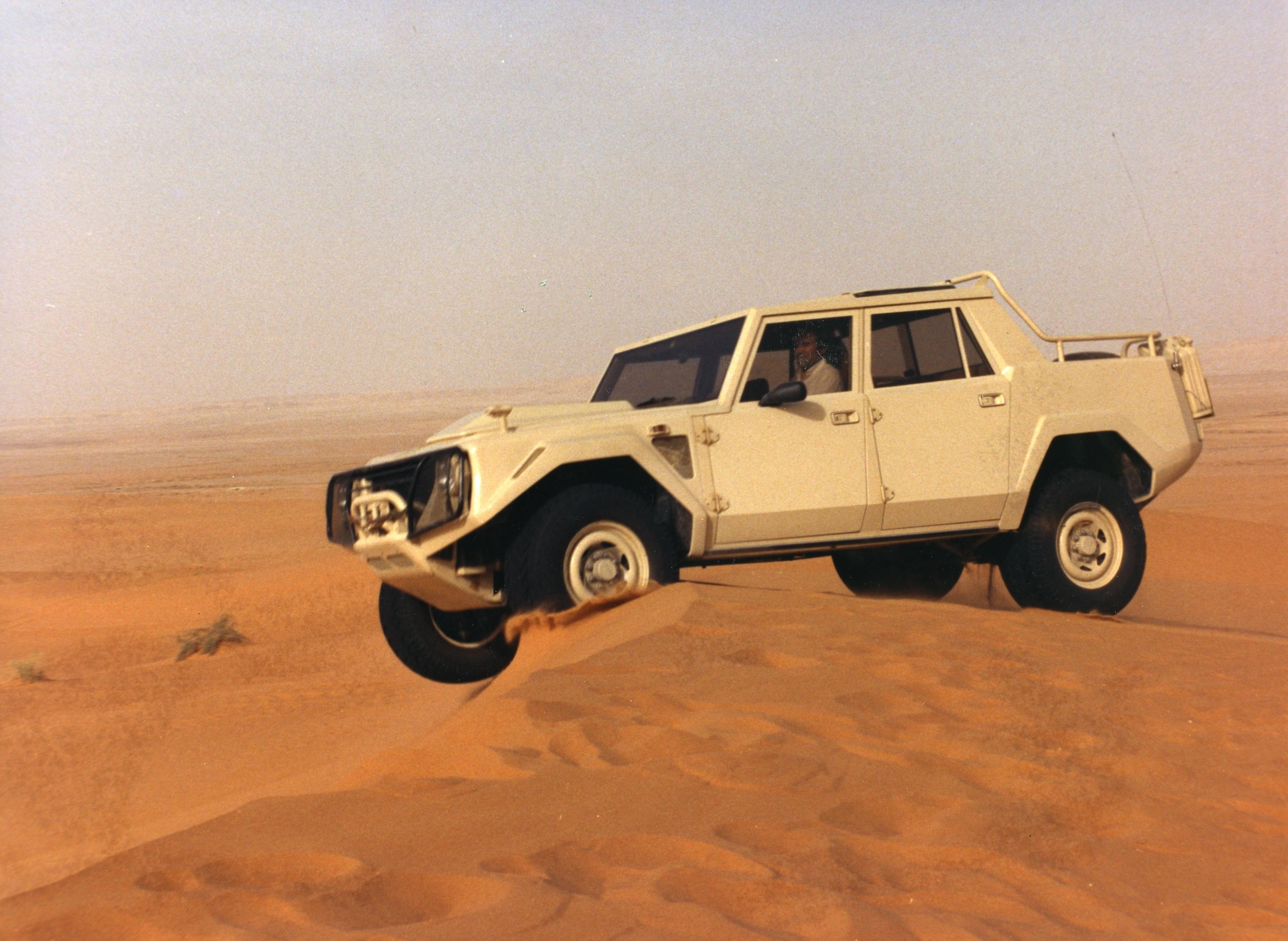
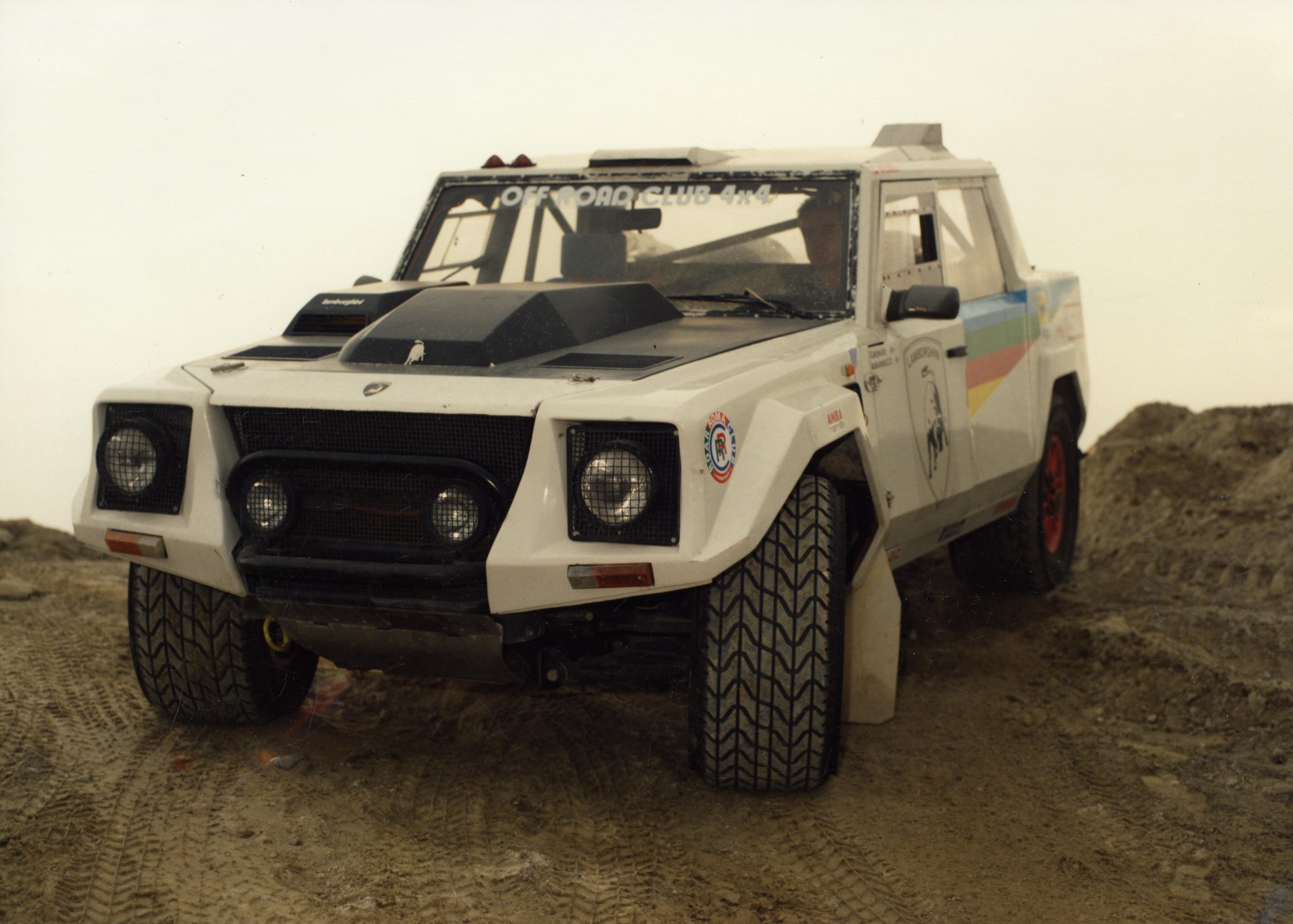
Alfieri’s solution was decisive. He moved the engine to the front, creating the LMA (Lamborghini Militare Anteriore) prototype. This single relocation of the V12 ahead of the cabin solved the weight distribution problem and established the architecture that would define the production LM002. The LMA also replaced the Chrysler automatic with a five-speed ZF manual gearbox and added the option to disengage the front axle for rear-wheel-drive operation. Testing in Saudi Arabia proved the concept: the LMA could climb gradients of up to 120% and reach nearly 190 km/h.

The Lamborghini Cheetah prototype showcases its robust design and off-road capabilities with a desert tan finish. Image: Automobili Lamborghini.
A Countach Heart in a 2,700 kg Body: Engineering the Production LM002
Lamborghini did not go straight from the LMA to the production car. Two more experimental prototypes explored alternative powertrain paths. The LM003, built in 1983, tested a 150 CV five-cylinder turbo-diesel from VM Motori, a sensible idea that proved hopelessly underpowered for a vehicle approaching three tons. The LM004, introduced in 1985, went the opposite direction: a marine-derived Lamborghini L804 V12 displacing seven liters and producing over 420 CV. Weight and reliability concerns killed that project too.
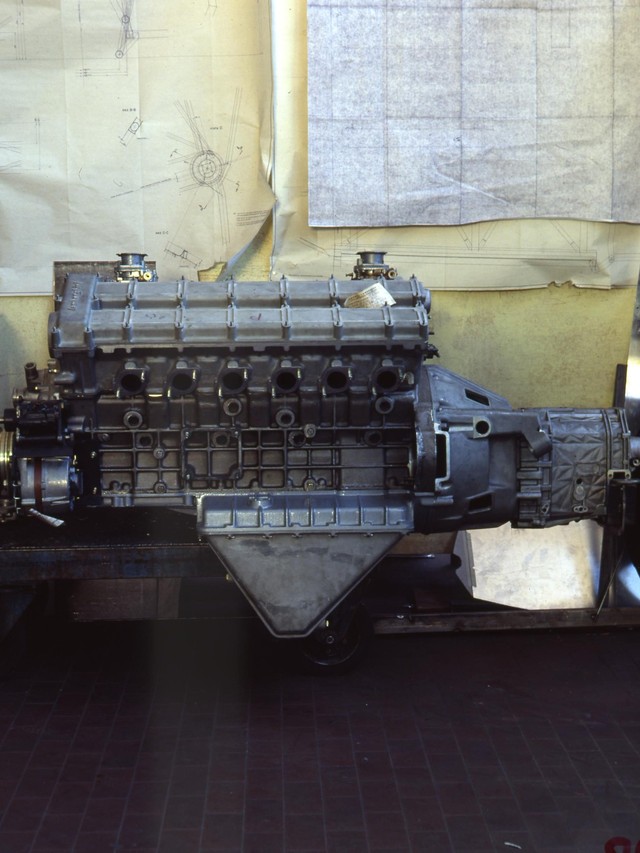
The production LM002 split the difference with the Countach Quattrovalvole’s 5,167 cc V12, producing approximately 450 CV (420 CV SAE NET). Early cars breathed through six Weber carburetors; a fuel-injected version arrived in 1989 for U.S. certification. The transmission was a five-speed ZF manual with low-range gearing and selectable all-wheel drive. Three self-locking differentials managed torque distribution: 25% at the front, 75% at the rear, and a central unit at 75% that could be mechanically locked to 100%.
The chassis was massively overbuilt. Lamborghini says the reinforced tubular steel frame could withstand forces up to eight times the acceleration of gravity. Fully independent suspension provided 130 mm of compression travel and 110 mm of extension. The vehicle could ford water 82 cm deep without preparation. Automotive journalist Brock Yates, according to one period report, called it “the closest thing to a street-legal Tiger tank known to man.”
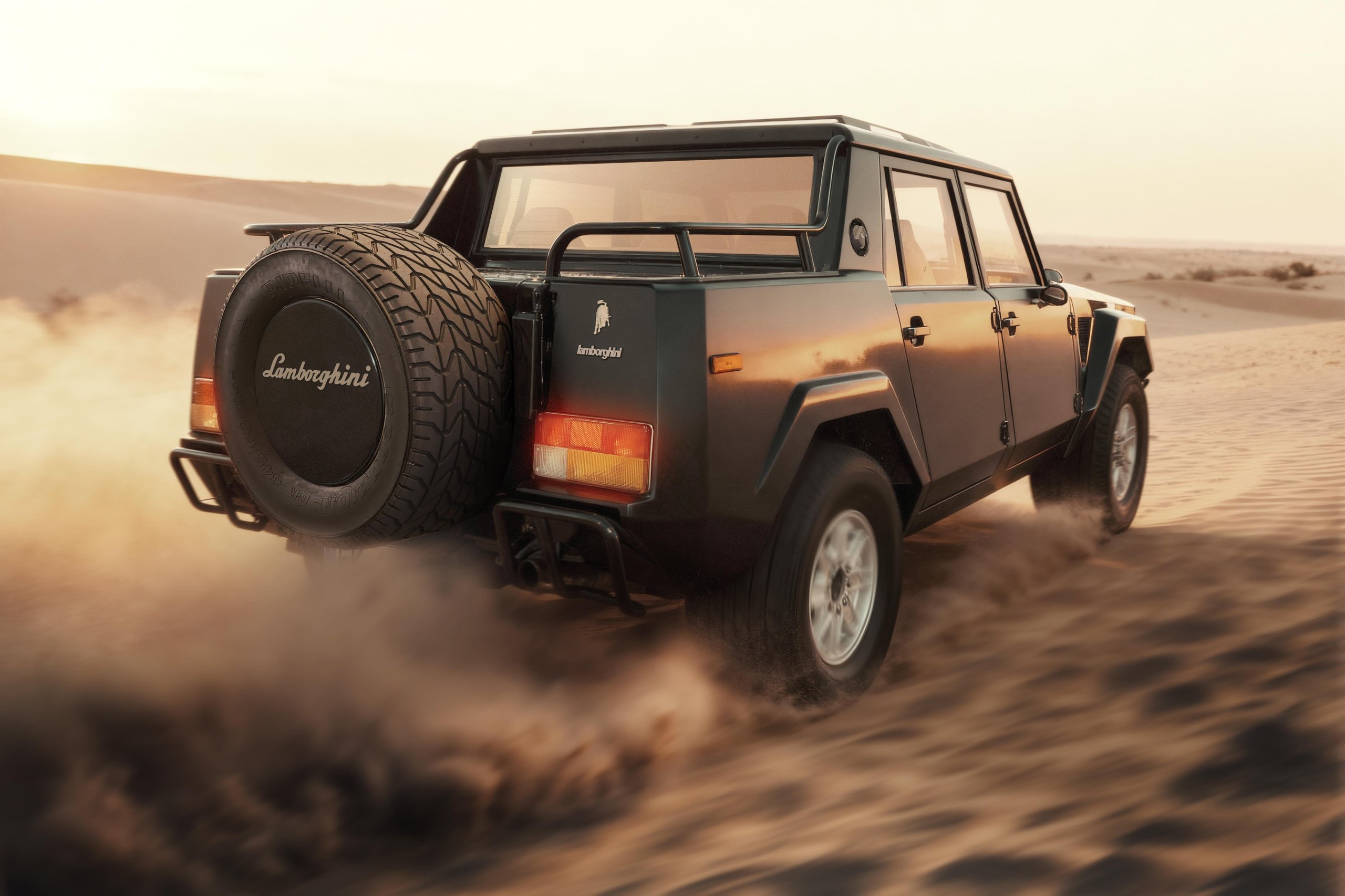
The Pirelli Scorpion BK tires deserve special mention. Developed specifically for the LM002 during the early 1980s, they featured distinctive sidewall “ears” designed to help the vehicle float across desert sand while maintaining directional control. The tread pattern drew from Pirelli’s rally competition tires, and the carcass was reinforced with aramid anti-cut materials for run-flat capability. Few production vehicles of any era have received bespoke tire development on this scale.

The robust Lamborghini LM002 engine and transmission assembly sits ready in a workshop environment. Image: Automobili Lamborghini.
Luxury Inside, Rally Car Outside
Despite the angular, military-derived exterior, the LM002’s cabin offered air conditioning, fine wood trim, premium leather upholstery, tinted blue windows, and a roof-integrated hi-fi system. A television set was available on request. Seating accommodated four inside the cabin, with a large rear cargo area adding genuine versatility. In 1987, the price tag sat at approximately 169 million Italian lire, reflecting both the engineering investment and the complete absence of competition.
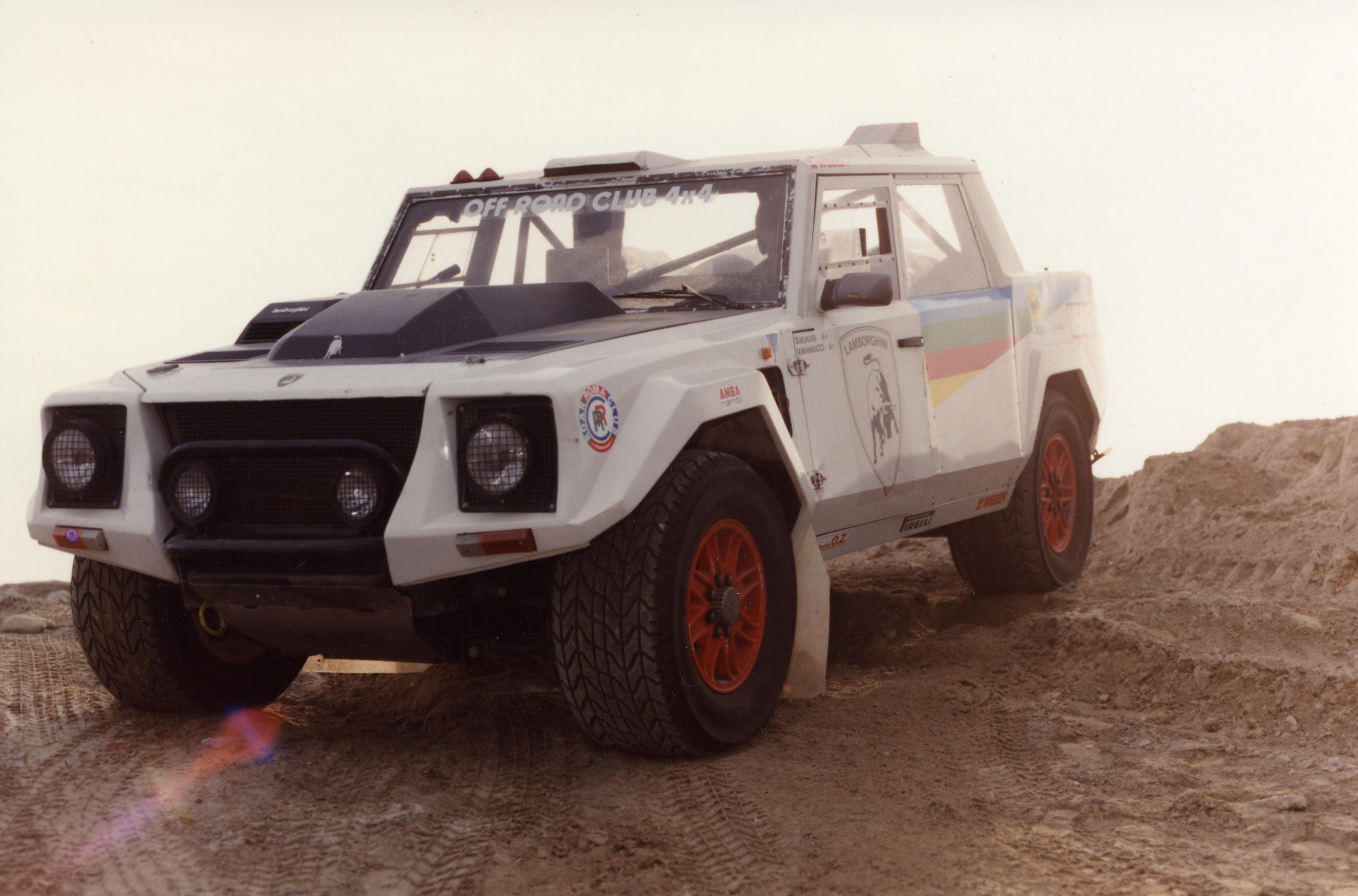
According to Lamborghini, around 300 examples were built before production ended in 1992, plus a unique right-hand-drive example now displayed at the museum. The LM/American variant, a run of 60 units reengineered for U.S. and California emissions compliance, represented the final evolution. In 1989, legendary rally driver Sandro Munari entered the “One Lap of America” endurance event covering roughly 10,000 miles across multiple states in a production-spec LM002 homologated for the American market. That kind of competitive use underscored the vehicle’s durability in ways no brochure could.
Collector values reflect the LM002’s growing stature. According to market data, a 1989 example achieved a record $703,500 at auction in August 2024, with average sale prices reported around $394,705. For a vehicle once dismissed as a curiosity, those figures tell a clear story about how the market now views the original Super SUV.

The luxurious red leather interior of the Lamborghini LM002 features a classic dashboard and elegant wooden accents. Image: Automobili Lamborghini.
From LM002 to Urus: The Through-Line Lamborghini Wants You to See
“The LM002 represents one of the roots of Lamborghini’s contemporary vision. It anticipated the concept of the Super SUV, inspiring not only our product philosophy but also design elements that can still be found today throughout the Urus family.”
Lamborghini CEO Stephan Winkelmann framed the connection explicitly: The link is more substantive than shared talking points. The LM002 proved that Lamborghini’s identity could stretch beyond two-seat supercars without diluting the brand. When the Urus launched in 2018, it faced skepticism from purists who questioned whether a Lamborghini SUV could be authentic. The LM002’s existence, 32 years earlier, was the company’s best rebuttal. Design sketches released for the anniversary explicitly label the LM002 as the “1st Super-SUV,” annotating its powerdome hood, wedge profile, and rugged proportions as deliberate design language that carried forward.
The Urus now accounts for more than half of Lamborghini’s annual sales, and the Urus SE plug-in hybrid extends the lineup further. Lamborghini’s willingness to build the Huracan Sterrato, a supercar with raised suspension and off-road capability, also traces a philosophical line back to the LM002’s core argument: performance and terrain capability are not mutually exclusive.

This design sketch of the Lamborghini LM002 emphasizes its 'Powerdome' and 'Rugged Look' for off-road capability. Image: Automobili Lamborghini.
Polo Storico and the Pirelli Partnership: Keeping the LM002 on the Road
For the roughly 300 LM002s in existence, the most practically significant anniversary news involves tires, not museum installations. Lamborghini Polo Storico collaborated with Pirelli to bring the original Scorpion BK tires back into production, and they are now available through Lamborghini’s dealer network and the Pirelli Collezione catalog. Sourcing correct-specification tires for rare vehicles is one of the most persistent headaches in classic car ownership, and having factory-correct rubber available through official channels removes a major barrier for owners who want to drive their cars rather than simply display them.
Polo Storico’s broader mandate covers preservation and technical authenticity for the entire LM002, not just tires. For prospective buyers weighing a purchase, this factory-backed support infrastructure matters. Multiple owners on enthusiast forums describe the LM002 as physically demanding to drive, with heavy unassisted steering and a wide turning circle, but that rawness is precisely what makes it compelling as a collector piece that rewards actual use. At current auction prices, knowing that Sant’Agata stands behind the car’s mechanical integrity through Polo Storico adds real value to what is now a serious financial commitment.

The robust front wheel and fender of the Lamborghini LM002 are perfectly suited for desert adventures. Image: Automobili Lamborghini.
Gallery