Third Win at the Nürburgring Puts Lamborghini Back on Top of the Championship
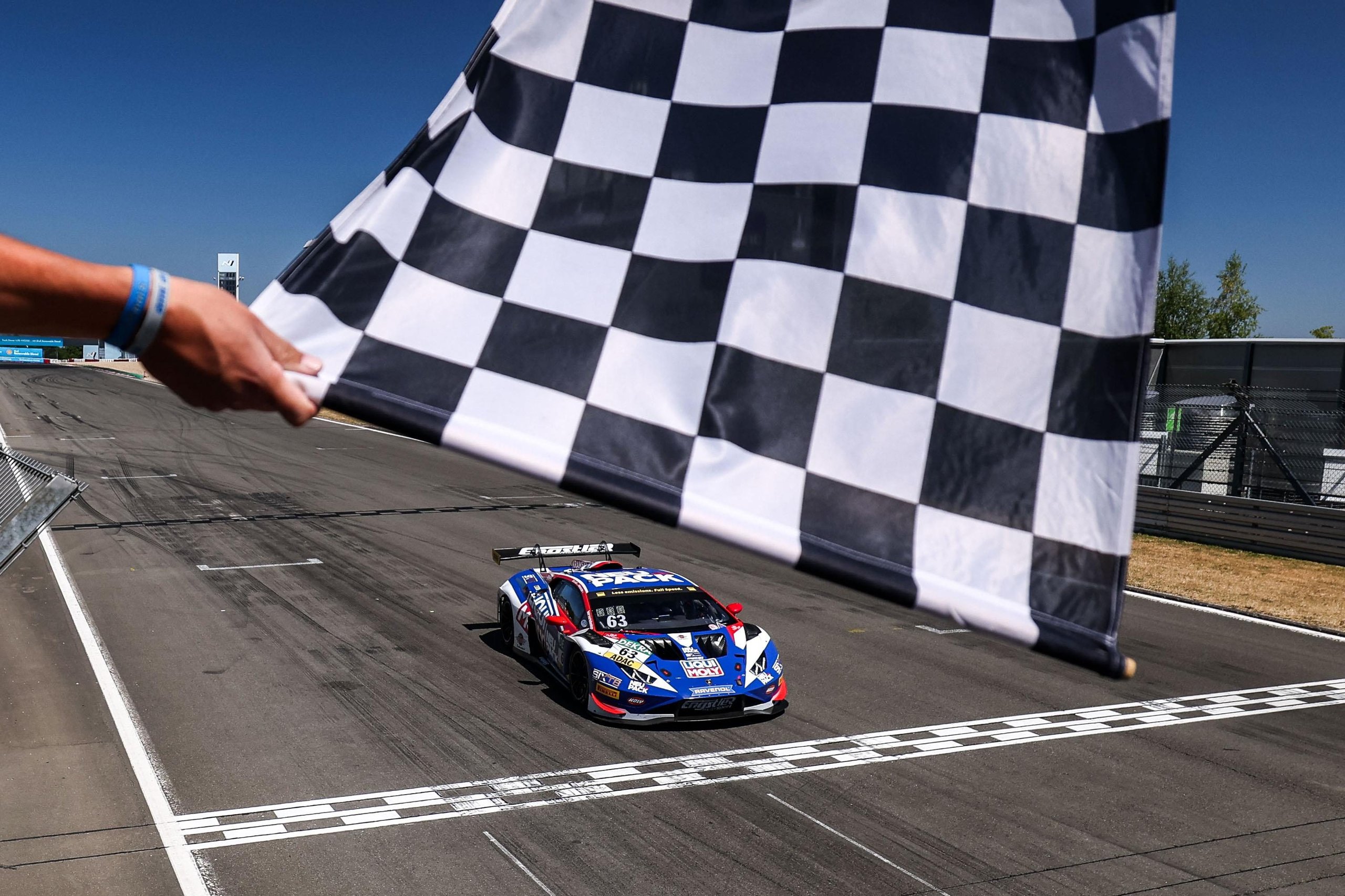
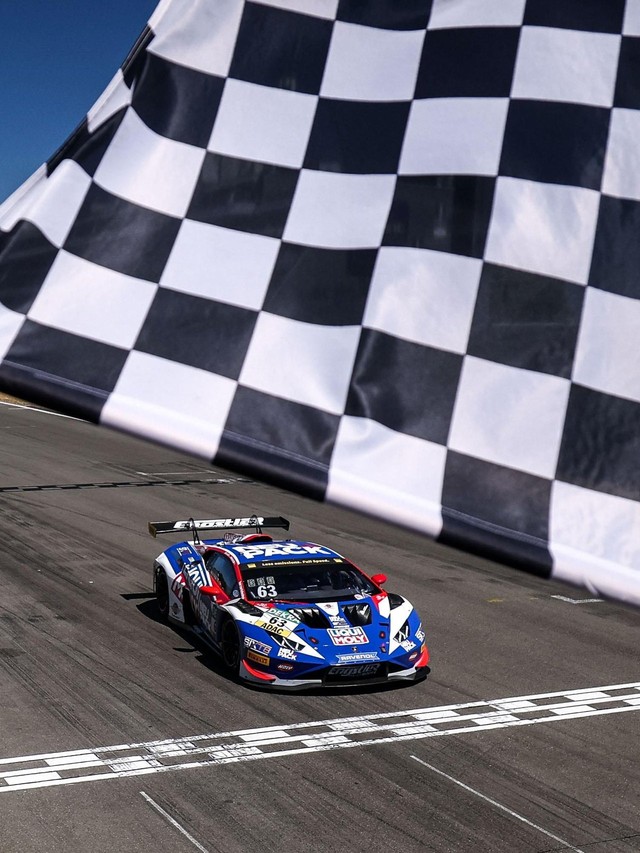
Finn Zulauf and Felix Hirsiger crossed the line at the Nürburgring nearly six seconds clear of the field on Saturday, giving Team Engstler Motorsport and the #63 Lamborghini Huracán GT3 EVO2 their third ADAC GT Masters victory of the 2026 season. The result came in the first of two 60-minute races at the Eifel circuit and moved the pair back to the top of the drivers’ standings, where they now hold a one-point championship lead heading into September’s round at the Salzburgring.
The margin told the story before the lights even went out. Hirsiger qualified on pole with a 1m25.104, comfortably the fastest time of the session and good for three bonus championship points. He built a two-second cushion in the opening stint, set the fastest lap of the race, and handed the car to Zulauf with just over 29 minutes remaining. Zulauf, a Lamborghini GT3 Junior Driver, stretched that gap further and brought the car home with daylight behind him. Lamborghini says the team carried no success ballast for race one, which helps explain the pace advantage, though qualifying half a second clear of the field before the race even begins is about more than weight savings.
Sunday’s second race told a different, equally instructive story. Carrying 20kg of success weight earned by their Saturday dominance, Zulauf and Hirsiger finished ninth. That penalty is the ADAC GT Masters system working as designed, handicapping winners to keep the championship competitive. That they still clung to a one-point lead despite a ninth-place finish speaks to the points buffer they built through qualifying and race-one dominance.
Why This Matters Beyond the Podium
Race wins in customer GT3 series validate the car, the team, the driver development pipeline, and the engineering organization behind all three. For Lamborghini, this Nürburgring result carries particular weight because of where it sits in the broader timeline: the Huracán GT3 platform, now a decade old, continues to win against machinery from manufacturers who have introduced entirely new GT3 cars in recent years.
As Road & Track noted when the Temerario GT3 was revealed, Lamborghini stuck with updated versions of the Huracán GT3 while the competitive landscape shifted around it. The EVO2 is the third generation of that platform, and it still qualifies on pole and wins by six seconds. For Lamborghini owners and enthusiasts, that longevity is a quiet but powerful statement about the depth of the original engineering.
The competitive context matters for LamboCars readers in a specific way. When a Huracán GT3 EVO2 beats a field that includes Ford Mustang GT3s and other factory-backed entries, it reinforces that Squadra Corse extracts performance from its platforms at a level that justifies the brand’s racing credibility. That credibility, in turn, underpins the desirability of road cars like the Huracán STO and, soon, the Temerario.

Three Lamborghini Huracan GT3 Evos navigate a tight turn, showcasing intense racing action. Image: Automobili Lamborghini.
The V10 That Refuses to Retire
At the heart of the Huracán GT3 EVO2 sits a 5.2-liter naturally aspirated V10 producing, according to ADAC GT Masters specifications, 640 PS. One report indicates the bodywork was developed in partnership with Dallara Engineering, and the car’s construction features a hybrid structure of aluminum and carbon fiber. A reported 42/58 front-to-rear weight distribution gives it the kind of rear-biased balance that rewards precise throttle application, particularly over a 60-minute race where tire degradation is the defining variable.
That naturally aspirated V10 is the detail that resonates most with Lamborghini enthusiasts. In an era where GT3 grids increasingly feature turbocharged powertrains, the Huracán’s atmospheric engine delivers power in a linear, predictable way that rewards driver skill over boost management. Zulauf’s own post-race comments hint at this: he described managing tire wear in extreme temperatures as the key challenge, not fighting the powertrain. When your engine delivers power cleanly and consistently, you can focus on the tires, the line, and the strategy.
The car weighs 1,230 kg according to one source and runs a 6-speed sequential transmission with paddle shifters. These are standard GT3 ingredients, but the combination of that V10’s character with Dallara’s aerodynamic expertise and Squadra Corse’s setup knowledge is what produces six-second winning margins at circuits like the Nürburgring.

A Lamborghini Huracan GT3 Evo blazes down the track, a blur of speed and power. Image: Automobili Lamborghini.
The Zulauf Factor and Lamborghini’s Junior Driver Pipeline
Finn Zulauf’s role in this championship campaign deserves specific attention. As a Lamborghini GT3 Junior Driver, he is part of a structured talent pipeline that Squadra Corse operates to develop the next generation of factory-affiliated racers. Leading the ADAC GT Masters championship is not a minor credential for a junior program participant; it demonstrates that Lamborghini’s investment in young talent produces results at the sharp end of competitive series, not just in development categories. Zulauf’s post-race quote revealed a composure that belies any “junior” label:
“It feels good to lead the championship again. I like being the hunted. However, what really matters to us, is to be top of the table after the final race of the season.”
That focus on the season-long picture rather than individual race euphoria is exactly the kind of mentality factory programs look for when deciding who graduates to higher-profile endurance racing seats. Placing a Junior Driver at the top of the ADAC GT Masters standings validates the program’s selection process and its ability to pair young talent with experienced co-drivers like Hirsiger.
Team Engstler Motorsport, which campaigned the Audi R8 LMS GT3 evoII for two years before switching to the Huracán GT3 EVO2, expanded its entry from two to three cars this season. According to one source, the team’s stated objective is the championship title. With three wins from the first half of the season and a points lead, that objective looks realistic.

Victorious drivers celebrate their first-place win on the podium, holding their well-deserved trophies. Image: Automobili Lamborghini.
How the Weekend Unfolded
The team arrived at the Nürburgring after what Lamborghini described as a difficult previous round at the Lausitzring. Friday’s first free practice session placed them tenth, an unremarkable position that gave little indication of what was coming. The afternoon session told a different story: Hirsiger and Zulauf topped the times with a 1m25.998, six-tenths clear of the next fastest crew. That gap, enormous in GT3 terms, carried into qualifying.
Hirsiger’s race management in the opening stint was textbook. He built the gap early, set the fastest lap, and kept the tires alive for a clean handover. The mandatory driver change, executed with just over 29 minutes on the clock, put Zulauf in the car with enough of a cushion to manage the final stint conservatively. Hirsiger himself noted that the first 10 to 20 minutes were the critical window for building a buffer that would allow tire conservation later.
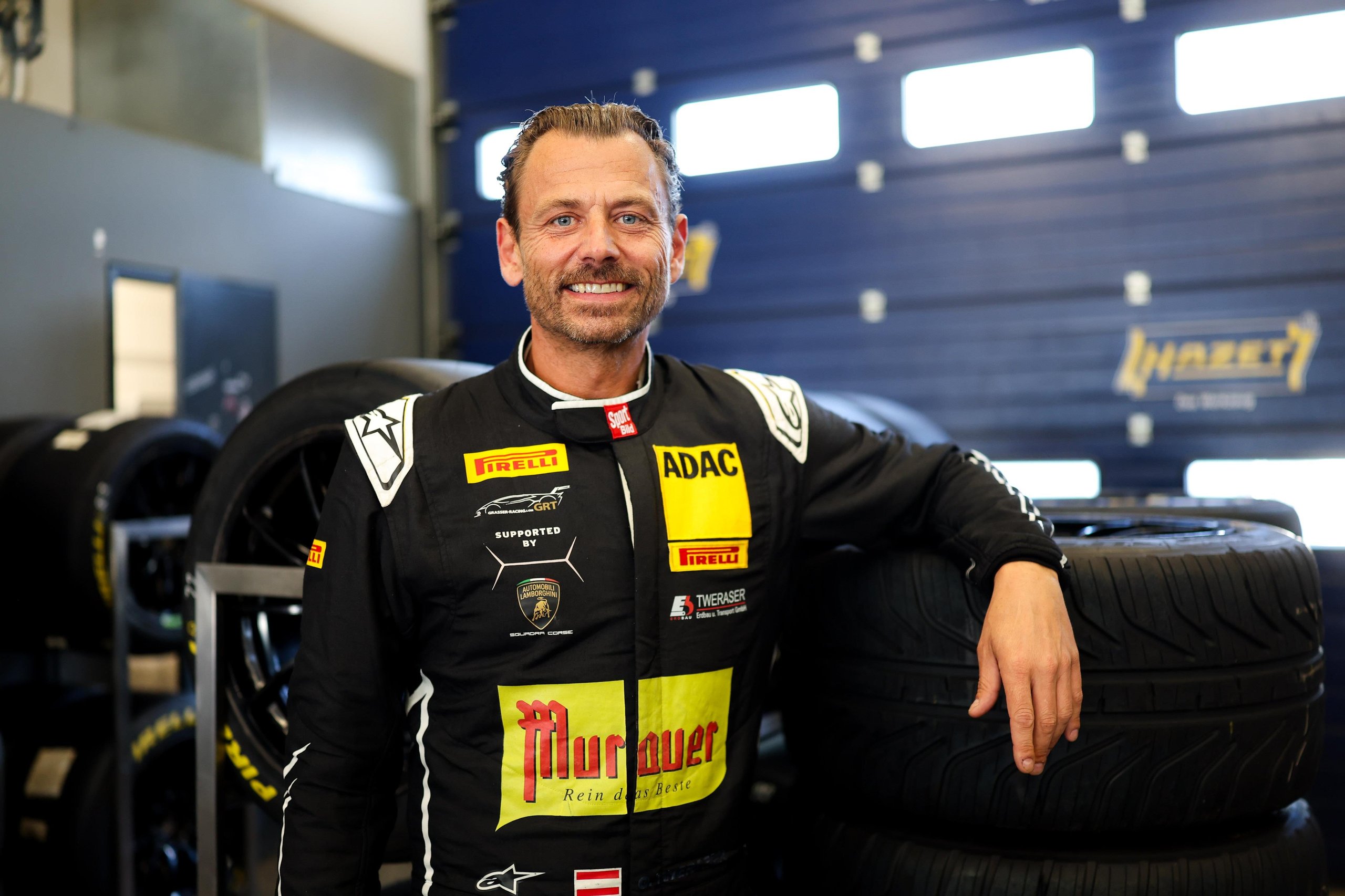
The guesting #22 GRT Grasser Racing Team Lamborghini, driven by team owner Gottfried Grasser and Gerhard Tweraser, finished ninth in the same race. A guest entry finishing in the top ten in a competitive GT3 field is a solid result and further evidence that the Huracán GT3 EVO2 platform delivers performance across different team setups and driver combinations.

A fleet of high-performance race cars, including Lamborghini Huracan GT3 Evos, competes on the track. Image: Automobili Lamborghini.
The Huracán’s Final Chapter and What Comes Next
Every win the Huracán GT3 EVO2 adds to its record now carries a layer of historical significance. The Temerario GT3, which will replace it as Lamborghini’s customer GT3 offering, represents a generational shift from naturally aspirated V10 to the twin-turbo V8 hybrid architecture that defines Lamborghini’s new road car direction. Road & Track reported that Lamborghini maintained the Huracán GT3 through continuous updates while other manufacturers launched entirely new platforms. The fact that this approach still produces championship-leading results in 2026 is a testament to the depth of the original design.
For teams currently running the Huracán GT3 EVO2, the transition to the Temerario GT3 will mean adapting to a fundamentally different powertrain character. The linear throttle response and predictable power delivery of the naturally aspirated V10 will give way to the complexities of turbo lag management and potentially hybrid energy deployment in racing trim. Lamborghini has not confirmed the full technical specification of the Temerario GT3 for competition use, so the exact nature of that transition remains an open question.
What the Nürburgring result confirms is that the Huracán GT3 EVO2 is finishing its competitive life at the top, not fading into irrelevance. A one-point championship lead, three wins from the opening rounds, and a Junior Driver at the helm of the title fight: that is the kind of final chapter that gives a platform lasting credibility. The Temerario GT3 will inherit a high standard to match.
Gallery