Two Circuits, Two Victories, One Platform
On a single July weekend, the Lamborghini Huracán GT3 EVO2 won at two circuits separated by nearly a thousand kilometers, in two different championships, for two different privateer teams. Leipert Motorsport’s Gabriel Rindone and Patrick Kujala took the Michelin Le Mans Cup race at Paul Ricard, while Grasser Racing Team‘s Marco Mapelli and Benjamin Hites delivered a lights-to-flag triumph in the second ADAC GT Masters race at the Nürburgring. Lamborghini says the Paul Ricard result is the brand’s first Michelin Le Mans Cup victory of the year, and its first in the series since FFF Racing Team’s double at Le Mans in 2020. At the Nürburgring, the story carried an additional milestone: Lamborghini’s 50th pole position in the ADAC GT Masters, a number that quietly underscores how long the Huracán platform has been a fixture at the sharp end of GT3 grids.
Taken together, these results tell a story that goes beyond trophies. In a GT3 class now populated by newer, often turbocharged machinery, the naturally aspirated V10 Huracán keeps winning. The weekend at Paul Ricard and the Nürburgring illustrates why: a mature platform, refined aerodynamics, and a customer racing ecosystem that puts strong drivers in well-prepared cars across multiple series simultaneously.
Paul Ricard: Persistence Rewarded at the Front
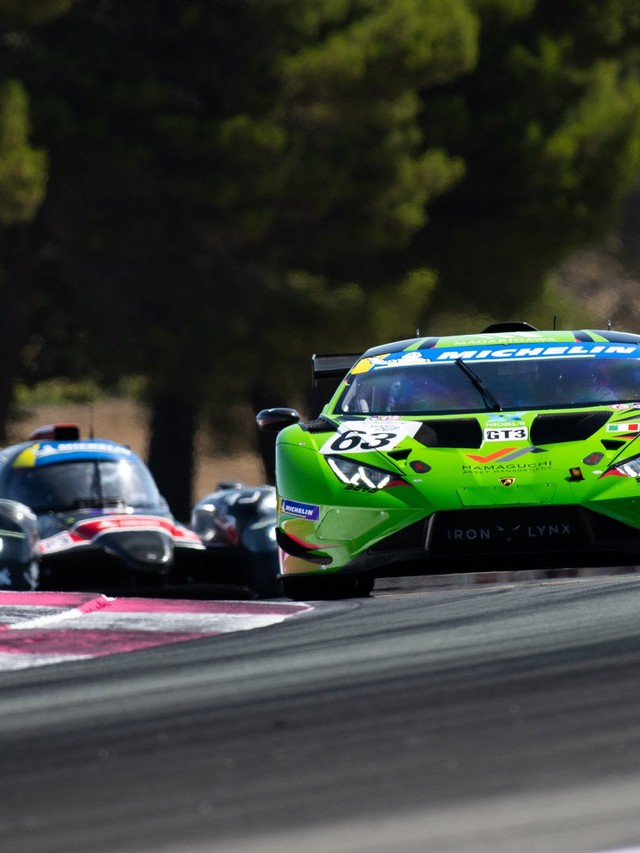
The Michelin Le Mans Cup race at Paul Ricard played out as a textbook study in why endurance racing punishes mistakes more than it rewards raw pace. The #63 Iron Lynx Huracán of Hiroshi Hamaguchi and Vincent Abril took pole position by 0.081 seconds, with the #19 Leipert Motorsport entry qualifying third. Both cars ran near the front throughout the one-hour-fifty-minute race, surviving multiple Full Course Yellow interruptions that compressed the field repeatedly.
Iron Lynx’s race unraveled when the #63 incurred a one-second stop-go penalty for violating the minimum pit-stop time, dropping the car to fourth. Abril recovered to third by the flag, giving Iron Lynx its first podium with Lamborghini in the series. At the front, the leading #10 Aston Martin slowed to a standstill behind a late Full Course Yellow, handing the effective lead to Kujala in the #19. Rather than simply inheriting the position and nursing it home, Kujala built a gap exceeding three seconds in the final eight minutes. That margin turned a fortunate promotion into a convincing victory and handed Leipert Motorsport its first-ever Michelin Le Mans Cup win.
The second Leipert car of Brendon Leitch and Gerhard Watzinger rounded out a strong team showing with fifth place. For a squad campaigning multiple Huracáns in an endurance format, that depth of results matters as much as the headline victory. Two cars in the top five is not luck; it reflects a team that understands the platform well enough to extract consistent pace from it.

The Lamborghini Huracán GT3 EVO, number 19, charges down the track with precision.
Nürburgring: Mapelli’s Razor-Thin Pole and a Dominant Race
Mapelli’s qualifying lap at the Nürburgring, a 1m25.231, was just 0.01 seconds faster than the next car. That kind of margin is almost comically small, barely the time it takes to blink, yet it was enough to deliver Lamborghini’s 50th pole position in the ADAC GT Masters. Fifty poles in a single national GT championship speaks to sustained competitiveness across multiple seasons and car generations, not a single lucky weekend.
The race itself offered less suspense. Mapelli defended his lead from the start, fending off the attacking BMW of Ben Green, then maintained position through to the mandatory driver-change pit stop. Hites, fresh from a Silver Cup class victory at the Spa 24 Hours with GRT, took over the #63 and controlled the field to the finish with a gap of over two seconds. In GT3 racing, where Balance of Performance regulations are designed to equalize the field, a two-second winning margin from a lights-to-flag drive suggests the team and driver combination extracted everything the regulations allowed.
Paul Motorsport’s Maximilian Paul and Simon Connor Primm added a seventh-place finish in race two to their third-place result from Saturday’s opening race, confirming that multiple Lamborghini entries were competitive across the weekend. As at Paul Ricard, the pattern held: the Huracán GT3 EVO2 was not a one-car story but a platform delivering results across different teams and driver pairings.

The Lamborghini Huracán GT3 EVO, number 63, races on the track under a dramatic cloudy sky.
The V10’s Quiet Advantage in a Turbocharged GT3 Field
Buried in these results is an engineering story worth telling. The Huracán GT3 EVO2’s naturally aspirated 5.2-liter V10 competes in a GT3 class increasingly populated by turbocharged rivals from BMW, Porsche, and others. The Lamborghini’s engine architecture offers something the regulations cannot fully equalize: throttle response. A naturally aspirated engine delivers torque in a linear, predictable curve, allowing drivers to modulate traction with a precision that turbo lag, however well managed, complicates. In close racing, where tenths are won on corner exit rather than top speed, that linearity becomes a genuine tool.
The EVO2 revision built on that advantage with revised aerodynamics developed with Lamborghini’s Centro Stile, including a swan-neck mounted rear wing, a larger rear diffuser, and a carbon fiber floor reinforced with Zylon fiber. These changes increased downforce and improved mid-corner stability, which is exactly where the car’s mid-rear engine layout already provides a natural advantage in weight distribution. The combination of engine character and aero refinement explains why the platform remains competitive against newer homologations.
Sim racers on platforms like iRacing echo what the real-world results show. Multiple forum discussions describe the Huracán GT3 as an “absolute blast to drive” with “neutral but confident handling,” though some note it can be track-dependent and unforgiving if unsettled on corner entry. That duality, rewarding when driven precisely and punishing when abused, mirrors what makes the car effective in the hands of experienced customer racing drivers like Mapelli and Kujala.
Why Customer Racing Wins Build the Brand Differently Than Factory Programs
Lamborghini’s motorsport strategy operates on two distinct tracks. The SC63 LMDh Hypercar program, which debuted in the FIA World Endurance Championship and IMSA in 2024, represents the factory’s ambition at the highest level of prototype racing. Customer GT3 racing, run through Squadra Corse, serves a fundamentally different purpose: it puts Lamborghinis in the hands of privateer teams and gentleman drivers across dozens of championships worldwide, generating visibility and brand loyalty that a single factory prototype entry cannot replicate.
The Squadra Corse ecosystem is layered deliberately. The Super Trofeo one-make series acts as an entry point for aspiring and amateur drivers, while the GT3 platform serves more experienced racers competing in international series. Teams like Leipert Motorsport and Grasser Racing Team purchase cars, receive factory support, and then go racing on their own budgets. When they win, Lamborghini wins. When they fill grids across Europe, Asia, and the Americas, the Huracán GT3 EVO2 becomes visible in a way that no amount of advertising can match.
For prospective buyers of Lamborghini road cars, these results carry more weight than they might initially seem. A brand whose customer racing cars win regularly signals engineering reliability and factory commitment. If a privateer team can campaign a Huracán GT3 EVO2 through a full season of endurance races and come away with victories, the engineering DNA shared with the road-going Huracán STO or Tecnica carries tangible credibility.

The blue Lamborghini Huracán GT3 EVO, number 71, navigates a turn with impressive speed.
Looking Ahead: The Temerario GT3 and What These Wins Set Up
Every victory the Huracán GT3 EVO2 collects at this stage of its life cycle carries a double meaning. Each win validates the current platform, and each raises the bar for its successor. The Temerario, Lamborghini’s twin-turbocharged V8 hybrid replacement for the Huracán road car, will eventually spawn its own GT3 variant. When it does, Squadra Corse will need to deliver a race car that matches or exceeds the competitive record the V10 platform built over years of development.
That transition from naturally aspirated V10 to turbocharged V8 hybrid in customer racing is not trivial. Teams and drivers who built their programs around the Huracán’s throttle characteristics will need to adapt to an entirely new powerband, different weight distribution, and the complexities of turbo management in wheel-to-wheel combat. Lamborghini confirmed nothing about the Temerario GT3‘s timeline in its race weekend summary, so the specifics remain unknown. What the Paul Ricard and Nürburgring results confirm is that the current car still wins at the highest level of customer GT racing, which means Squadra Corse faces no pressure to rush its replacement.
The practical takeaway for anyone following Lamborghini’s racing program: the Huracán GT3 EVO2 remains one of the most competitive and proven GT3 platforms available to customer teams. Its naturally aspirated V10 gives it a character that newer turbocharged rivals cannot replicate, and its aerodynamic package continues to extract results even as the competition evolves. Fifty poles in the ADAC GT Masters alone tells that story in a single number.
Gallery


