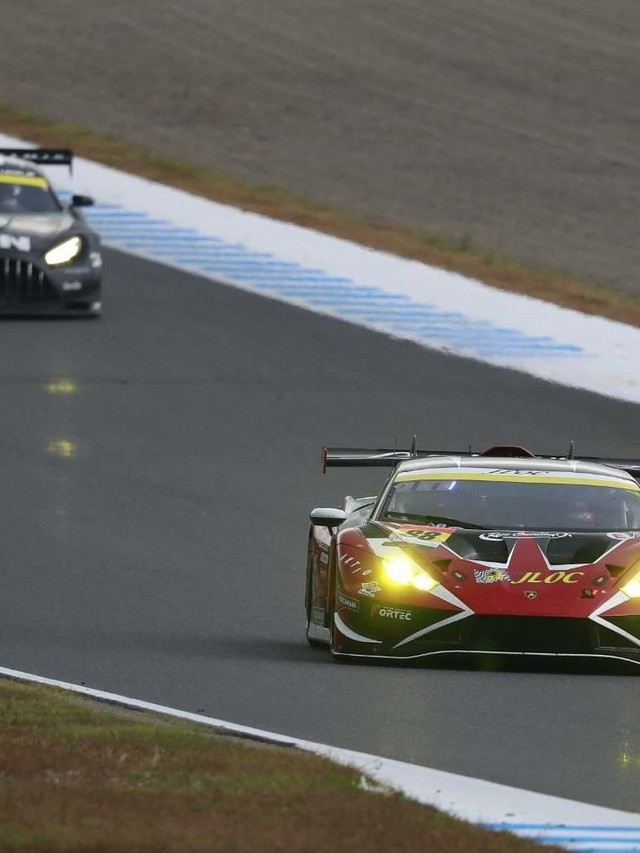
JLOC Breaks Through at Motegi with the EVO2’s First Japanese Victory
Four years is a long time to wait for a win. In a championship as fiercely contested as Japan’s Super GT series, where factory-backed Toyota and Nissan efforts routinely dominate the GT500 class and the GT300 field overflows with well-funded Mercedes-AMG, Porsche, and domestic machinery, a privateer Lamborghini operation claiming outright class victory requires something close to a perfect weekend. At Motegi in the 2023 season finale, JLOC delivered exactly that.
Drivers Takashi Kogure and Yuya Motojima piloted the #88 Lamborghini Huracán GT3 EVO2 to a commanding win, finishing more than seven seconds clear of the chasing pack despite a late rain shower that could easily have unraveled their advantage. Lamborghini says this marked the first Super GT victory for the brand since 2019 and, critically, the first win anywhere in Japan for the Huracán GT3 EVO2, which joined the championship only mid-season.
The last time a Huracán won in Super GT, the setting was the prestigious Fuji 500, with Kiyoto Fujinami, André Couto, and Tsubasa Takahashi sharing the car. Between that result and this one: nothing. For a brand investing heavily in customer racing through Squadra Corse, a four-year gap in one of Asia’s most visible GT championships is the kind of silence that starts to raise questions about competitiveness. Motegi answered them, and in doing so gave the Huracán GT3 platform a fitting late-career triumph just as its successor waits in the wings.
How the Race Unfolded: Strategy, Speed, and a Rain Shower
JLOC’s weekend started with quiet confidence rather than headline-grabbing pace. The #88 Huracán GT3 EVO2 posted the second-fastest time in free practice, sitting just over two-tenths of a second off the leader. Qualifying followed the same pattern: second overall across the two-part cumulative session. Close enough to threaten, far enough back that the car avoided carrying the psychological weight of pole position into the race.
Motojima handled the opening stint on a dry track, initially shadowing the leading Toyota before making a decisive move just before the pit window opened. The timing mattered. By taking the lead before the mandatory stop rather than gambling on an undercut, JLOC ensured Kogure inherited a clean track when he climbed aboard. From that point, the race became an exercise in tire management and composure.
A late rain shower introduced the kind of variable that destroys even large gaps. Kogure kept the car on the island, and the #88 crossed the line with a margin exceeding seven seconds. In a GT300 field where finishing gaps are often measured in fractions, that cushion tells you the car was genuinely faster, not merely lucky with strategy. For a platform introduced to the championship only partway through the season, the performance spoke to something deeper than a single good setup: the EVO2’s underlying engineering was delivering on its promise.

The JLOC Lamborghini Huracan GT3 sits ready in the pit garage, surrounded by its dedicated team.
What Makes the EVO2 Different from Its Predecessor
The Huracán GT3 platform first appeared a decade ago, and while the basic architecture, a naturally aspirated V10 mounted behind the driver in a rear-wheel-drive chassis, remained constant throughout, the EVO2 revision represents the most substantial rework in the car’s competitive life. According to one report, the car was engineered to comply fully with the FIA’s 2022 technical regulations, which demanded changes across aerodynamics, safety structures, and weight distribution.
The most visible difference borrows directly from the Huracán STO road car: a hexagonal airscoop and rear fin that channel airflow through a snorkel directly into the engine intake. The result, per the same source, is improved throttle responsiveness from the V10, which produces 515 horsepower at 8,250 rpm through ten individually actuated throttle bodies and titanium valves. A six-speed sequential gearbox handles the power, and the all-carbon-fiber bodywork, developed with Lamborghini’s Centro Stile, keeps dry weight at a reported 1,230 kg.
For existing Huracán GT3 EVO owners, Lamborghini offers an evolution kit to bring older cars up to EVO2 specification. That detail matters commercially: it means customer teams do not need to buy an entirely new chassis to stay competitive, lowering the barrier for privateer outfits like JLOC. The car made its global racing debut at the 2023 Daytona 24 Hours before filtering into regional championships, including Super GT, mid-season. One practical note for anyone following customer racing economics: the Huracán Super Trofeo EVO2, the one-make series variant that shares much of the GT3’s DNA, carries a reported base price of $360,000 according to Car and Driver. The GT3 car itself commands a premium over that figure, though Lamborghini does not publicly list the price. Compared to building a program around a brand-new platform, the upgrade-kit approach keeps the Huracán competitive without forcing teams into six-figure replacement cycles, and Motegi proved the investment pays off on track.
JLOC: Lamborghini’s Longest-Running Super GT Partner
JLOC occupies an unusual position in Super GT. While many GT300 entries carry factory support or operate as satellite arms of manufacturer programs, JLOC functions as a dedicated Lamborghini privateer team with a history stretching back well over a decade in the championship. The team’s persistence through lean years, including the entire 2020-to-2022 winless stretch, speaks to a genuine commitment to the brand rather than a transactional sponsorship arrangement.
Kogure, the more experienced of the two drivers, brought the kind of race-craft that matters when conditions deteriorate. Motojima’s aggression in the opening stint, particularly the pre-pit-stop pass for the lead, set the strategic foundation. The pairing worked because each driver handled the phase of the race that suited their strengths. Teams that get driver pairings wrong in endurance-format GT racing rarely win, regardless of how quick the car is.
For Lamborghini’s Squadra Corse operation, JLOC’s success validates the customer racing model at the most meaningful level. The entire point of building a GT3 car is to put competitive machinery in the hands of independent teams and let results do the talking. When a privateer wins against factory-adjacent entries, the car’s engineering credibility rises in a way that no press event or test-day demonstration can replicate. And with the Huracán platform nearing the end of its racing life, that credibility becomes a powerful selling point for whatever comes next.

The victorious JLOC drivers celebrate their Super GT finale win at Motegi with trophies and smiles.
The Huracán’s Racing Legacy as the Temerario GT3 Approaches
This Motegi victory carries extra weight because the Huracán GT3 platform is nearing the end of its competitive life. Road & Track noted that Lamborghini ran updated versions of the same basic Huracán race car for a full decade while rivals like Porsche cycled through three entirely different GT3 chassis in the same period. The Temerario GT3, revealed at the 2025 Goodwood Festival of Speed, replaces it with a twin-turbocharged V8, an entirely new chassis designed and developed in-house at Sant’Agata Bolognese, and a clean-sheet aerodynamic package.
The transition from naturally aspirated V10 to forced-induction V8 mirrors what happened on the road-car side with the Temerario, though the GT3 version drops the hybrid system entirely to meet racing regulations. For customer teams currently running the Huracán, the switch means adapting to a fundamentally different powerband, altered weight distribution, and the added complexity of turbo management during wheel-to-wheel racing. None of that is trivial.
What Motegi proves is that the outgoing car still has teeth. A platform winning races in its final season sends a clear message to prospective Temerario GT3 customers: Squadra Corse knows how to build competitive machinery, and the baseline they are working from is proven at the highest level. The Huracán GT3’s decade-long career produced victories at Daytona, Spa, Bathurst, and now, one final time, in Japan. Whatever the Temerario GT3 achieves, it inherits a formidable standard.
Where This Leaves Lamborghini in the GT3 Landscape
Super GT remains one of the most technically demanding GT championships in the world, with Balance of Performance regulations that keep manufacturer performance tightly bunched. Winning in that environment, particularly as a privateer operation without direct factory engineering support at the circuit, requires the car itself to be fundamentally sound. The Huracán GT3 EVO2’s seven-second margin at Motegi suggests the latest aerodynamic and intake revisions gave JLOC a genuine performance advantage rather than a marginal one.
Lamborghini’s competitive position in global GT3 racing sits at an inflection point. The Huracán platform delivered consistent results across multiple continents, but rivals have not stood still. Mercedes-AMG’s latest GT3 car, Porsche’s 992-generation 911 GT3 R, and Ferrari’s 296 GT3 all represent newer architectures. The Temerario GT3 needs to match or exceed what those competitors offer from day one.
For buyers considering a Temerario GT3 purchase for the 2026 season and beyond, the practical takeaway from Motegi is encouraging. Squadra Corse demonstrated it can extract race-winning performance from the Huracán platform even in its twilight, and the engineering discipline required to squeeze competitive gains from a ten-year-old architecture through aerodynamic refinement and intake optimization is exactly the kind of development rigor that should translate well to an all-new platform. The Huracán’s final chapter in Japan ended with a trophy. The Temerario’s first chapter will need to start the same way.
Gallery


