A Win, a Podium, and a Wheel Nut: Lamborghini’s DTM Opener in Full
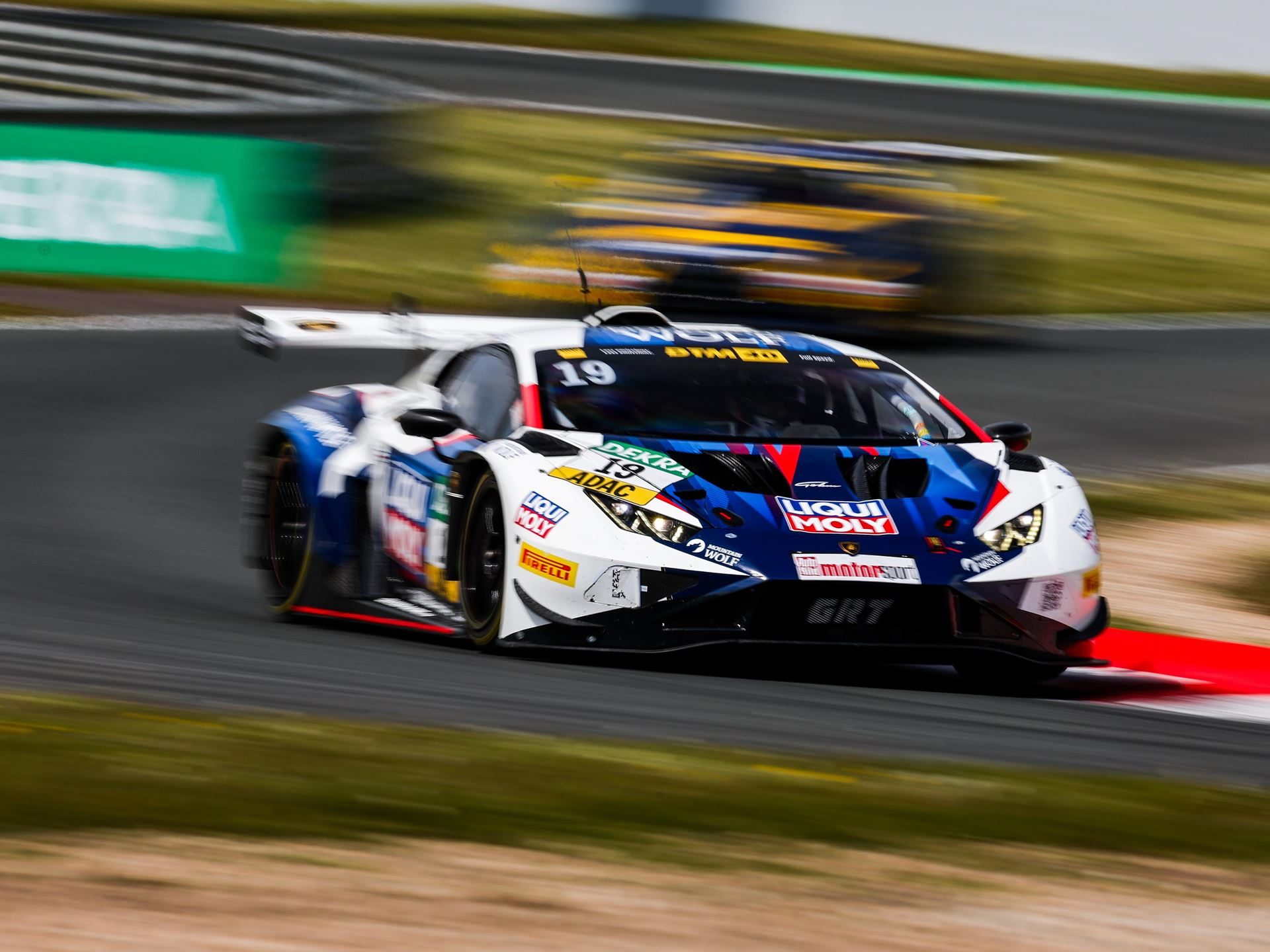
Luca Engstler crossed the finish line at Oschersleben with just three-tenths of a second separating his #19 Lamborghini Huracán GT3 EVO2 from Maro Engel’s Mercedes, clinching victory in Race 2 of the DTM season opener. A day earlier, Mirko Bortolotti brought his #92 SSR Performance Huracán home in second place during Race 1, finishing 1.159 seconds behind winner Jack Aitken. Two races, two top-two results for the naturally aspirated V10, and a weekend that laid bare both the car’s raw competitiveness and the razor-thin margins separating glory from disaster in modern GT3 racing.
Lamborghini says this marks the brand’s sixth DTM race win, and the symmetry is hard to ignore: the company’s first DTM victory came at this same Oschersleben circuit a year prior. The venue is becoming something of a talisman. Yet the more revealing story from this weekend is not the win itself. It is how Engstler won, what went wrong for Bortolotti when he should have doubled up, and what both results tell us about the Huracán GT3 EVO2’s competitive standing as its replacement looms on the horizon.
How Engstler Turned Luck Into a Masterclass
Engstler started Race 2 from fourth on the grid, and by his own admission, raw pace alone would not have put him on the top step. The decisive moment came mid-race when a full course yellow, triggered by contact between a Ferrari and a BMW, froze the field just as the GRT pit crew was ready to execute Engstler’s mandatory stop. The timing effectively gave the #19 car a free pit window, vaulting him into the lead without losing meaningful track position.
Opportunistic? Absolutely. But the 30 minutes that followed required something luck cannot provide.
Engel’s Mercedes was visibly the faster car in the second stint, and Engstler knew it. His own words are refreshingly blunt:
“On pure pace I don’t think we would have been in the fight for the win… I was basically watching my mirrors for half an hour and not giving him space.”
What he described is a defensive clinic: choosing braking points that closed the apex, positioning the car to deny overtaking angles, maintaining composure while a quicker rival probed every corner. For a Lamborghini Young Driver who only recently switched from Audi to the Huracán platform, the maturity on display was striking. Three-tenths at the flag tells you everything about how close Engel came and how little room Engstler gave him.
The broader lesson for Lamborghini is that the Huracán GT3 EVO2 did not need to be the outright fastest car on the day to win. In DTM’s compressed, sprint-format racing, the ability to manage tires across a stint, exploit safety car timing, and execute under pressure matters as much as qualifying pace. The GRT team and Engstler maximized every variable they could control.

Three DTM race cars, led by the Lamborghini Huracán GT3 Evo, corner tightly on the track.
Bortolotti’s Weekend: Podium Saturday, Pit Lane Heartbreak Sunday
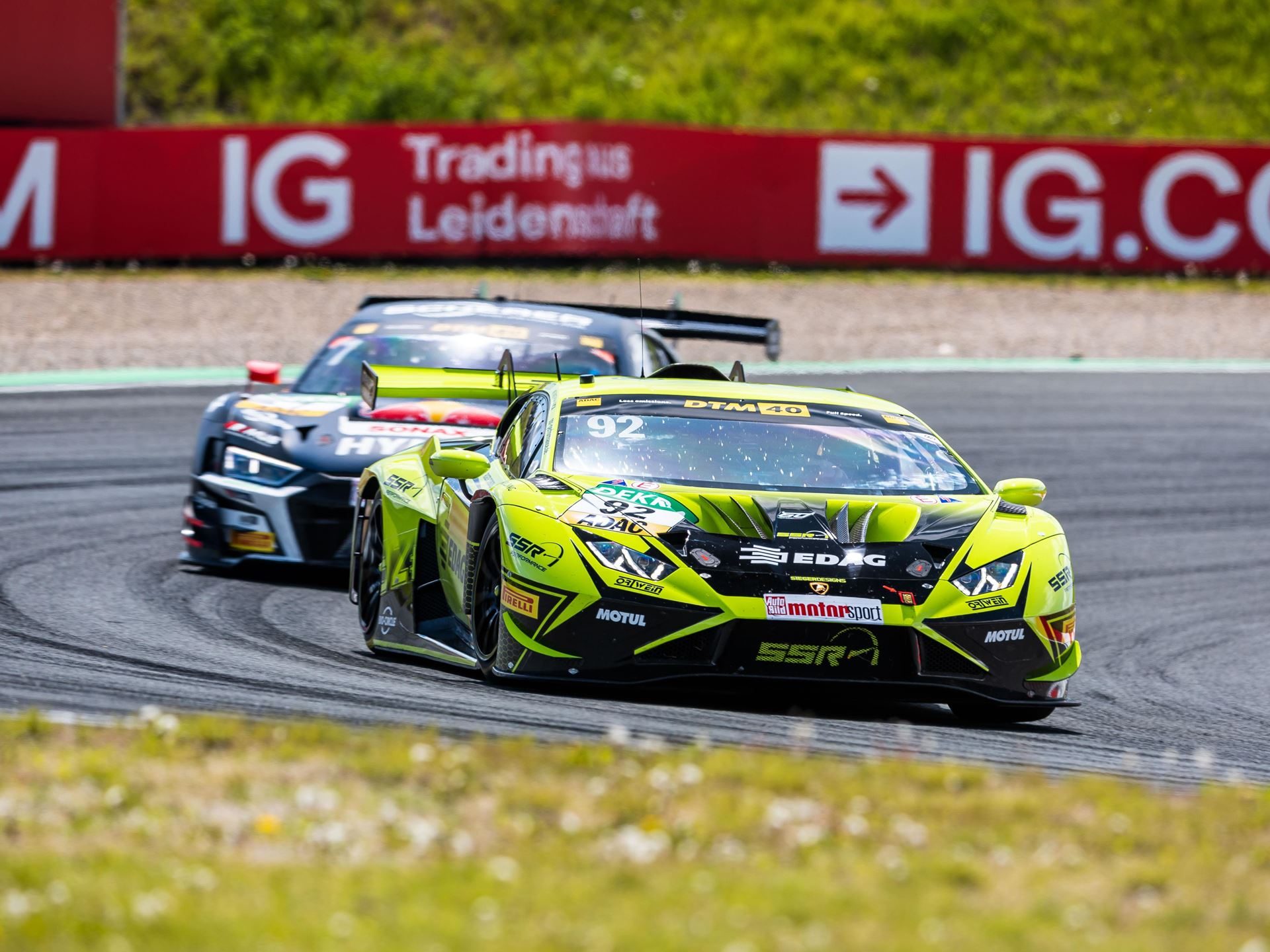
Mirko Bortolotti’s Race 1 was the kind of clean, professional drive that factory-caliber pilots deliver when the car is underneath them. Starting on the outside of the front row, the #92 Huracán held station behind Aitken through the opening stint. A routine mandatory pit stop dropped Bortolotti to third behind BMW’s Marco Wittmann, but the BMW hit trouble late, handing second place back without a fight.
Sunday looked even more promising. Bortolotti claimed pole position for Race 2, collecting three additional championship points before the lights even went out. He led the early laps convincingly. Then the pit stop happened.
Lamborghini’s account attributes the problem to a left-rear wheel nut issue that cost catastrophic time. Bortolotti plummeted from the lead to 15th. Nicki Thiim, piloting the second SSR Performance Huracán, suffered an identical problem and retired outright. Two cars from the same team, the same failure mode, the same race. For SSR Performance, it turned a potential one-two weekend into a damage-limitation exercise.
Pit stop reliability is one of those invisible performance factors that rarely gets discussed until it goes wrong. In DTM, where mandatory stops compress strategy into a narrow window, losing even five extra seconds can drop a car a dozen positions. The SSR crew will need to diagnose and resolve this before the Lausitzring round on May 25-26, because the car clearly had the pace to compete for wins all weekend.

The Lamborghini Huracán GT3 Evo undergoes a rapid pit stop with its dedicated crew.
Why the V10 Still Works in a Turbo-Dominated Field
The Huracán GT3 EVO2 occupies a peculiar position in the current GT3 landscape. Its 5.2-liter naturally aspirated V10, a powerplant architecture no other current GT3 competitor uses, delivers a linear powerband and immediate throttle response that turbocharged rivals cannot perfectly replicate. In a series governed by Balance of Performance regulations designed to equalize lap times across manufacturers, the character of the power delivery becomes a differentiator rather than the peak number itself.
In practical racing terms, a naturally aspirated engine gives the driver a more predictable relationship between throttle input and rear-tire load. On corner exit, where GT3 races are won and lost, that predictability translates into confidence. Drivers can modulate traction with their right foot rather than waiting for a turbo to spool. Engstler’s defensive second stint, where precise corner-exit speed kept a faster car behind for half an hour, is a textbook example of this advantage at work.
Christian Engelhart, driving the second GRT Huracán, finished eighth in Race 2, a result that quietly confirms the car’s baseline competitiveness even without the strategic fortune that boosted Engstler. Two different teams, GRT and SSR Performance, both showed front-running pace across the weekend. When multiple independent operations extract strong results from the same chassis, it points to a fundamentally sound platform rather than a single team’s magic setup.

The vibrant yellow Lamborghini Huracán GT3 Evo, number 92, leads a competitive DTM field.
The Temerario GT3 Looms, and That Changes Everything
Engstler’s Oschersleben victory carries an extra layer of significance because the driver himself represents Lamborghini’s bridge between eras. He is slated to compete in the GT World Challenge Europe in 2026 driving the new Lamborghini Temerario GT3, the twin-turbocharged V8 successor to the car he just won in. His current DTM season in the Huracán is, in effect, a final campaign for the naturally aspirated platform and a proving ground for a young driver being groomed for the next generation.
The transition from V10 to twin-turbo V8 in GT3 specification is not a simple engine swap. It redefines the car’s weight distribution, cooling requirements, throttle mapping, and the entire driving technique that teams and customers have refined over a decade with the Huracán. Road & Track reported that the Temerario GT3 represents Lamborghini’s first clean-sheet GT3 design since the original Huracán racer arrived ten years ago.
Online discussion among racing enthusiasts, particularly on forums like r/wec and r/Sportscar_Racing, reflects genuine anxiety about this transition. Early reports of the Temerario GT3’s initial outings have drawn scrutiny, with forum users noting concerns about mechanical grip, braking performance, and the maturity of the car’s electronic systems in its development phase. Whether those early-development growing pains will persist into the car’s full competitive rollout remains an open question, but they underscore why results like Oschersleben matter so much right now. Every Huracán GT3 EVO2 win reinforces Lamborghini’s credibility in GT3 racing during a period when the successor still needs time to mature.
Lamborghini’s broader motorsport portfolio adds context. The SC63 hypercar program, competing in WEC’s top class, has faced its own well-documented reliability challenges. A strong GT3 program provides a counterbalance, keeping the brand visible on podiums while the prototype effort develops. For customer teams investing in Lamborghini machinery, Oschersleben is reassurance that the current car still delivers.

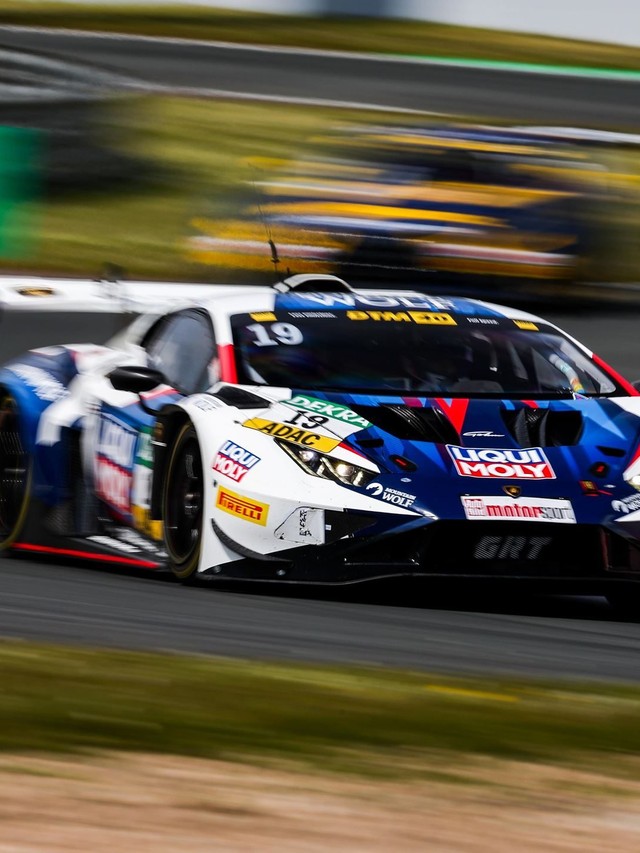
The Lamborghini Huracán GT3 Evo, number 19, powers through a turn on the race track.
What Oschersleben Means for the Championship and for Buyers
Two races into a long DTM season, projecting championship outcomes is premature. But the data points are encouraging. Bortolotti collected strong points in Race 1 and qualified on pole for Race 2 before the pit stop failure intervened. Engstler went from 11th in Race 1 to a win in Race 2. Christian Engelhart added a solid eighth. The Huracán GT3 EVO2 showed pace across both races, with two separate teams extracting competitive results against Mercedes-AMG, BMW, and Ferrari entries.
For anyone following Lamborghini’s customer racing ecosystem, the practical takeaway is straightforward: the Huracán GT3 EVO2 remains a viable, race-winning platform in its final competitive seasons. Teams that already own and operate the car are not nursing an obsolete product. They are running machinery that can fight for podiums at the highest level of GT3 sprint racing, which matters enormously for resale value, spare-parts support, and the confidence of gentleman drivers who invest significant money into these programs.
The season continues at the Lausitzring on May 25-26. If SSR Performance resolves its pit stop reliability and Engstler’s GRT team maintains its strategic sharpness, Lamborghini could realistically challenge for regular podium contention throughout the year. The V10 may be singing its final DTM chapters, but at Oschersleben, it proved the song is far from over.

Mirko Bortolotti celebrates his DTM victory on the podium, proudly holding his trophy aloft.
Gallery