The Halfway Mark at Spa: A Championship on a Knife’s Edge
Three of four championship classes separated by a single point. A 37-car grid filling one of the most demanding circuits in European motorsport. The 24 Hours of Spa running as the headlining event, with Lamborghini’s brand-new Temerario GT3 making its race debut on the same asphalt. If the 2026 Lamborghini Super Trofeo Europe season needed a crucible to sort pretenders from contenders, it could hardly have designed a better one than this weekend at Spa-Francorchamps.
Round 3 runs June 25 to 27 on the support bill of the 24-hour race, which means the paddock will be packed with GT3 teams, manufacturer brass, and talent scouts watching closely. For the drivers threading through Eau Rouge in identical Huracán Super Trofeo EVO2 machines, the audience is both literal and professional. A strong result here echoes well beyond the Super Trofeo points table.
Spa-Francorchamps holds a distinction no other venue on the calendar can claim: it is the only circuit to have appeared in every single edition of the Super Trofeo Europe since the series launched in 2009. That continuity gives teams a deep well of data and setup knowledge to draw from, but it also means the margins between cars shrink further. When everyone knows the 7.004-kilometer, 19-turn layout, the difference comes down to the driver. And this year, the stakes of that difference have never been higher.
Where Future GT Racers Earn Their Stripes
One-make series exist across the supercar landscape, from Porsche’s Carrera Cup to Ferrari’s Challenge. What separates Lamborghini’s Super Trofeo is its proximity to the factory’s GT3 program and the career pipeline it feeds. Spa provides the clearest illustration of that connection: while Super Trofeo drivers contest their two 50-minute races, the Temerario GT3 will be circulating in the 24-hour event just meters away. The ladder is visible, physically and metaphorically.
The series organizes its field into four classes (Pro, Pro-Am, Am, and Lamborghini Cup) that race simultaneously for separate titles. A gentleman driver in the Am class shares the same track, the same conditions, and the same car as a young professional in Pro, all fighting their own battles within the broader field. Lamborghini’s Squadra Corse division treats this structure as a genuine development tool, and Spa’s history in the series reinforces the point: several drivers claimed their maiden Pro victories at this circuit, including 2024 champion Amaury Bonduel, as well as Milan Teekens, Marzio Moretti, Cedric Wauters, and Silas Lovén Rytter.
For prospective entrants watching from the sidelines, the Super Trofeo represents one of the more accessible routes into competitive GT racing with a major manufacturer’s backing. The cars are identical, Hankook supplies the tires across the grid, and the technical regulations keep the playing field level. What you bring is your talent and your team’s preparation. What you take away, if you perform at Spa, is the attention of people who can put you in a GT3 cockpit.

Three Lamborghini Huracán Super Trofeo Evo race cars battle for position on the track, heading towards the arena. Image: Automobili Lamborghini.
Championship Drama Across All Four Classes
The Pro standings offer the closest thing to breathing room at the top, and even that is relative. DL Racing’s Kevin Gilardoni and Simone Iaquinta lead the class after collecting a fourth consecutive podium at Imola. Oregon Team’s Silas Lovén Rytter and Patrik Fraboni sit four points behind following a double victory in Italy, with Rexal Villorba Corse’s Benedetto Strignano and Nicholas Pujatti only two points further back. Below the top three, just 10 points separate the next four crews. In a series where a single race win can swing the entire order, the Pro title fight remains genuinely open.
Pro-Am is even tighter. Anthony Pretorius and Bronislav Formánek of Mičánek Motorsport hold a one-point advantage over Josef Knopp and Pietro Perolini of Oregon Team. ASR’s Paolo Biglieri and Marzio Moretti, who finished second twice at Imola, sit one point behind Knopp and Perolini. The weekend also brings reinforcements that could scramble the standings considerably: Brendon Leitch (the 2023 European Pro champion) returns alongside American driver Don Yount, Chris van der Drift (2023 Asian Pro champion) will partner Super Trofeo Asia regular Hairie Zairel Oh, and Shota Abkhazava, who owns Am, Pro-Am, and LB Cup titles across multiple seasons, makes his 2026 debut with Art-Line alongside 2024 World Finals winner Egor Orudzhev.
In the Am class, GT3 Poland’s Grzegorz Moczulski leads Mičánek Motorsport’s Jakub Knoll and Renaud Kuppens by one point. The Lamborghini Cup mirrors that pattern: Oregon Team’s Adalberto Baptista edges Rexal Villorba Corse’s Claude-Yves Gosselin by a single point, with defending class champion Holger Harmsen lurking nine points off the lead after a podium at Imola. Four separate title fights, all decided by margins this small, converging on a single mid-season weekend. A bad qualifying session, a slow pit stop, or a first-lap incident could redraw the entire championship picture.

A striking pink and yellow Lamborghini Huracán Super Trofeo Evo race car powers through a turn on the circuit. Image: Automobili Lamborghini.
The Huracán Super Trofeo EVO2: A Naturally Aspirated Equalizer
Every car on the grid runs the same hardware, and that hardware is worth understanding in the context of what makes these championship margins so meaningful. The Huracán Super Trofeo EVO2 is powered by Lamborghini’s 5.2-liter naturally aspirated V10, producing 620 horsepower. According to one report, the car weighs 1,270 kg dry and uses a sequential six-speed X-Trac gearbox with racing ABS and traction control. These are purpose-built race cars developed by Lamborghini’s Centro Stile and Squadra Corse, sharing the road car’s basic architecture but stripped and re-engineered for circuit duty.
The naturally aspirated V10 is the philosophical heart of the series. In an era where turbocharged and hybrid powertrains dominate headlines, including Lamborghini’s own Temerario road car and its twin-turbo V8, the Super Trofeo EVO2 preserves a direct, linear throttle response that rewards precision over boost management. For a one-make series designed to isolate driver skill, that characteristic matters. The engine delivers its power predictably, which means the gap between drivers shows up in braking points, corner entry speed, and racecraft rather than in who manages turbo lag best.
The race format adds its own strategic layer. Each weekend features two 50-minute races with a mandatory pit stop between the 20th and 30th minute. Solo drivers must remain stationary for at least 63 seconds; two-driver entries get a 60-second minimum. That three-second difference is a deliberate balancing mechanism, a small but meaningful concession to the solo driver who does not benefit from a fresh co-driver after the stop. It is the kind of regulatory detail that rarely makes headlines but shapes race outcomes every weekend, and at Spa, where the championship gaps are measured in single points, it could prove decisive.

A Lamborghini Huracán Super Trofeo Evo race car navigates a turn with precision and speed on the track. Image: Automobili Lamborghini.
The Temerario GT3 Steps Into Spa’s 24-Hour Arena
Running alongside the Super Trofeo weekend, the 24 Hours of Spa will host the race debut of the Temerario GT3 over the full endurance distance. Grasser Racing Team and Rutronik Racing will field the new car, a pairing that carries weight: Grasser won the 24 Hours of Spa in 2025 with the outgoing Huracán GT3 EVO2, making them the natural team to shake down its successor under maximum pressure.
The Temerario GT3 represents a significant shift for Lamborghini’s competition program. As Autoblog reported at its Goodwood debut in 2025, the car is Lamborghini’s first competition machine to be fully designed, developed, and built in-house by Squadra Corse. Previous GT3 efforts involved external partners for significant portions of the development. Bringing the entire process under one roof signals a level of commitment and control that puts Lamborghini on a similar footing to how Ferrari and Porsche manage their factory GT3 programs.
For the broader GT3 competitive landscape, the Temerario’s arrival matters because it replaces the Huracán GT3, which became one of the most successful and widely campaigned customer race cars of its generation. The question now is whether the new platform, built around a twin-turbo V8 rather than the naturally aspirated V10, can replicate that dominance. A 24-hour race at Spa is about the most demanding test imaginable for answering that question. Reliability, tire management, driver comfort over long stints, and performance consistency through temperature swings and weather changes all get exposed over the course of a full day and night.
Fans watching the Super Trofeo races this weekend would do well to pay attention to the Temerario GT3 in the main event. The Super Trofeo grid still showcases the V10 that defined Lamborghini’s mid-engine identity for over a decade. The GT3 car circulating on the same circuit represents what comes next. Both are Lamborghini, but they belong to different eras of the company’s engineering philosophy, and Spa is the stage where those eras overlap.

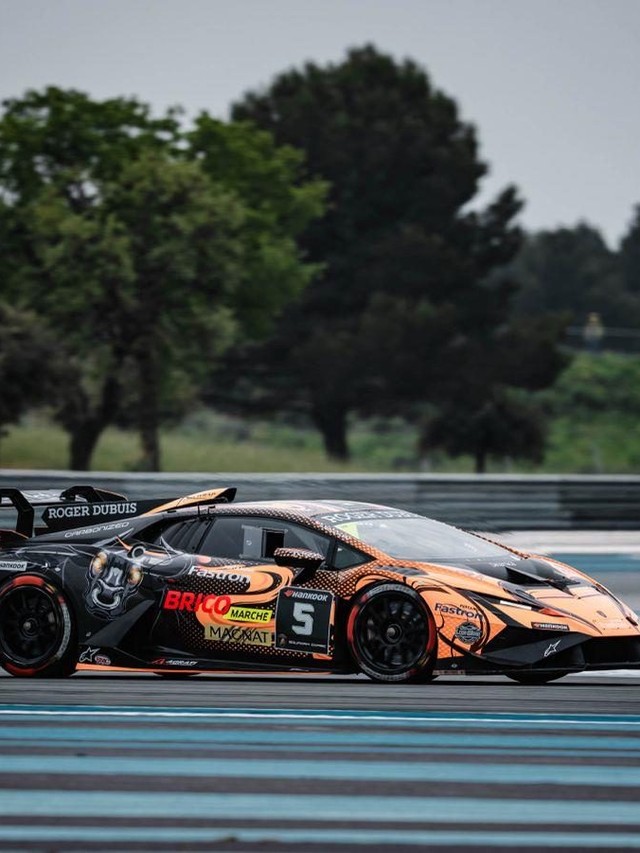
An orange and black Lamborghini Huracán Super Trofeo Evo speeds along the track during a race event. Image: Automobili Lamborghini.
How to Watch and What to Expect
The weekend schedule opens with two free practice sessions on Thursday, June 25, followed by qualifying and Race 1 on Friday, and Race 2 on Saturday. Both races will be livestreamed on the official Lamborghini Squadra Corse YouTube channel, making this one of the more accessible rounds for fans who cannot travel to Belgium.
The remaining 2026 calendar runs through the Nurburgring (August 28 to 30), Barcelona (October 2 to 4), and a season finale at Monza (October 21 to 23) that doubles as the venue for the Lamborghini World Finals, where European, North American, and Asian championship competitors converge for a single weekend. With four rounds and the World Finals still to come, the points leaders hold advantages measured in single digits. Nothing is decided.
The grid size alone tells a story. Thirty-seven cars is substantial for a one-make series, and the depth of the driver talent pool, bolstered by returning champions and cross-regional entrants, suggests a program that is expanding rather than contracting. Pair that with the Temerario GT3’s debut in the headlining endurance race, and this Spa weekend becomes more than a mid-season checkpoint. It is the moment where Lamborghini’s racing present and its racing future share the same piece of Belgian asphalt, with everything still to play for in both arenas.
Gallery


