Four Titles, 112 Drivers, and a Season’s Worth of Scores Settled at Misano
When Danny Formal climbed from the #101 Wayne Taylor Racing Huracán Super Trofeo EVO2 at the Misano World Circuit Marco Simoncelli on November 9, the result carried weight beyond a single race win. Formal and co-driver Hampus Ericsson secured the Pro class title at the 2025 Lamborghini World Finals, delivering WTR its first World Finals crown since Riccardo Agostini and Trent Hindman won for the team in 2017. That eight-year gap tells you something about how difficult this event is to win.
The 12th edition of the World Finals drew 112 drivers representing 35 nationalities and 36 teams. Lamborghini says 10,000 spectators attended across the weekend. Alongside the Pro battle, titles were decided in Pro-Am, Am, and Lamborghini Cup, each class producing its own narrative of redemption, dominance, or sheer attrition. Across every class, the same pattern held: no title was safe until the final meters, and the compressed two-race format punished hesitation as ruthlessly as it punished recklessness.

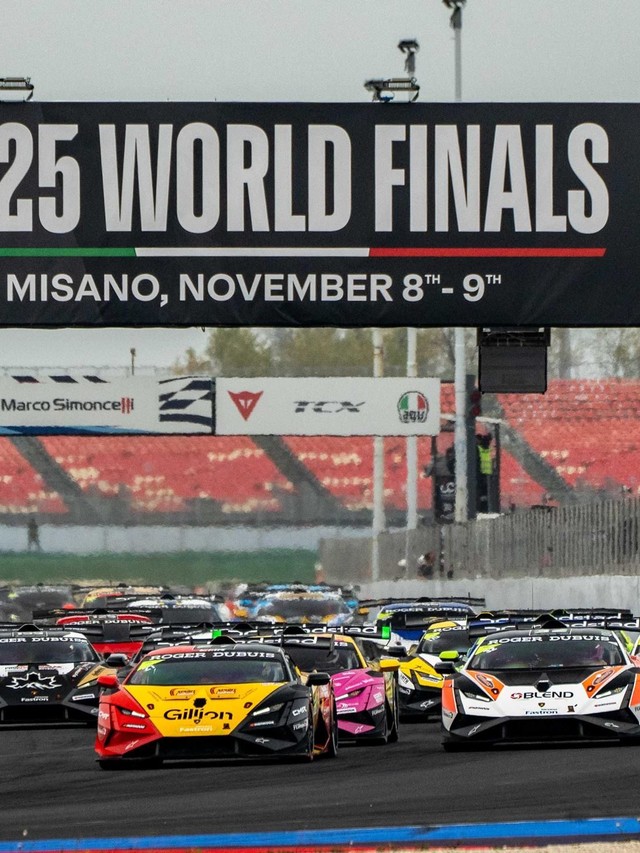
The grid of Lamborghini Huracán GT3 EVO2 cars lines up for the start of the 2025 World Finals race at Misano.
Pro Class: How Formal and Ericsson Recovered from a Race One Spin
The Pro title fight was defined by a brutal contrast between the two races. In Race 1, Formal qualified on pole and controlled the opening stint before pitting and handing over to Ericsson. Will Bamber and co-driver De la Torre in the #129 emerged in the lead, and the closing laps became a three-car knife fight involving the #101, the #129, and Adam Putera in the #6 VSR entry.
Ericsson twice reclaimed the lead under braking into turn eight, and twice De la Torre responded with a cutback at turn 10. On the final lap, Ericsson lunged again, only for Putera to pitch the #101 into a half-spin at turn 10, dropping Formal and Ericsson to sixth at the flag. Putera crossed the line first but collected a five-second penalty, handing the win to De la Torre and Bamber.
Race 2 required a completely different approach. Starting ninth overall and fourth in Pro, Ericsson kept the car clean while chaos erupted around him. Josef Knopp and Enzo Geraci in the #36 Oregon Team car were eliminated at the first corner after contact with Brian Changwoo Lee’s #263. Putera and Paul Levet were tagged into a spin by Anthony Pretorius of Leipert Motorsport. Formal took over at the pit window and methodically picked off Giacomo Pedrini, Gavin Huang, and Andrzej Lewandowski to claim the overall win and the Pro title.
Lamborghini states the victory also represented WTR’s 100th Super Trofeo race win. Formal and Ericsson had already wrapped up the North American championship before arriving at Misano, so the World Finals title completed a clean sweep of everything available to them in 2025.

A black and blue Lamborghini Huracán GT3 EVO2 car navigates a turn during intense racing action.
Pro-Am, Am, and Lamborghini Cup: Consistency, Controversy, and Clean Sweeps
Art-Line’s Shota Abkhazava and Egor Orudzhev were crowned Pro-Am champions through a combination of pace and stewards’ room drama. In Race 1, ASR’s Andrzej Lewandowski and Frederik Schandorff crossed the line first in Pro-Am, but multiple penalties dropped them down the order. Abkhazava and Orudzhev were initially penalized 10 seconds themselves, only for the stewards to reverse the decision and award them the class win. Second place in Race 2 clinched the title on points, as Schandorff-Lewandowski and Chris van der Drift-Todd Kingsford of VSR tied for second, five points behind.
Orudzhev claimed his second consecutive World Finals title, having won in Pro last year before moving to Pro-Am. One competitor report notes that Art-Line secured world championships at three consecutive World Finals events, counting Abkhazava’s 2023 win, Orudzhev’s 2024 Pro title, and this year’s Pro-Am crown.
Oregon Team’s Massimo Ciglia and Pietro Perolini swept both Am races with clinical efficiency. Perolini built a 14-second margin in the opening stint of Race 1, and Ciglia maintained it to the flag, finishing 4.530 seconds clear of Paolo Biglieri in the #32 ASR entry. Race 2 followed a similar pattern: Perolini overtook early leader Rodrigue Gillion and pulled away, though a late safety car restart produced a scare when Adrian Lewandowski collected the Oregon Team car. The contact did not compromise the result. Lamborghini’s event summary notes Ciglia lost the Am title at this same circuit four years ago by a single point.
Karim Ojjeh of Rexal Villorba Corse dominated Lamborghini Cup with pole position and victory in both races. In Race 1, he passed the Privitelio father-son entry on the inside of turn one with 12 minutes remaining and never relinquished the lead. Race 2 was equally decisive despite a nervous late safety car period. Holger Harmsen of GT3 Poland completed the podium in Race 1, while Rocky T Bolduc of RAFA Racing Team rounded out the Race 2 podium.

The pit crew celebrates as a pink and yellow Lamborghini Huracán GT3 EVO2 speeds past the finish line.
Penalties, Pile-Ups, and the Thin Line Between Silverware and Scrap Metal
Regional season points do not carry over to the World Finals. Two races, one weekend, winner takes all. That format rewards aggression, but it also punishes it, and the 2025 edition produced an unusually high rate of incidents that reshaped every title fight.
The Race 1 Pro battle was effectively decided by Putera’s contact with Ericsson on the final lap, earning a five-second penalty but not disqualification. In Pro-Am, the stewards reversed their own penalty against Art-Line, directly determining the class winner. Race 2’s opening corner eliminated two genuine Pro contenders in Knopp-Geraci and damaged the Leipert Motorsport cars of Pretorius and team-mate Ethan Brown, who ended up facing opposite directions after tangling with each other.
The Am class was not immune. Stéphane Tribaudini, who had qualified on pole for Race 1, pulled off with a mechanical issue before the race started. Perolini’s late-race contact with Adrian Lewandowski in Race 2 could have erased the entire Am title campaign in a single moment.
For teams investing significant budgets in a full Super Trofeo season, the World Finals represents both the ultimate payoff and the ultimate risk. The compressed format means a single first-corner incident can wipe out an entire year’s investment in a championship run.

A Lamborghini Huracán GT3 EVO2 race car expertly navigates a tight corner on the circuit.
The Huracán Super Trofeo EVO2: Racing’s Best Argument for the Naturally Aspirated V10
Every car on the Misano grid ran the same platform: the Huracán Super Trofeo EVO2, a purpose-built race car that strips the road-going Huracán’s naturally aspirated V10 down to its competitive essentials. No street-legal compromises, no sound deadening, no air conditioning.
The Super Trofeo series, established in 2009, operates as a single-make championship where the car is equalized and the driver pairing becomes the primary variable. That format serves two purposes for Lamborghini. It creates a global racing ecosystem that feeds talent upward: Am class drivers graduate to Pro-Am, Pro-Am runners move to Pro, and the best Pro drivers attract attention from GT3 and endurance racing teams. It also puts Lamborghini race cars on circuits around the world with minimal manufacturer risk, since customer teams bear the operational costs.
The mid-engine layout of the Huracán creates different driving characteristics, different failure modes, and a different spectacle from rival single-make series built around front-engine GTs or rear-engine sports cars. The 2025 World Finals grid of 112 drivers suggests the market finds that distinction compelling.

A striking blue and orange Lamborghini Huracán GT3 EVO2 races intensely on the track.
What the World Finals Signals About Lamborghini’s Customer Racing Future
The 2025 World Finals is likely among the last major events for the Huracán Super Trofeo EVO2 platform. Lamborghini’s Squadra Corse division is developing the Temerario GT3 for international GT racing, and the natural expectation is that a Temerario-based Super Trofeo car will eventually replace the Huracán. Lamborghini has not confirmed a timeline for that transition, and no specifications for a Temerario Super Trofeo car are publicly available.
What the 2025 results confirm is that the existing program remains healthy: 36 teams, 35 nationalities, and enough competitive depth to produce 11 different race winners and 29 podium finishers across four races. The shift from a naturally aspirated V10 to a twin-turbo V8 hybrid powertrain will fundamentally change the character of the series whenever it arrives. For teams and drivers who built their programs around the Huracán’s linear power delivery and high-revving character, adapting to turbocharged torque curves and hybrid energy management will require significant recalibration.
For prospective buyers considering entry into Lamborghini customer racing, the practical takeaway is timing. The current EVO2 platform is proven, well-understood by teams, and supported by a mature parts and service ecosystem. Waiting for the next generation means being an early adopter of an unproven platform.
Misano demonstrated that Lamborghini’s investment in customer racing continues to produce genuine competition. The penalties, the first-corner eliminations, the reversed stewards’ decisions, the final-lap contact: these are the marks of a series where the result is not predetermined. As the Huracán era winds down, the 2025 edition provided a fitting send-off for a platform that turned Lamborghini from a GT racing curiosity into a legitimate single-make racing force.

A vibrant pink and yellow Lamborghini Huracán GT3 EVO2 crosses the finish line as officials wave the checkered flag.
Gallery


