Pfaff Motorsports Delivers the Temerario GT3’s First IMSA Endurance Win
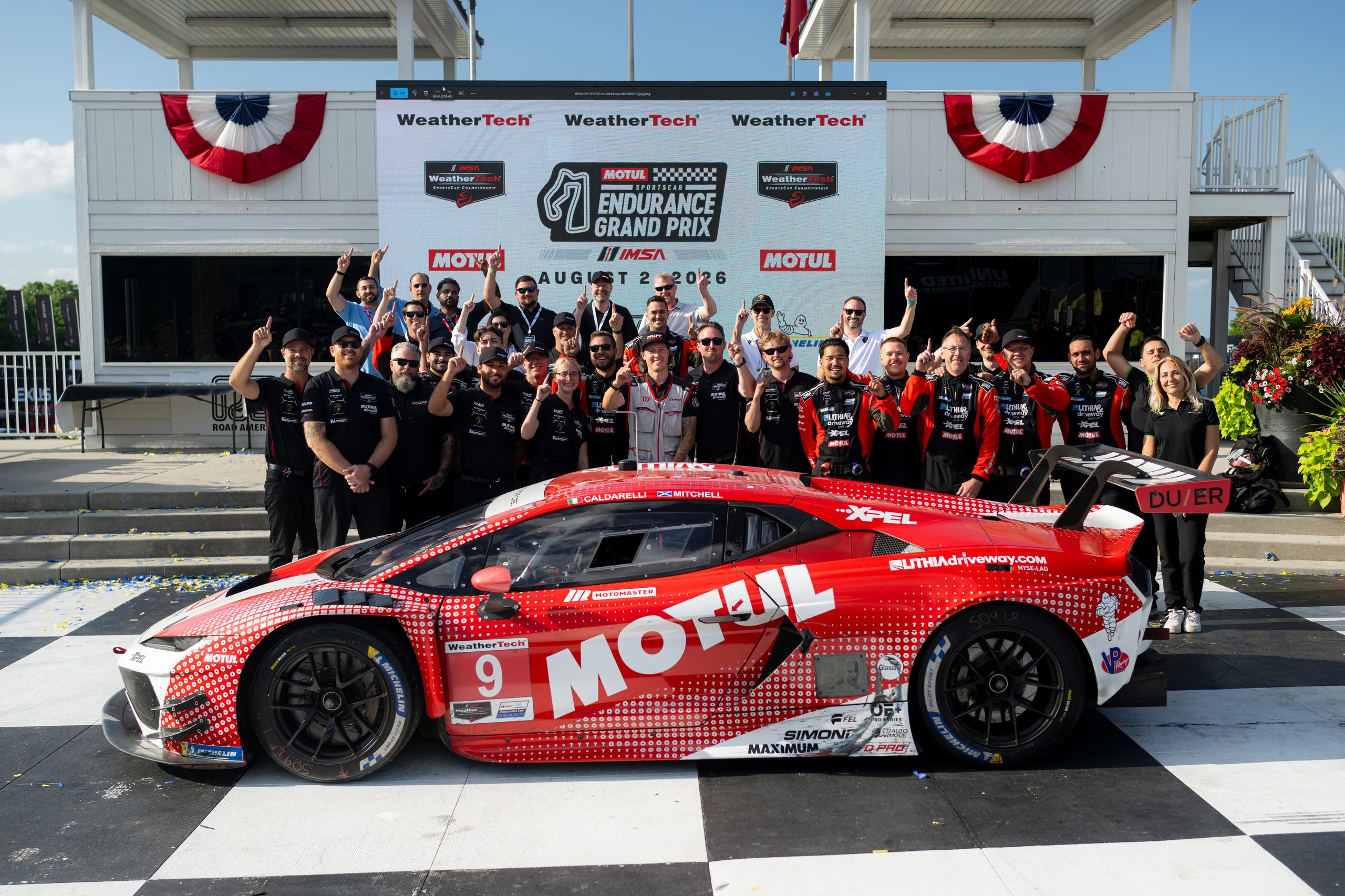
Five months after rolling off the grid at Sebring for its competitive debut, the Lamborghini Temerario GT3 scored its first IMSA WeatherTech SportsCar Championship endurance victory at the six hours of Road America on August 3. Factory drivers Andrea Caldarelli and Sandy Mitchell piloted the #9 Pfaff Motorsports entry from eighth on the GTD Pro grid to the top step, combining clean driving, sharp strategy, and improved race pace to build a lead that ultimately survived a race-ending full course yellow.
That the win came so quickly matters. The Temerario GT3 is the first GT3 race car entirely designed, developed, and produced in-house by Lamborghini Squadra Corse. Its predecessor, the Huracán GT3, served the brand for a full decade across multiple evolutions but was developed with external partner Dallara. Bringing the entire process inside Sant’Agata Bolognese represents a fundamental shift in how Lamborghini approaches motorsport engineering, and an IMSA endurance win within five months of the car’s first race suggests the gamble is paying off.
The result also snapped a 36-race winless drought for Pfaff Motorsports, according to IMSA, a streak dating to March 2023. For a team that played a key development role in bringing the Temerario GT3 from prototype to race-ready machine, earning its first endurance win with the car it helped shape carries real weight.

The red and white Lamborghini Temerario GT3 race car speeds past enthusiastic fans on a bright day at the track. Image: Automobili Lamborghini.
Why This Win Validates Lamborghini’s In-House Engineering Gamble
Caldarelli, now in his tenth year as a Lamborghini factory driver, highlighted a detail that enthusiasts often overlook: Squadra Corse operates as a comparatively small group relative to the factory racing operations at Porsche, Ferrari, and Mercedes-AMG. Winning at Road America against those programs, with a brand-new car still accumulating race miles, speaks to efficient engineering rather than brute-force resource spending.
The Huracán GT3 earned its reputation through longevity and iterative improvement over a decade. Road & Track reported that Lamborghini soldiered on with that same racer while other manufacturers cycled through multiple new GT3 platforms; Porsche alone released three entirely new GT3 cars in that span. The Temerario GT3’s rapid competitiveness suggests Lamborghini absorbed lessons from watching those rivals iterate while it refined the Huracán, then applied them all at once when the time came to build its successor from scratch.
For prospective Temerario road car buyers, the racing program serves as a kind of public stress test. GT3 regulations strip away the road car’s hybrid system (electric motors are not permitted in the class), but the core architecture remains: the same chassis and a modified version of the same 4.0-liter twin-turbo V8 form the foundation. When that package survives six hours of Road America without mechanical drama, it tells you something about the structural integrity of the platform you might park in your garage.
The Rapid Ascent: From Sebring Debut to DTM Victory to Road America
The timeline of the Temerario GT3’s early career reads like an accelerated version of what most new GT3 cars experience. Its global competitive debut came at the IMSA 12 Hours of Sebring in March, a notoriously punishing race that serves as a reliability crucible. Pfaff Motorsports then delivered the car’s first outright podium on the streets of Detroit. By early August, the endurance win at Road America completed the progression from finishing to competing to winning.
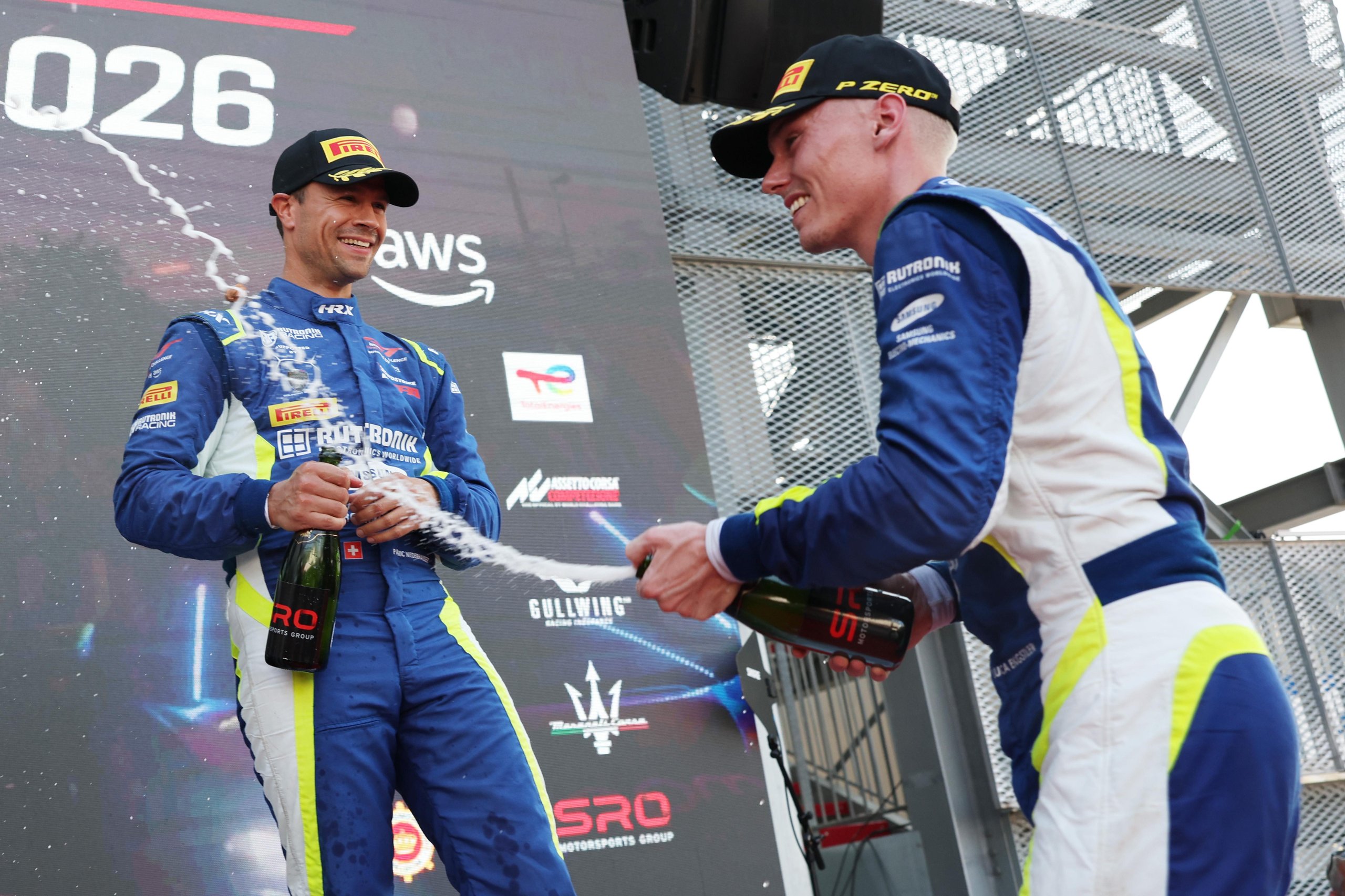
That trajectory was not confined to North America. Running parallel to the IMSA campaign, the Temerario GT3 claimed its maiden DTM victory with Mirko Bortolotti and Team TGI by GRT. On the same day as the Road America triumph, Rutronik Racing’s Patric Niederhauser and Luca Engstler secured Lamborghini’s first overall podium in GT World Challenge Europe at Magny-Cours, finishing third after Engstler passed a Ferrari with 11 minutes remaining.
Caldarelli emphasized the car’s reliability throughout its debut year, noting zero mechanical issues. Each of these results, across different series, circuits, and conditions, reinforces the same point: the in-house engineering that produced this car delivered a platform that was competitive from the outset, not one that needed seasons of painful development to find its feet.

The red and white Lamborghini Temerario GT3 leads a competitive field of race cars on the challenging track. Image: Automobili Lamborghini.
Strategy, Setup Gambles, and an Improved Brake Package
Starting eighth in GTD Pro, the #9 car’s path to the front was anything but straightforward. Caldarelli revealed that the team made a strategic gamble on setup after a challenging qualifying session placed them near the bottom of the class grid. Within the opening 90 minutes, that gamble appeared to work: the car climbed to third.
Lamborghini says the Temerario GT3 benefited from a performance upgrade ahead of Road America. IMSA’s own reporting identified this as an improved brake package, a detail Lamborghini’s official account left vague. In endurance racing, brakes are not a glamorous talking point, but they are a survival item. Consistent braking performance over a six-hour stint directly affects tire management, fuel strategy windows, and driver confidence under heavy traffic. An upgrade in that area can unlock pace gains that compound across hundreds of laps, and for a car built entirely in-house, the ability to develop and deploy such improvements quickly reflects the same engineering agility that got the Temerario GT3 to the grid in the first place.
The strategic picture grew complex as multiple full course yellows reshuffled the field. Mitchell maintained a strong position through the middle stint, and Caldarelli then exploited the Temerario’s improved race pace by running an alternative fuel strategy that put the #9 at the head of the field. A nearly 10-second margin built up before the race was neutralized with 45 minutes remaining. Further caution periods compressed the field, and the final yellow with under 10 minutes left meant the race ended under caution, sealing the victory.
“The team nailed the race today: they got every call right, we got a bit of luck here and there but we also had the pace at the end to finish it off,” Sandy Mitchell said after the race.

Two triumphant race car drivers proudly display their hard-earned trophies on the victory podium. Image: Automobili Lamborghini.
Lamborghini’s GTD Pro Position Against Porsche, Ferrari, and Mercedes-AMG
GT3 racing operates under Balance of Performance regulations designed to equalize different cars, which means raw specification advantages are intentionally neutralized. The real differentiators become reliability, team execution, driver talent, and the manufacturer’s ability to extract the maximum from the BoP window they are given. Lamborghini winning at Road America with a car that debuted five months earlier, developed by a smaller factory operation, is a competitive statement that the BoP framework amplifies rather than diminishes.
The Huracán GT3 spent a decade proving Lamborghini could compete consistently in this arena, but it also spent much of that time as the oldest platform on the grid. The Temerario GT3 resets that dynamic. Lamborghini now fields a current-generation car against the latest from Porsche (992-generation 911 GT3 R), Ferrari (296 GT3), and Mercedes-AMG (GT3), and the early results suggest it belongs at the front.
One detail worth tracking: the Temerario Super Trofeo, the customer one-make racing variant, is expected to arrive in 2027, according to one report. That would give Lamborghini a complete racing ecosystem built around the Temerario platform, from the accessible Super Trofeo series up through GT3 competition in IMSA, GT World Challenge, and DTM. Ferrari and Porsche already operate similar pyramids. Lamborghini building its own version entirely in-house, rather than relying on external constructors, represents a structural commitment to motorsport that extends well beyond any single race result.

The vibrant blue and yellow Lamborghini Temerario GT3 race car navigates a turn with precision and speed. Image: Automobili Lamborghini.
What Road America Signals for the Road-Going Temerario
The Temerario GT3 strips away the road car’s three electric motors and plug-in hybrid architecture to comply with GT3 regulations, running the 4.0-liter twin-turbo V8 with racing-specific turbochargers, exhaust, and intake systems. The GT3 car does not directly prove the hybrid system’s durability. What it does prove is that the fundamental mid-engine layout, the chassis structure, and the combustion engine at the heart of the road car can withstand the most demanding conditions in production-based racing.
For buyers currently on the Temerario waiting list, or those considering placing an order, the racing program provides a form of engineering validation that no marketing campaign can replicate. Car and Driver’s Lightning Lap test of the road-going Temerario already demonstrated the car’s track capability in a controlled environment. The GT3 program extends that proof into the chaotic, high-attrition world of multi-class endurance racing, where mechanical fragility gets exposed ruthlessly.
Lamborghini describes the production Temerario as the benchmark V8 High Performance Electrified Vehicle in its category. The GT3 car’s job is to make sure the “performance” part of that label carries weight beyond a specification sheet. Five months into its racing career, with victories in both IMSA and DTM and podiums across two continents, the Temerario GT3 is building that case faster than anyone, perhaps even Squadra Corse, expected.
Gallery