A Year of Reversal at Sant’Agata Bolognese
For the first time in recent memory, Lamborghini’s annual sustainability data tells a story of decline rather than growth in emissions. The 2025 Sustainability Report, published this week and prepared under both European ESRS and international GRI standards, delivers two headline figures that rewrite the trajectory the company had been on. Tailpipe CO₂ emissions across the entire Lamborghini fleet fell 40% compared with the 2024 average. Production site greenhouse gas emissions (Scope 1 and 2) dropped 9%, landing at 27,122 tonnes of CO₂e. Indirect Scope 3 emissions, the sprawling category capturing everything from supplier logistics to end-of-life, declined 15% year on year.
Those numbers carry extra weight because of what preceded them. External reports covering the 2023 to 2024 period documented the opposite trajectory: Scope 1 emissions climbed from 15,653 to 19,738 tCO₂e, Scope 2 rose from 9,108 to 10,111 tCO₂e, and Scope 3 ballooned from roughly 746,000 to over 821,000 tCO₂e. Publications attributed those increases to higher energy consumption from a new cogeneration plant, the activation of a thermal power unit in the paint shop, and a larger number of vehicles reaching customers. The 2025 report does not represent steady incremental progress. It represents a genuine reversal, and the mechanism behind it is the same one that has divided enthusiast opinion for years: full hybridization of the product range.

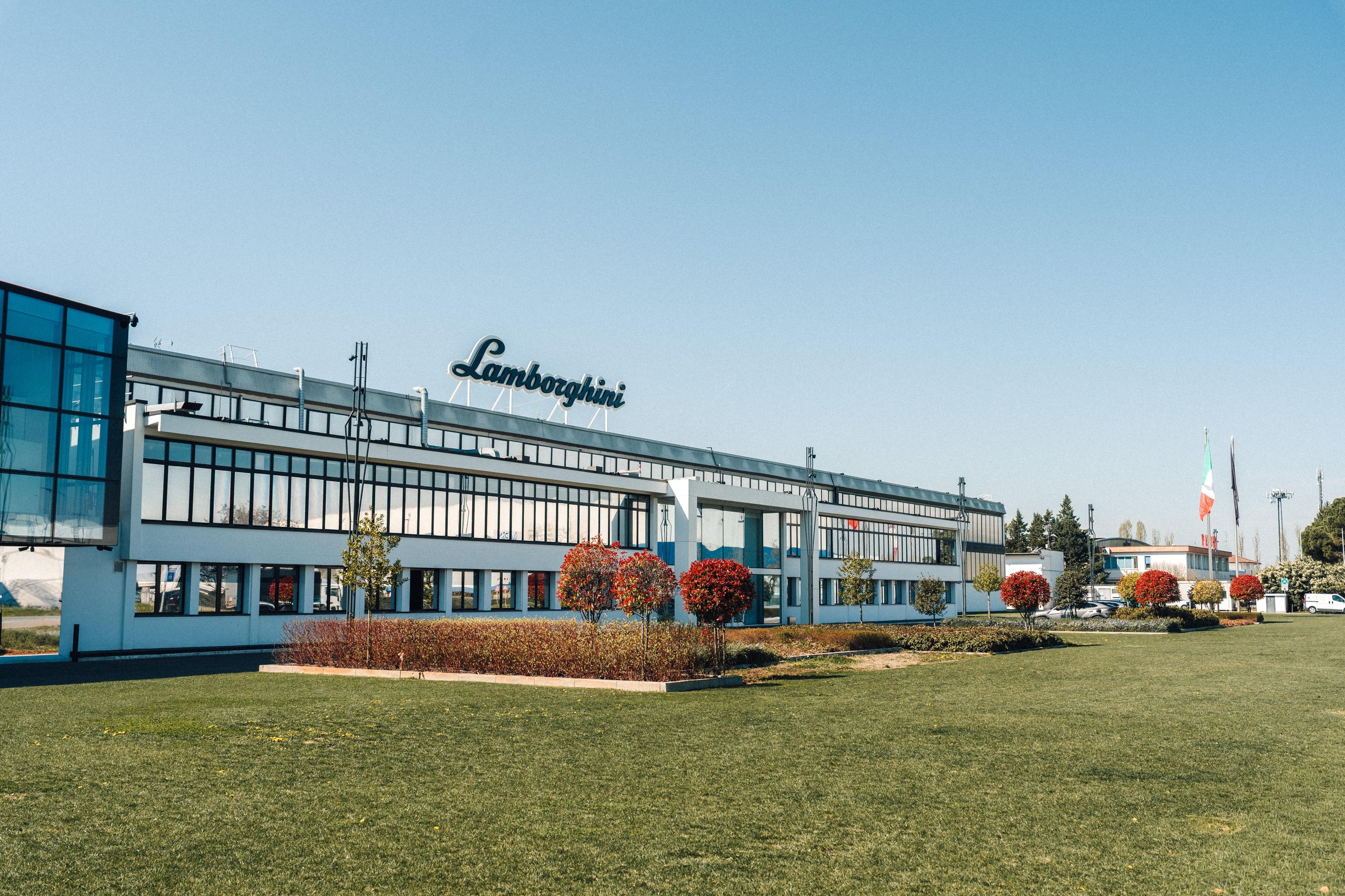
An aerial view reveals the Lamborghini factory nestled within expansive green fields, showcasing its integration with the landscape. Image: Automobili Lamborghini.
The Hybrid Range Completes the Picture
Every car Lamborghini now sells carries a hybrid powertrain, and that single fact is the engine behind the 40% tailpipe reduction. The Revuelto replaced the Aventador with its V12 plus three electric motors. The Urus SE brought plug-in hybrid capability to the SUV line. And the Temerario, which reached commercial debut during 2025, completed the transition by replacing the naturally aspirated Huracán with a twin-turbo V8 hybrid producing a combined 907 horsepower.
Lamborghini says this full hybridization, the culmination of its Direzione Cor Tauri roadmap, is what bent the emissions curve. Plug-in capability means electric-only driving in certain conditions, and even when the combustion engines are running, the hybrid systems allow smaller displacement units (in the Temerario’s case) or more efficient operating windows for the V12. The fleet-average CO₂ figure drops accordingly.
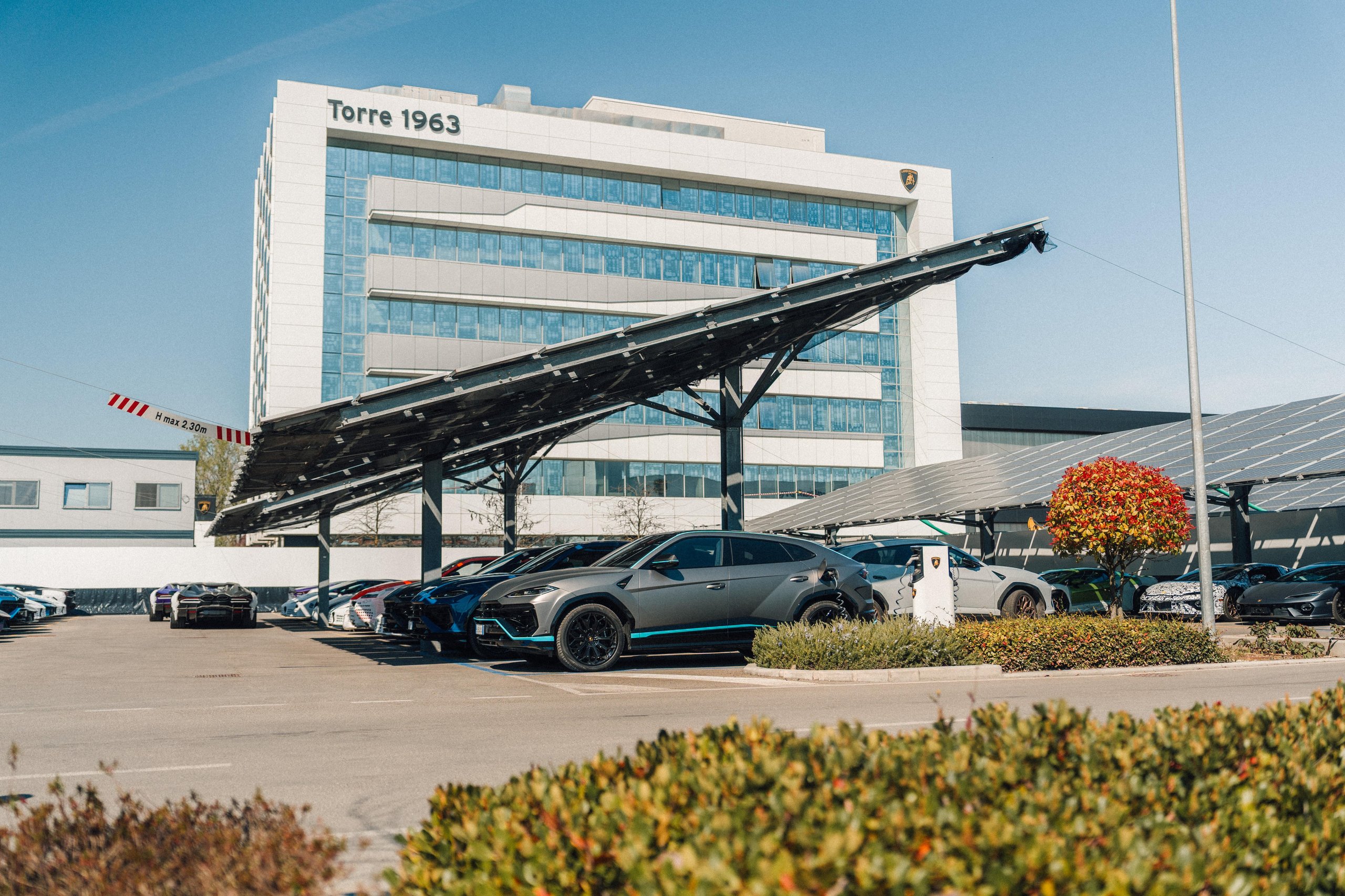
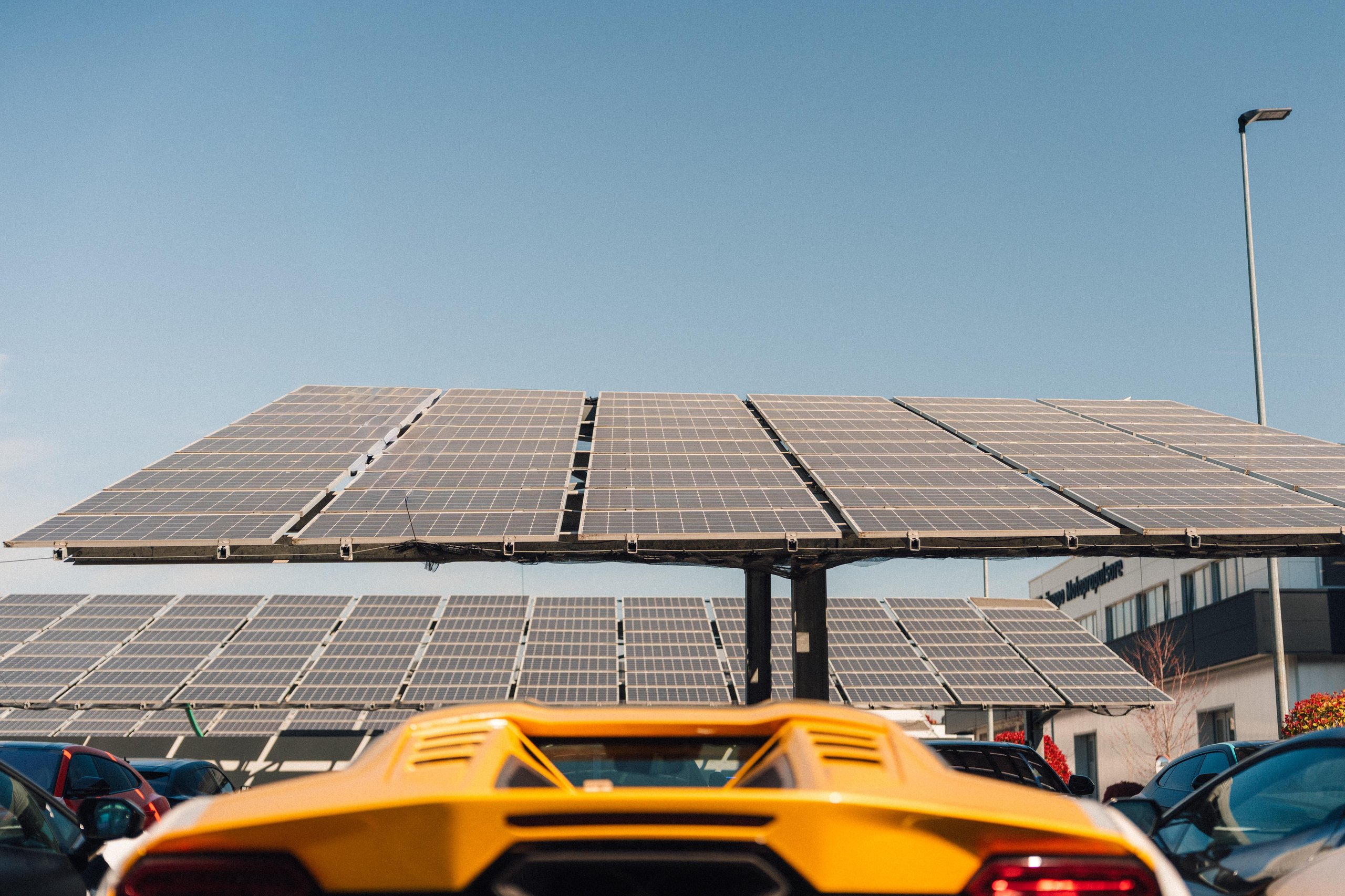
The factory’s own 9% Scope 1 and 2 decline raises a fair question: does it reflect genuine efficiency gains or simply a different production mix? The report does not break that down in granular detail, but the fact that Lamborghini simultaneously exceeded 3,000 employees for the first time and maintained high production volumes suggests the improvement came from process changes rather than reduced output. One external report noted a 22% rise in Lamborghini’s self-generated energy during the prior reporting period, pointing to the solar canopy infrastructure visible across the Sant’Agata campus as a meaningful contributor to the facility’s energy balance. In other words, the reversal is not just about what rolls off the line; it extends to how the line itself is powered.

The stunning green Lamborghini Revuelto navigates a scenic road, showcasing its dynamic design amidst a lush forest setting. Image: Automobili Lamborghini.
Life Cycle Assessment: Measuring Beyond the Exhaust Pipe
Tailpipe numbers grab headlines, but one of the more consequential details in the report sits further down the page. The Revuelto earned Lamborghini’s first Life Cycle Assessment certification, conducted under ISO 14040 and ISO 14044 standards. An LCA does not simply measure what comes out of the exhaust. It accounts for the environmental impact of raw material extraction, component manufacturing, assembly, the vehicle’s operational life, and its eventual disposal or recycling.
Matteo Ortenzi, Lamborghini’s General Secretary and Chief Strategy Officer, framed the certification as a “methodological step change” and confirmed that the company intends to extend LCA analysis to the Temerario and eventually the full range. For buyers, this matters because it introduces transparency that goes well beyond regulatory compliance. A supercar with a certified LCA makes it harder for critics to dismiss hybrid adoption as mere greenwashing, and it gives Lamborghini a documented baseline against which future models can be measured.
The report also notes a first-ever mapping of inbound logistics emissions, now folded into Lamborghini’s ISO 14064:2018-certified greenhouse gas inventory. In plain language: the company is tracking the carbon cost of getting parts to Sant’Agata, not just what happens once they arrive. Combined with the LCA work, this suggests Lamborghini is building a more complete accounting framework than many competitors currently publish. Ferrari, for instance, produces its own sustainability reports, but direct LCA certification of individual models remains uncommon across the supercar segment. That distinction matters because it transforms the emissions reversal from a single-year talking point into the foundation of a longer-term measurement system.

A skilled technician meticulously assembles a high-performance Lamborghini engine on the production line. Image: Automobili Lamborghini.
People, Pay, and the Factory Floor
An emissions reversal built on hybrid technology only holds if the organization behind it is structured to sustain the effort. Lamborghini’s social and governance data in the 2025 report suggests the company is trying to embed sustainability into its workforce, not just its powertrain strategy. The headcount surpassed 3,000 for the first time, with 99.7% on permanent contracts and a 10.6% increase over the prior year. For the thirteenth consecutive year, Lamborghini earned Top Employer Italia certification, and it renewed its UNI/PdR 125:2022 certification on gender equality.
More telling than the certifications is how Lamborghini ties sustainability to compensation. A share of variable pay for parts of the management team links directly to ESG objectives, including decarbonization targets and female representation in leadership. The company also confirmed a sustainable mobility incentive within its Performance Bonus structure: 10% of the bonus value depends on meeting targets for reducing CO₂ emissions from employee commuting. That mechanism effectively asks every worker, not just the C-suite, to treat emissions reduction as a personal metric.
Lamborghini also joined the BBS Women Initiative in 2025, a program supporting female presence in managerial and leadership roles through dedicated scholarships. On the governance side, the company’s Data Protection Officer now participates permanently in a project with Maastricht University’s European Centre on Privacy and Cybersecurity, working to integrate data protection into future ESG standards. Whether that academic collaboration produces tangible policy changes remains to be seen, but it signals that Lamborghini views data governance as part of its broader responsibility framework rather than a siloed compliance exercise.

Lamborghini employees look towards the modern facility, embodying the brand's forward-thinking spirit. Image: Automobili Lamborghini.
What This Means for Lamborghini Buyers and the Competitive Landscape
Stephan Winkelmann put it directly: “Innovation, performance, and sustainability are not conflicting ambitions but mutually reinforcing dimensions.” That is corporate language, but the 2025 numbers give it some backing. The question enthusiasts keep circling is whether hybrid adoption dilutes the Lamborghini experience or simply repackages it. The Urus SE, which CarBuzz described as “the best of every world” in a 2025 test drive, sold out its entire production run before deliveries began. The Revuelto’s V12 hybrid architecture retains the high-revving drama that defined the Aventador lineage. The Temerario, despite swapping the Huracán’s naturally aspirated V10 for a twin-turbo V8, spins to 10,000 rpm with combined output that would have seemed absurd a generation ago. Demand, clearly, has not suffered.
For current and prospective owners, the practical takeaway is that Lamborghini’s hybrid strategy appears to be producing measurable environmental results without cratering the desirability that justifies the price. If the company extends LCA certification to the Temerario and Urus SE as planned, future buyers will be able to compare the full lifecycle footprint of their car against documented baselines, a level of accountability that most rivals in this price bracket do not yet offer.
Among direct competitors, Ferrari publishes sustainability data and operates hybrid models like the SF90 and 296 GTB, but individual model LCA certification is not standard practice. McLaren’s Artura brought hybrid power to Woking’s lineup, though the company’s financial turbulence over recent years complicates any direct sustainability comparison. Lamborghini’s position as the first brand in this segment to certify an LCA on a flagship and to report a fleet-wide 40% tailpipe reduction in a single reporting cycle gives it a concrete talking point that competitors will need to match or explain away.
The report also reveals where Lamborghini sees its own vulnerabilities. The inclusion of inbound logistics in its certified emissions inventory, the commuter incentive program, and dealer sustainability training all point to a company that understands its factory-gate numbers alone will not satisfy regulators or increasingly ESG-conscious buyers. Whether the 2026 report can sustain these downward trends as production volumes potentially grow further is the open question. For now, the hybrid bet looks less like a concession and more like a competitive advantage that Lamborghini is learning to quantify.

A Lamborghini Urus Plug-in Hybrid charges at a station, powered by solar energy, showcasing sustainable mobility. Image: Automobili Lamborghini.
Gallery