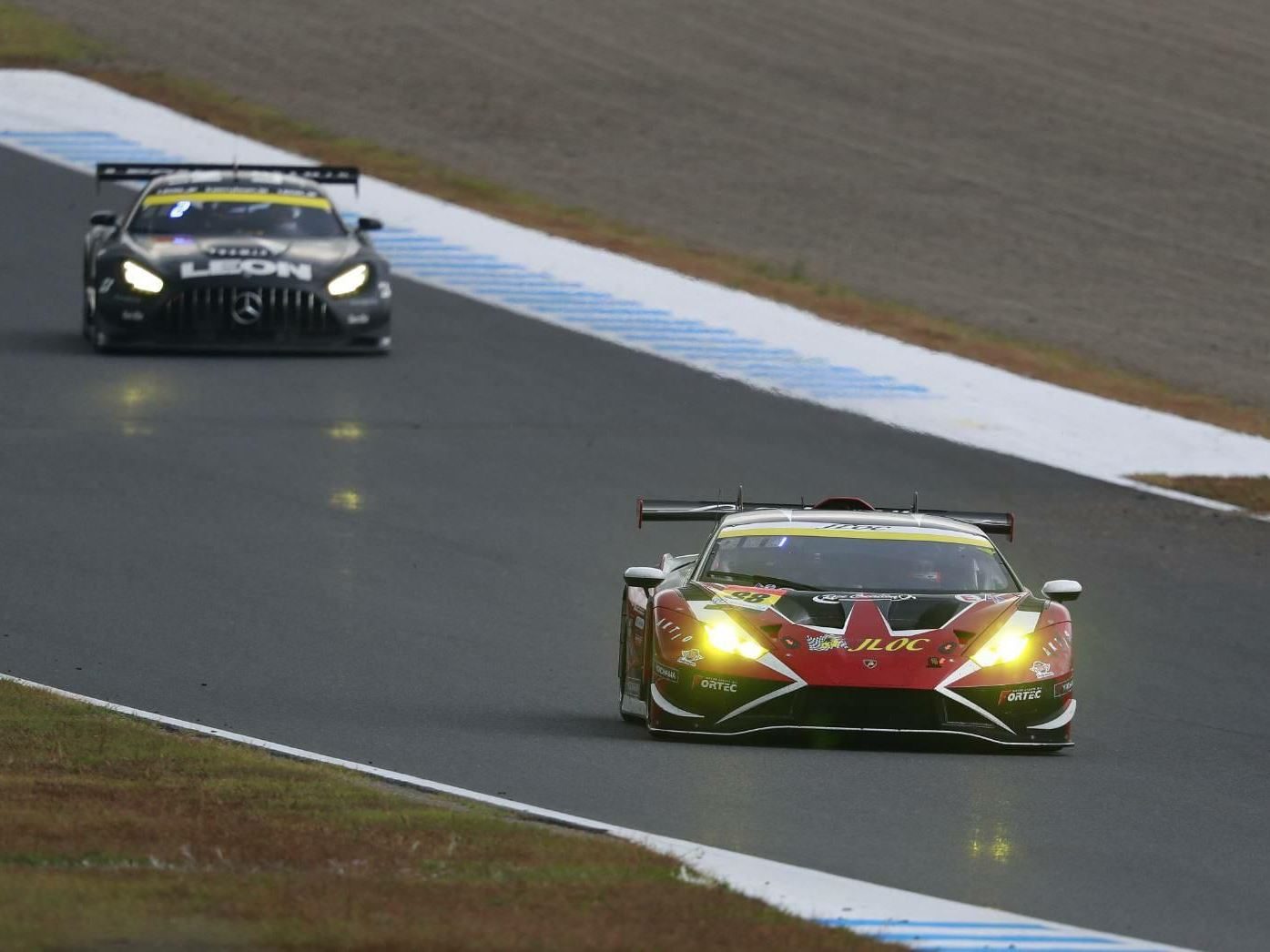
Huracán GT3 EVO2 Ends Lamborghini's Four-Year Super GT Drought at Motegi
JLOC delivered a near-perfect weekend to claim the brand's first Super GT win since 2019.
A privateer Lamborghini operation claiming outright GT300 class victory in Japan's Super GT series, against factory-backed Toyota, Nissan, Mercedes-AMG, and Porsche machinery, requires something close to a perfect weekend.
The EVO2's underlying engineering delivers on its promise
The Huracán GT3 EVO2 joined the Super GT championship only mid-season, yet its performance at Motegi spoke to something deeper than a single good setup.
A decade-old platform, substantially reworked
The Huracán GT3 platform first appeared a decade ago with a naturally aspirated V10 in a rear-wheel-drive chassis, and the EVO2 revision represents the most substantial rework in the car's competitive life.
Kogure and Motojima celebrate JLOC's Motegi victory
JLOC functions as a dedicated Lamborghini privateer team with a history stretching back well over a decade in Super GT, persisting through the entire 2020-to-2022 winless stretch.
The Huracán GT3's final season on track
The Temerario GT3 replaces the Huracán with a twin-turbocharged V8 and an entirely new chassis, meaning customer teams must adapt to a fundamentally different powerband and altered weight distribution.
Squadra Corse's engineering discipline in the Huracán's twilight
Squadra Corse demonstrated it can extract race-winning performance from the Huracán platform even in its final season, squeezing competitive gains from a ten-year-old architecture through aerodynamic refinement and intake optimization.
JLOC's pit garage at Motegi before the season finale
Drivers Takashi Kogure and Yuya Motojima piloted the #88 Lamborghini Huracán GT3 EVO2 to a commanding win, finishing more than seven seconds clear of the chasing pack despite a late rain shower.
Privateer credibility no press event can replicate
When a privateer wins against factory-adjacent entries, the car's engineering credibility rises in a way that no press event or test-day demonstration can replicate.
From naturally aspirated V10 to the Temerario's twin-turbo V8
The transition from naturally aspirated V10 to forced-induction V8 mirrors what happened on the road-car side with the Temerario, though the GT3 version drops the hybrid system entirely to meet racing regulations.
The Huracán GT3's decade-long legacy sets the bar for its successor
The Huracán GT3's career produced victories at Daytona, Spa, Bathurst, and now one final time in Japan, setting a formidable standard that the Temerario GT3 must match from day one.