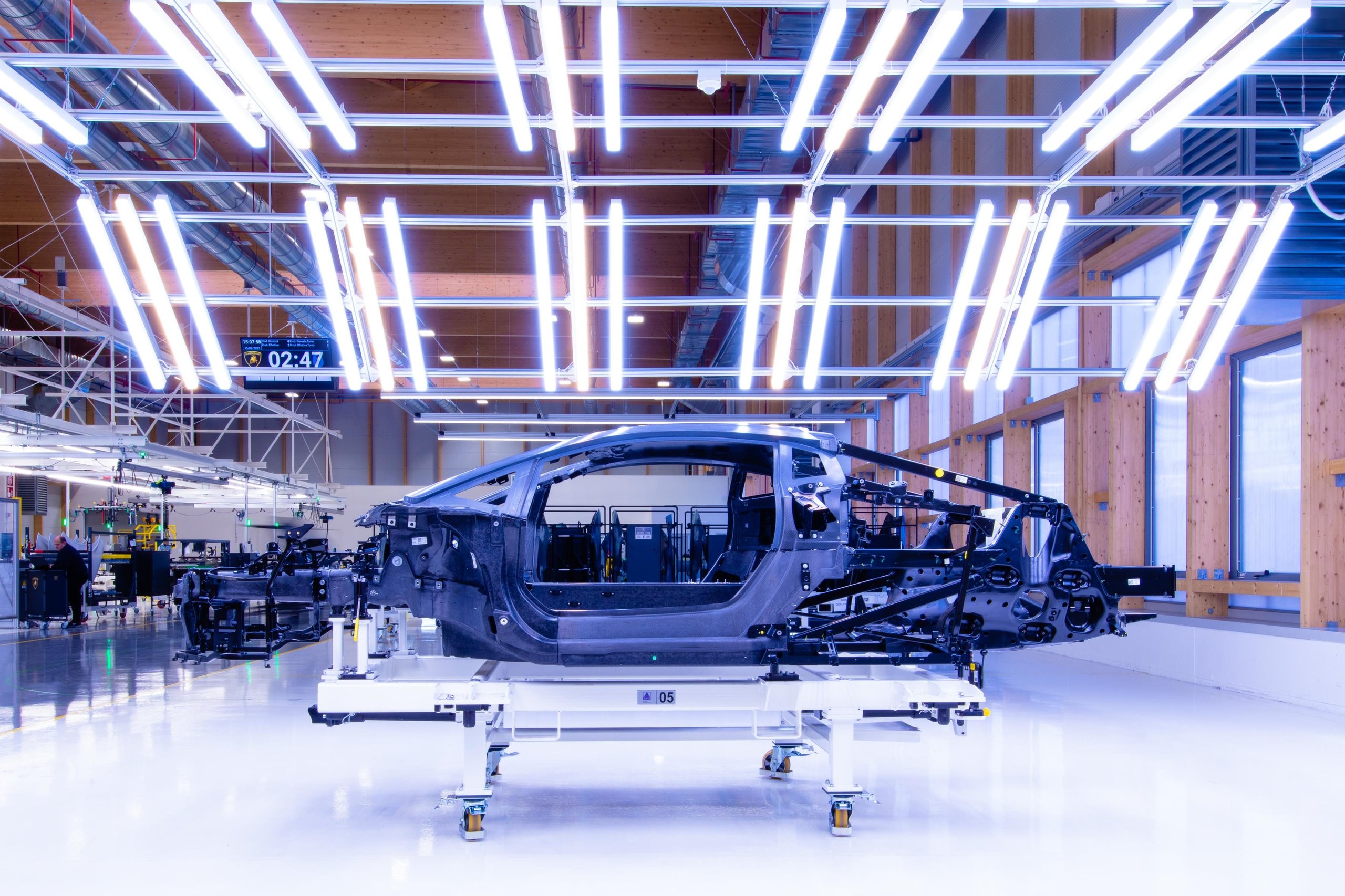
How Lamborghini Actually Builds the Revuelto
Inside the €150 million factory overhaul powering the brand's first V12 plug-in hybrid.
Building a 1015 CV plug-in hybrid around a one-piece carbon fiber tub, three electric motors, a battery pack, and a new eight-speed dual-clutch gearbox is a fundamentally different manufacturing problem than anything Lamborghini has tackled before.
Bespoke specification, one car at a time
Each Revuelto leaving Sant'Agata carries a unique specification, from paint and interior trim to carbon fiber weave patterns, which is why a rigid, fully automated line would never work here.
Human-priority philosophy on the assembly line
Lamborghini's expanded CFK plant now spans 16,200 square meters, and it operates with the same philosophy as the main assembly line — machines handle repetitive layup and pressing while operators manage quality and process decisions.
AGVs keeping the line moving
Automated Guided Vehicles transport materials and partially assembled vehicles between stations, keeping components flowing to operators without interrupting their work.
Manifattura Next Level in action
Full production of the Revuelto now runs under a completely overhauled manufacturing framework called Manifattura Lamborghini Next Level, backed by 172,000 square meters of new facility space in Sant'Agata Bolognese.
Automation guided by human authority
A Manufacturing Executive System guides operators step by step through each assembly task, but the operator can override the machine at any point, stopping automated sequences to intervene manually.
From racing monocoque to repeatable production
Lamborghini's Forged Technology turns carbon fiber once reserved for hand-laid racing monocoques into a repeatable production component without sacrificing structural ambition.
Cobots and operators sharing the factory floor
Collaborative robots work across engine assembly, main assembly, and upholstery lines, handling repetitive tasks like windshield installation while sharing the same physical space as human operators.
Digital traceability across every station
Every step on every car is digitally logged by the MES system, giving Lamborghini better tools to catch problems early than any previous production system the brand has used.