Revuelto Production in Full Swing, and the Backlog Tells the Story
Orders for the Lamborghini Revuelto currently cover more than two years of production. That backlog alone would be newsworthy for any supercar, but the more revealing detail is how Lamborghini plans to fulfill it. Full production of the brand’s first V12 plug-in hybrid is now running under a completely overhauled manufacturing framework called Manifattura Lamborghini Next Level, a system the company also refers to as Manifattura 4.0.
The commitment behind that name is tangible: Lamborghini expanded its facilities by 172,000 square meters and invested €150 million in Sant’Agata Bolognese. Around 500 production operators work on the Revuelto between the carbon fiber plant and final assembly. The Aventador line never required anything close to this level of infrastructure overhaul, and the reason is straightforward. Building a 1015 CV plug-in hybrid around a one-piece carbon fiber tub, three electric motors, a new eight-speed dual-clutch gearbox, and a battery pack is a fundamentally different manufacturing problem than bolting a naturally aspirated V12 into an aluminum and carbon structure. Manifattura Next Level exists because the old factory simply could not have built this car.
Where Human Touch Meets Robotic Precision
Lamborghini keeps repeating one phrase about Manifattura Next Level: the human stays at the center. That sounds like corporate boilerplate until you examine how the system actually functions.
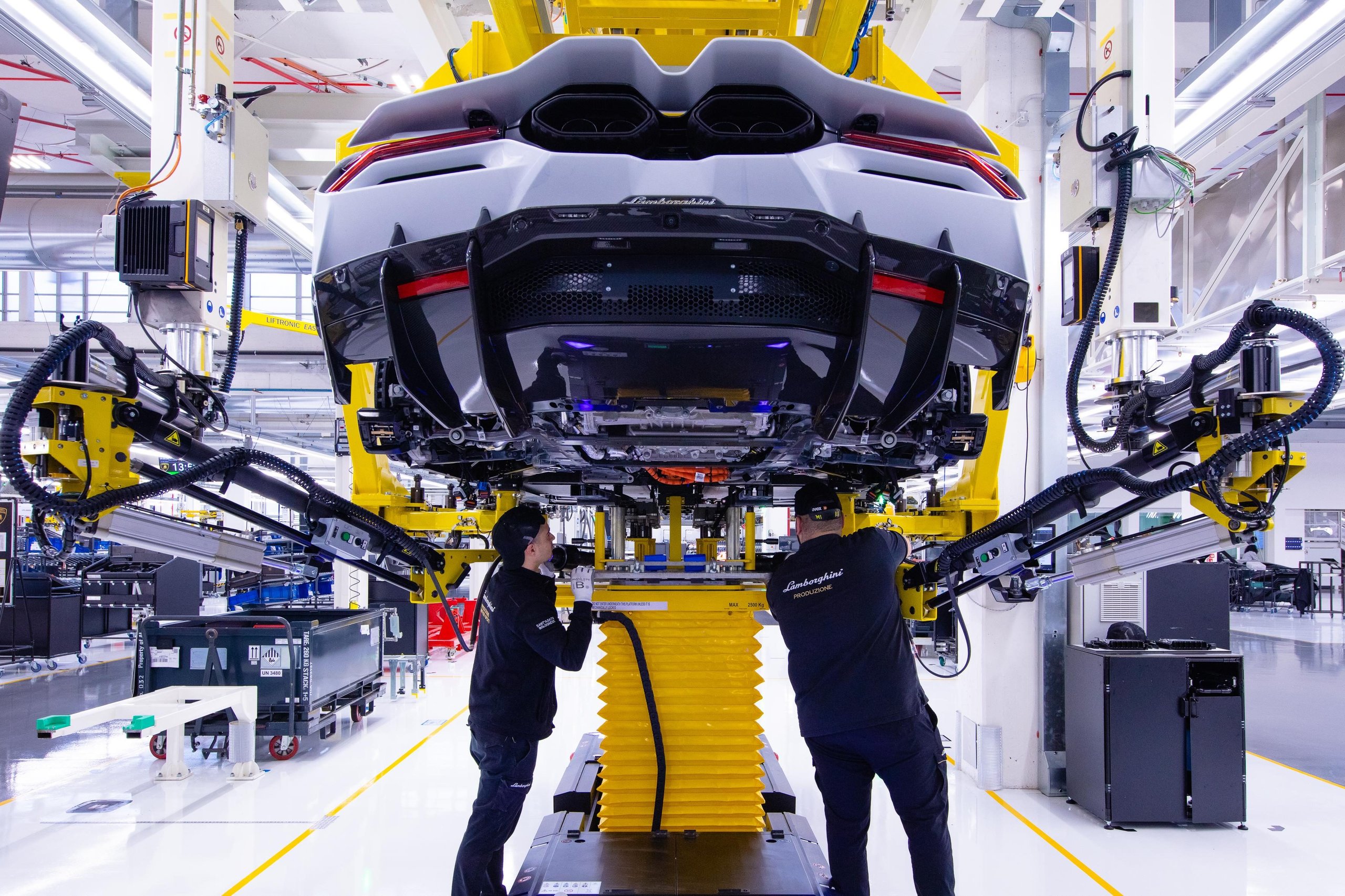
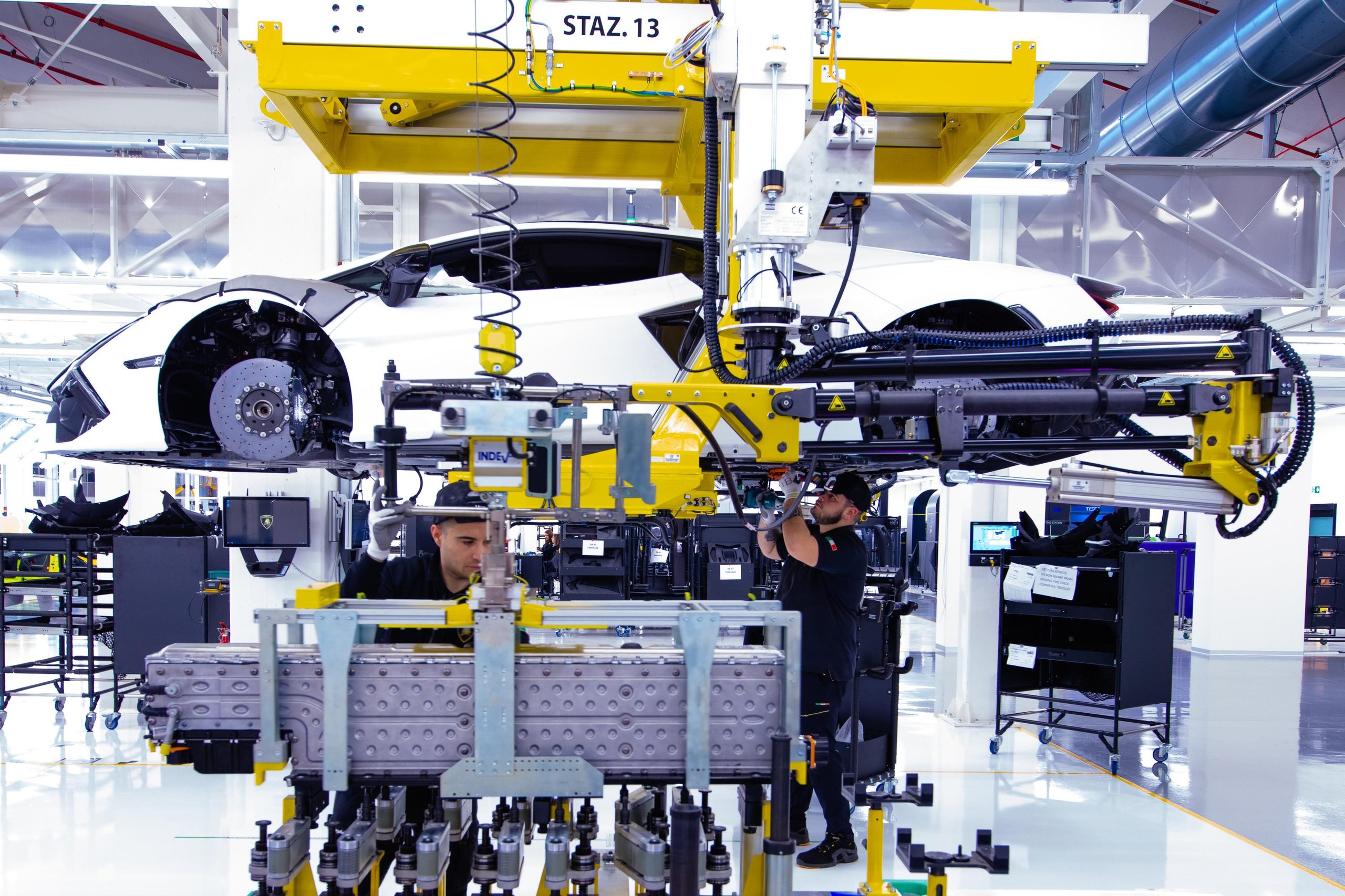
Every workstation on the Revuelto line is managed by a Manufacturing Executive System (MES) that guides operators step by step through each assembly task. Each operator wears a personal wristband to authenticate into the system and interacts through touchscreen monitors or tablets. Crucially, the operator can override the machine at any point, stopping automated sequences to intervene manually. The MES tracks, suggests, and records, but a human decides when to deviate.
That flexibility exists for a practical reason: Lamborghini builds highly customized vehicles. Each Revuelto leaving Sant’Agata carries a unique specification, from paint and interior trim to carbon fiber weave patterns. A rigid, fully automated line cannot accommodate that level of variation without constant reprogramming. The MES approach lets Lamborghini scale production speed while preserving the bespoke flexibility owners expect from a car in this price bracket. One report from Car and Driver notes a base price exceeding $625,000, with tested examples approaching $730,000. At that level, buyers reasonably expect a car that feels individually assembled, not stamped out. The human-centered philosophy is not sentimentality; it is the only way to reconcile volume with personalization.

Skilled technicians meticulously assemble the front components of a Lamborghini Revuelto on the advanced production line.
Forged Technology and the One-Piece Carbon Fiber Tub
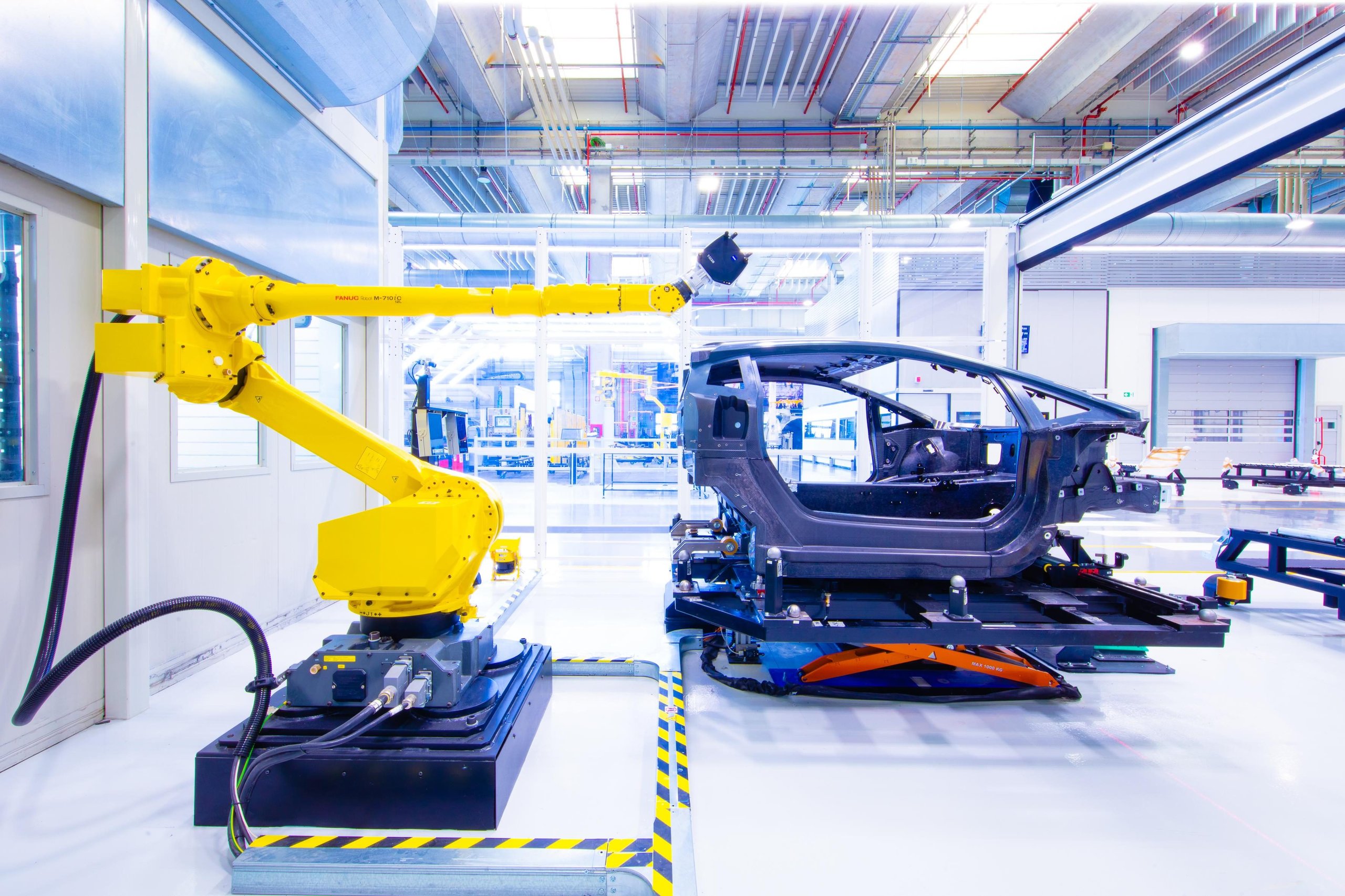
Carbon fiber forms both the Revuelto’s monofuselage chassis and a significant portion of its body panels. The key manufacturing innovation is Lamborghini Forged Technology, a process that produces the tub as a single piece through what the company describes as total industrialization.
Forged carbon fiber uses chopped carbon fiber strands compressed under heat and pressure rather than the traditional method of layering woven carbon sheets by hand. The result looks different, that distinctive marbled texture versus a clean weave pattern, but offers comparable stiffness at lower production cost and, critically, with more repeatable quality. Producing the entire tub in one shot eliminates bonding joints between separate panels, which are potential weak points in a crash structure.
Lamborghini says the Revuelto’s extensive use of carbon fiber and ultralight materials delivers the best power-to-weight ratio in the brand’s history: 1.75 kg/CV. Car and Driver’s instrumented test describes the front subframe as entirely forged carbon fiber, replacing the aluminum used on the Aventador. The CFK plant where all of this happens now spans 16,200 square meters after the expansion, and it operates with the same human-priority philosophy as the main assembly line: machines handle repetitive layup and pressing while operators manage quality and process decisions. The carbon fiber story, in other words, is not separate from the Manifattura Next Level story. It is the clearest proof that the system works, turning a material once reserved for hand-laid racing monocoques into a repeatable production component without sacrificing structural ambition.

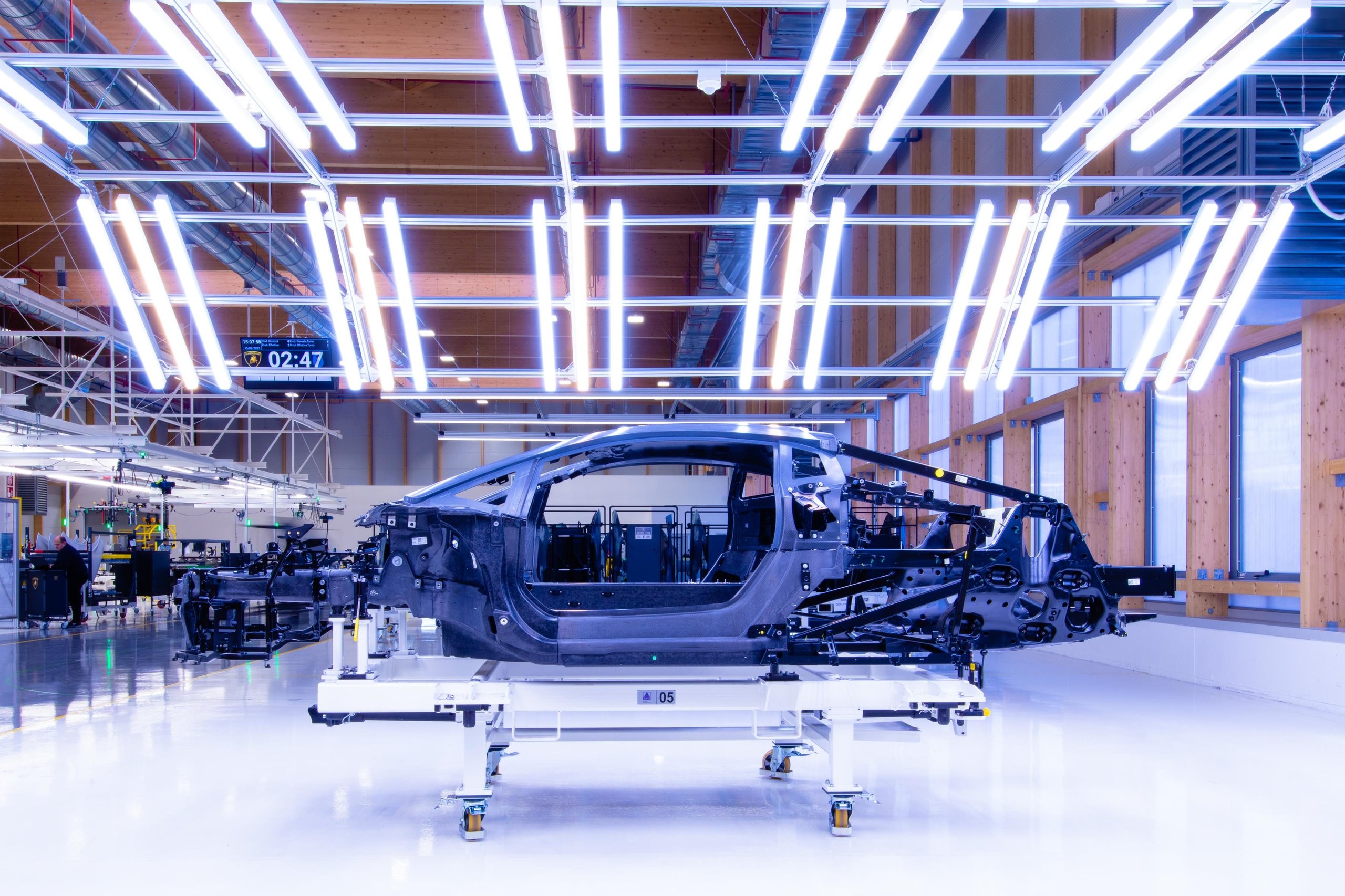
A robotic arm precisely works on the advanced carbon fiber monocoque of a Lamborghini Revuelto.
Cobots, AGVs, and the Tech Running the Line
Two specific technologies define the automation layer that supports those 500 operators. Collaborative robots (cobots) work across engine assembly, main assembly, and upholstery lines, handling repetitive tasks like windshield installation. Unlike traditional industrial robots caged behind safety barriers, cobots occupy the same physical space as human operators, adjusting force and speed in real time. Lamborghini says they vastly reduce the proportion of inaccuracies in repetitive assembly steps.
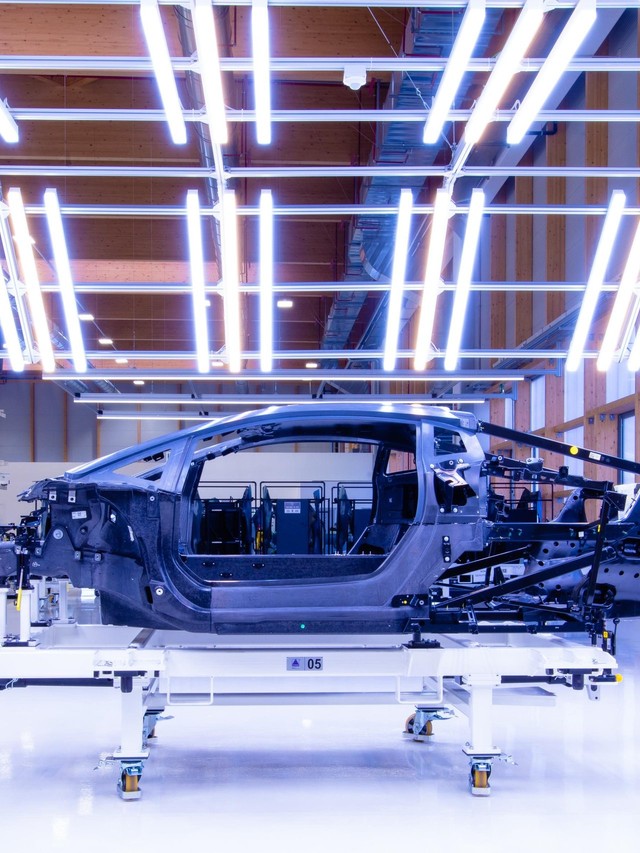
Automated Guided Vehicles (AGVs) transport materials and partially assembled vehicles between stations. These autonomous sleds follow programmed routes across the factory floor, removing the logistical bottleneck of manual material handling. In factory images, an AGV is visible moving toward a Revuelto chassis positioned under inspection lighting, illustrating how the system keeps components flowing to operators without interrupting their work.
For prospective buyers wondering whether all this automation dilutes the “hand-built” character: the answer appears to be no, but with a caveat. Forum discussion around early Revuelto deliveries is mixed. Multiple owners on enthusiast forums describe software bugs in the infotainment system and occasional transmission issues in early production units, which Lamborghini addressed through warranty replacements and updates. These are launch-phase growing pains common to complex new platforms, not evidence that automation compromised build quality. The MES tracking system should make quality control more traceable over time, since every step on every car is digitally logged.

An autonomous guided vehicle navigates the factory floor towards a Lamborghini Revuelto chassis under intense inspection lighting.
What Manifattura Next Level Means for Lamborghini’s Electrified Future
The Revuelto is the flagship product of the second phase of Lamborghini’s Direzione Cor Tauri electrification strategy, which represents a total investment of €1.9 billion. The company targets hybridization of the entire model range by 2024 and plans for its first fully electric model, a 2+2 grand tourer, to debut in 2028.
The strategic question is whether the Manifattura Next Level infrastructure was built solely for the Revuelto or designed to scale across future models. Lamborghini has not confirmed this explicitly, but the investment math suggests the latter. You do not spend €150 million and add 172,000 square meters of factory space for a single model line. The MES framework, cobot integration, and AGV logistics are modular by nature; adapting them for the Temerario or the eventual electric grand tourer would require reconfiguration, not a ground-up rebuild.
This positions Lamborghini differently from competitors navigating similar transitions. Ferrari builds the SF90 Stradale at Maranello using its own blend of automation and craft, but Ferrari has not publicly detailed a comparable named production system or disclosed equivalent investment figures for hybrid-specific manufacturing upgrades. McLaren’s Artura production at the McLaren Technology Centre in Woking relies on a carbon fiber monocell architecture, but McLaren’s well-documented financial challenges over the past several years raise questions about its ability to invest at a comparable scale.
For owners and buyers on the waiting list, the practical takeaway circles back to the thesis running through every station on the Revuelto line: Lamborghini built the factory to match the complexity of the car. Whether that translates into fewer early-production issues as the line matures is the real test, and the digital traceability baked into the MES system gives the company better tools to catch problems early than any previous production system the brand has used.

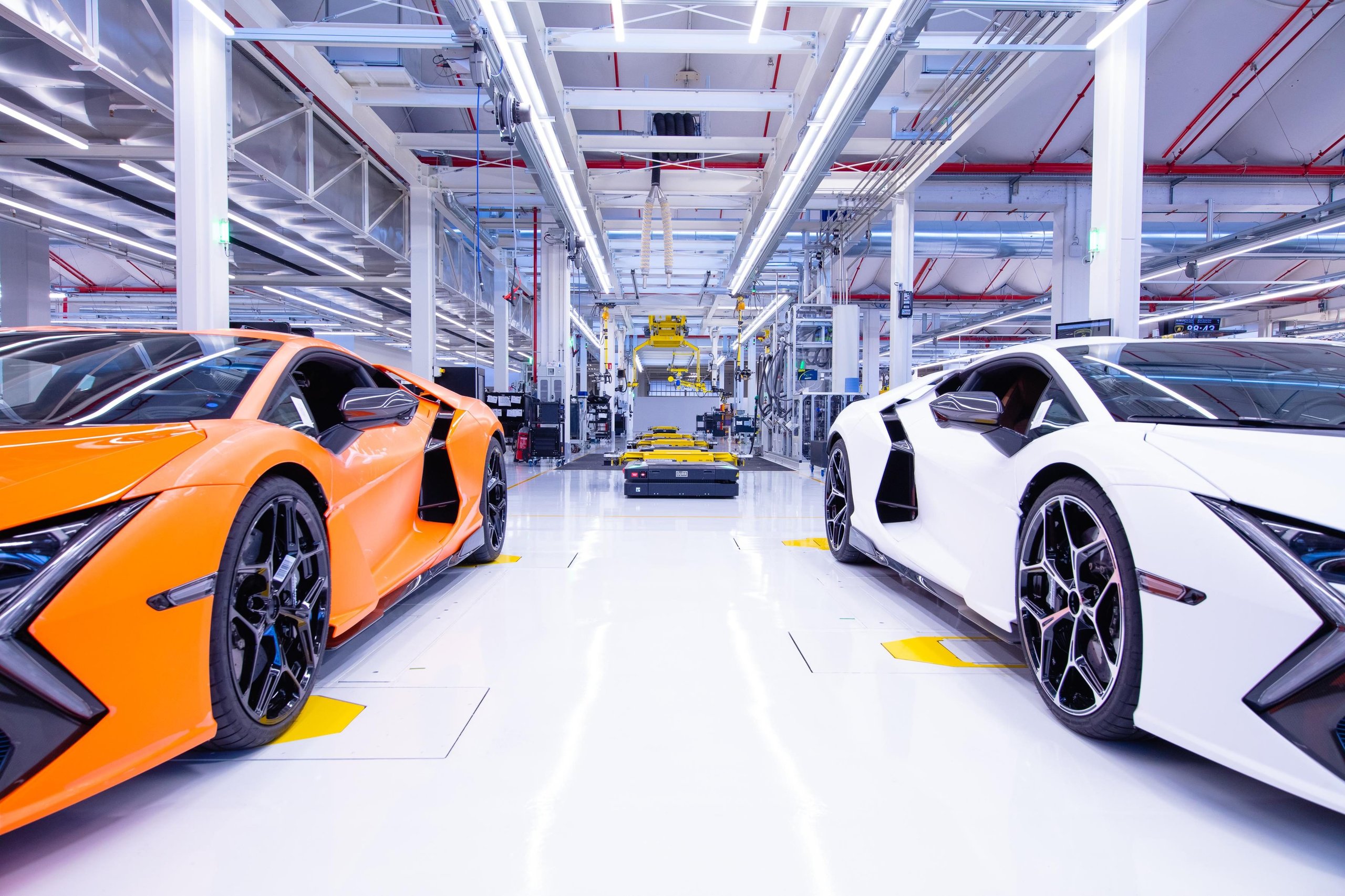
A comprehensive view of the modern Lamborghini Revuelto production line, showcasing various assembly stages.
Gallery