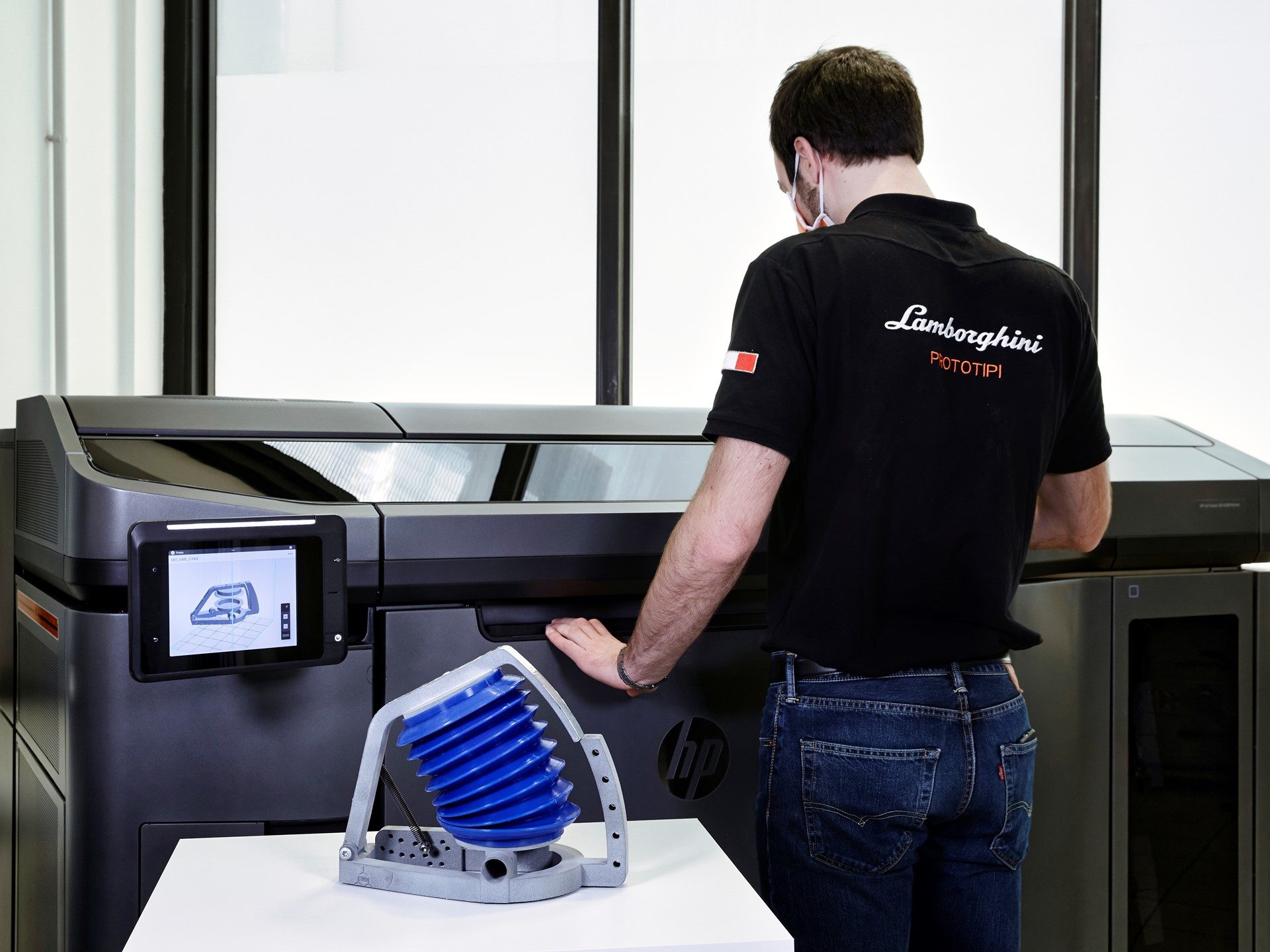
How Lamborghini's 3D Printing Lab Went from Supercar Prototypes to Breathing Simulators in Two Weeks
A supercar prototyping facility became a medical-device production line in fourteen days.
Lamborghini's R&D department in Sant'Agata Bolognese co-engineered breathing simulators for Siare Engineering International Group, Italy's leading ventilator manufacturer, using a 3D printing lab originally built to prototype supercar parts.
The technology behind the pivot
The lab's HP Jet Fusion 3D 4200 printer uses Multi Jet Fusion technology, which lays down nylon powder, applies a fusing agent, and passes an infrared energy source across each layer to achieve precision of 0.08 mm.
The supercars this printer normally serves
The same HP printer now producing breathing simulators ordinarily prints prototype intake manifold components, interior trim pieces, and aerodynamic test parts for cars that might see only a few hundred units.
Supercar tolerances meet medical-device demands
Lamborghini says the simulator was designed, produced, and validated within a two-week window, working closely with Siare's engineering team to define acceptance criteria before the first print job ran.
Engineering identity beyond the supercar
Lamborghini's separate collaborative research project with the Houston Methodist Research Institute, exploring biocompatibility of carbon-fiber composites for potential medical implant applications, suggests the company sees long-term strategic value in applying its materials expertise beyond cars.
Why low-volume production was the advantage
Lamborghini builds roughly 10,000 cars per year, a volume low enough that its R&D department relies heavily on additive manufacturing for functional prototypes, jigs, and short-run parts rather than investing in hard tooling for every iteration.
Lamborghini's manufacturing roots
Polycarbonate medical visors produced on the same printer addressed a higher-volume need, and polycarbonate was a logical material choice because it is optically clear, impact-resistant, and already well understood in Lamborghini's composites department.
Every department joined the effort
Lamborghini's Upholstery Department, the same team that stitches Alcantara headliners and hand-finishes leather interiors, began producing surgical masks while the composites facility and R&D department printed polycarbonate face shields.
Motorsport discipline, medical results
Designing the validation protocol alongside the part itself is standard practice in motorsport programs like Super Trofeo and GT3, and the breathing simulator project proved that discipline translates directly outside the automotive domain.