Supercar Prototyping Meets Ventilator Testing
When Italy’s COVID-19 crisis demanded that every capable manufacturer step forward, Lamborghini’s Research and Development department in Sant’Agata Bolognese answered with the most unlikely asset in its arsenal: a 3D printing laboratory built to prototype supercar parts. Within two weeks, that lab had co-engineered and produced breathing simulators for Siare Engineering International Group, Italy’s leading ventilator manufacturer, while simultaneously turning out 3D-printed medical visors in polycarbonate. The collaboration paired two Emilia-Romagna companies occupying opposite ends of the industrial spectrum, one building supercars and the other building life-support equipment, yet both grounded in the same core competency: precision manufacturing under pressure.
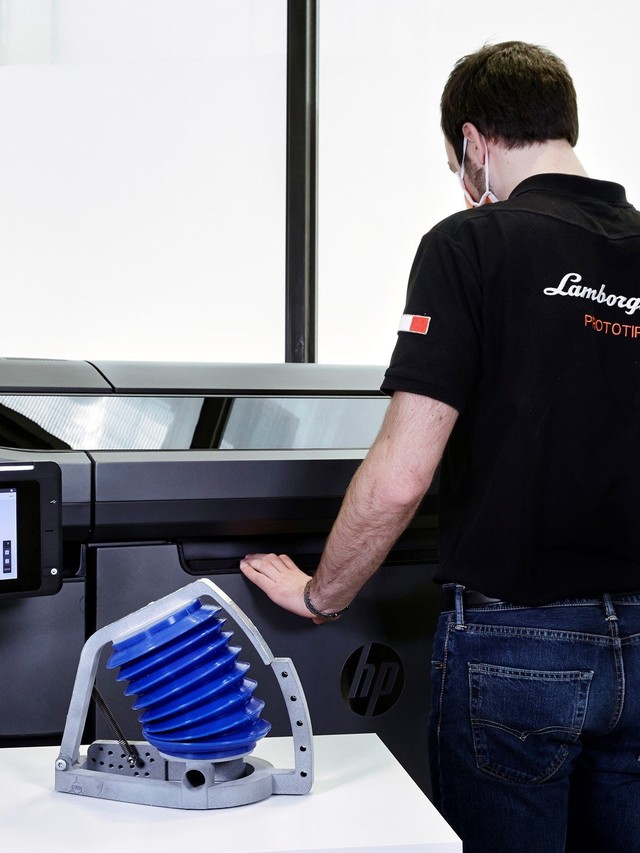
The breathing simulator itself serves a specific and critical function. Lamborghini says it allows technicians to perform an initial evaluation of a ventilator’s performance before the unit moves to a final, comprehensive test using certified equipment. It acts as a quality gate, a functional check that catches problems before the expensive final validation stage. For a ventilator manufacturer scrambling to scale output during a national emergency, that kind of upstream screening tool saves time and prevents defective units from consuming scarce certified test rigs.
What elevates this beyond a corporate goodwill gesture is the timeline. Lamborghini says the entire process of designing, producing, and validating the simulator took just two weeks. Automotive prototype cycles for a single carbon-fiber aerodynamic component can stretch across months. Compressing design, print, and medical validation into fourteen days required the kind of iterative rapid-prototyping workflow that Lamborghini’s R&D team practices daily on supercar parts, only now pointed at a radically different problem. That speed is the thread connecting every aspect of this story: the same operational muscle that lets Lamborghini develop race-spec components on tight timelines proved transferable to crisis manufacturing.
The Engineering Behind the Pivot
The machine at the center of the effort is an HP Jet Fusion 3D 4200 printer running Multi Jet Fusion (MJF) technology, capable of printing with a precision level of 0.08 mm. To put that number in perspective, 0.08 mm is roughly the thickness of a single sheet of standard printer paper. When you are building a device that must accurately simulate the mechanical behavior of human lungs, that kind of dimensional fidelity is not optional. A breathing simulator with sloppy tolerances would give ventilator testers misleading data, defeating its entire purpose.
MJF works differently from the stereolithography or fused-deposition methods most people picture when they hear “3D printing.” Rather than tracing a laser or extruding filament, MJF lays down a thin bed of nylon powder, selectively applies a fusing agent, then passes an infrared energy source across the entire layer. The result is parts with more uniform mechanical properties and finer surface finish than many competing additive processes, which explains why HP’s industrial machines appear in aerospace and medical applications alongside automotive prototyping labs.
Lamborghini optimized the simulator’s components to sustain a production rate of 18 units per week. That number sounds modest until you consider that each simulator is a functional test instrument, not a disposable consumer product. Eighteen per week, sustained, gives Siare a meaningful supply of screening tools to keep pace with its own accelerated ventilator output. The polycarbonate medical visors running on the same printer represent a simpler geometry but a higher-volume need, and polycarbonate was a logical material choice: optically clear, impact-resistant, and already well understood in Lamborghini’s composites department, where it appears in various interior and prototype applications.
Why Lamborghini’s R&D Was Uniquely Positioned
The more revealing question behind this initiative is not whether Lamborghini wanted to help, but why it could execute so quickly when many larger manufacturers struggled to retool for medical production at all.
The answer sits in the nature of low-volume supercar development. Lamborghini builds roughly 10,000 cars per year, a fraction of what mass-market automakers produce. That constraint means its R&D department relies heavily on additive manufacturing for functional prototypes, jigs, fixtures, and short-run production parts rather than investing in hard tooling for every iteration. The same HP printer now producing breathing simulators ordinarily prints prototype intake manifold components, interior trim pieces, and aerodynamic test parts for cars that might see only a few hundred units. One report indicates Lamborghini used 3D printing for bridge manufacturing on Gallardo parts as early as 2003, which would place the company’s additive manufacturing experience at nearly two decades by the time the pandemic arrived. Years of daily practice with rapid iteration on supercar components created exactly the institutional reflexes needed to compress a medical device program into fourteen days.
Prior to the breathing simulator project, Lamborghini had already converted sections of its Sant’Agata Bolognese plant to produce surgical masks and protective shields. The Upholstery Department, the same team that stitches Alcantara headliners and hand-finishes leather interiors, began producing masks, while the composites facility and R&D department printed polycarbonate face shields. That earlier effort established the internal logistics and safety protocols for running medical production inside an automotive facility, making the more complex breathing simulator project feasible on a compressed timeline.
The broader Volkswagen Group connection also deserves mention, even though Lamborghini has not detailed specific resource sharing for this initiative. Lamborghini’s access to VW Group engineering infrastructure, shared materials databases, supplier relationships, and validation frameworks gives it a structural advantage that independent rivals simply do not possess. Whether VW Group resources played a direct role in the breathing simulator project remains unconfirmed, but the underlying R&D ecosystem that enabled Lamborghini to maintain an industrial-grade 3D printing lab in the first place is partly a product of that relationship.

A Lamborghini 'PROTOTIPI' employee operates an HP 3D printer, showcasing a prototype part for medical equipment. Image: Automobili Lamborghini.
Supercar Tolerances vs. Medical Device Demands
For anyone who follows automotive engineering, an obvious question arises: how do the precision requirements for a breathing simulator compare to those for supercar components?
They overlap more than you might expect, though the validation burden differs. A carbon-fiber aerodynamic element on a Huracán or Aventador demands tight dimensional tolerances because airflow behavior changes meaningfully with fractions of a millimeter of surface deviation. The breathing simulator demands comparable dimensional accuracy for a different reason: it must replicate the compliance and resistance characteristics of human lung tissue closely enough that a ventilator’s sensors respond as they would to a real patient. Get the geometry wrong, and the simulator either passes a faulty ventilator or rejects a functional one. In both cases, 0.08 mm precision is not an academic boast but a functional requirement.
Where the two worlds diverge is in regulatory validation. Automotive prototype parts go through internal engineering sign-off and, in some cases, homologation testing for crash or emissions standards. Medical devices, even test instruments like a breathing simulator, require clinical validation against established performance benchmarks. Lamborghini says the simulator was validated within the two-week development window, which suggests the company worked closely with Siare’s engineering team and likely with clinical advisors to define acceptance criteria before the first print job ran. That kind of concurrent engineering, designing the validation protocol alongside the part itself, is standard practice in motorsport development programs where calendar time is the scarcest resource. The Super Trofeo and GT3 programs demand exactly this discipline, and the breathing simulator project proved it translates directly outside the automotive domain.
What This Signals About Lamborghini’s Engineering Identity
Lamborghini’s brand identity rests on emotional pillars: dramatic design, visceral sound, extreme performance. The breathing simulator project adds a quieter but arguably more substantive dimension: engineering versatility. Few competitors demonstrated the ability to design, print, and validate a functional medical test instrument in two weeks during the pandemic’s early months. Ferrari contributed financial donations and logistical support, which mattered enormously, but the hands-on, R&D-driven manufacturing pivot Lamborghini executed speaks to a different organizational capability, one rooted in the daily rhythms of low-volume supercar prototyping rather than in crisis-specific generosity.
Whether this experience will shape future Lamborghini R&D strategy remains an open question. The company has a separate collaborative research project with the Houston Methodist Research Institute, initiated before the pandemic, exploring biocompatibility of carbon-fiber composites for potential medical implant applications. That partnership suggests Lamborghini sees long-term strategic value in applying its materials expertise beyond cars, not just as a crisis response but as a deliberate diversification of its engineering portfolio.
For owners and prospective buyers, none of this changes the exhaust note or the way an Aventador SVJ feels at 8,000 rpm. But it reinforces something the spec sheets and lap times alone cannot convey: the depth of engineering talent and manufacturing capability sitting behind the badge. The same team, the same printer, the same facility that prototypes the next Lamborghini supercar proved it could build medical instruments under emergency conditions with clinical-grade precision. As the brand navigates an era of hybrid powertrains and increasingly complex vehicle architectures, that kind of R&D adaptability will matter more than ever. The two-week breathing simulator sprint was not a detour from Lamborghini’s engineering identity. It was a concentrated expression of it.


