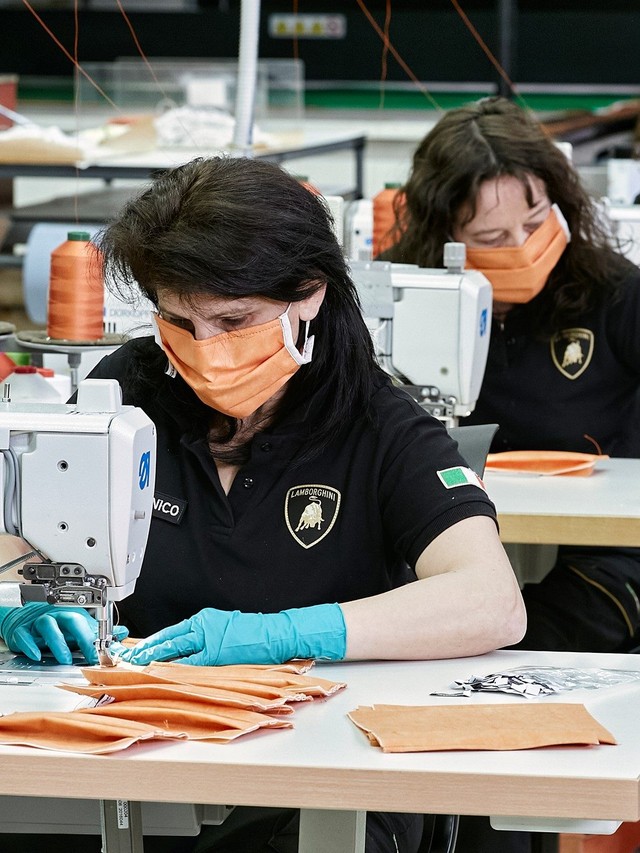
Supercar Sewing Machines, Repurposed for a Hospital
Automobili Lamborghini converted departments of its Sant’Agata Bolognese production plant to manufacture surgical masks and protective plexiglass shields, donating all output to the Sant’Orsola-Malpighi Hospital in Bologna. The saddlery department, where artisans normally stitch Alcantara headliners and hand-finish leather interiors for the Aventador, Huracán, and Urus, began producing 1,000 surgical masks per day. Simultaneously, 3D printers housed in the carbon fiber production plant and the Research and Development department turned out 200 protective medical shields daily.
The story here is not simply one of corporate goodwill. Lamborghini did not write a check or lend warehouse space. It deployed two of its most distinctive manufacturing competencies, the precision handwork of its interior artisans and the additive manufacturing capability of its composites division, toward an entirely different product category. That pivot reveals something about the factory in Sant’Agata Bolognese that press releases about lap times and power figures rarely capture: the depth and adaptability of the skills concentrated inside those walls. The initiative received approval and support from the Emilia-Romagna Region and was carried out in collaboration with the University of Bologna, whose Department of Medical and Surgical Sciences oversaw validation testing of the devices before they reached the hospital.
From Ad Personam Stitching to Surgical-Grade Fabric
Lamborghini’s saddlery is one of the least visible and most critical departments in Sant’Agata Bolognese. These are the workers who execute the bespoke interior commissions of the Ad Personam customization program, where a single car’s cabin can require dozens of hours of hand-stitching across contrasting leather hides, Alcantara panels, and carbon fiber trim. The dexterity required to produce consistent, tight seams on compound-curved supercar surfaces translates, perhaps unexpectedly, to the kind of precision needed for layered surgical mask construction.
The masks themselves are not exotic objects. They are functional medical supplies, produced under time pressure for a hospital dealing with an overwhelming caseload. Yet Lamborghini could redirect this workforce so rapidly because the core skill, disciplined, repetitive handwork at a high standard of consistency, was already embedded in the department’s daily routine. Most coverage of Lamborghini’s manufacturing focuses on the paint shop, the engine assembly line, or the carbon fiber autoclaves. The saddlery, by contrast, operates with the quiet discipline of a tailoring house. Repurposing those skills for medical textiles required adapting patterns and materials, not retraining an entire workforce from scratch.
For enthusiasts who follow how these cars are actually built, the detail worth noting is that the same hands responsible for the stitching on a supercar interior were, during this period, producing protective equipment at a rate of over a thousand units per day. That throughput from a bespoke workshop is a quiet demonstration of manufacturing discipline, and a reminder that Lamborghini’s artisan workforce is not merely decorative. It is a genuine production capability, one flexible enough to serve a purpose no one at the factory could have anticipated.
3D Printing Shields in the Carbon Fiber Plant
The protective plexiglass shields came from a different corner of the factory entirely. Lamborghini’s carbon fiber production facility and its R&D department house industrial 3D printers used primarily for prototyping components and producing tooling for the company’s advanced composites work. These machines, designed to iterate on aerodynamic elements and structural parts, were redirected to print the frames and structural components of medical face shields.
Two hundred shields per day is not a massive number by industrial standards, but it reflects the practical throughput of additive manufacturing equipment optimized for precision rather than volume. The same 3D printing capability that allows Lamborghini to prototype a new splitter design in hours, test it, and revise it before committing to carbon fiber layup was applied to a product where fit, clarity, and comfort matter in a completely different context. Medical shields need to sit securely on a clinician’s face for hours, resist fogging, and allow unobstructed vision. The tolerances differ from those of an aerodynamic component, but the underlying manufacturing philosophy, rapid iteration on a precise physical object, carries over directly.
The University of Bologna’s involvement in validation testing added institutional rigor to the effort. Medical devices, even relatively simple ones like face shields, require confirmation that they meet protective standards before clinical use. Lamborghini did not simply produce and ship; the devices went through a formal review process overseen by the Department of Medical and Surgical Sciences. That collaboration reinforced the central point: the factory’s technical infrastructure, from sewing machines to 3D printers, was genuinely capable of producing validated medical equipment, not just symbolic gestures.
What This Reveals About Lamborghini Beyond the Badge
Corporate philanthropy from luxury brands can feel performative: a donation, a limited-edition livery, a social media campaign. Lamborghini’s approach during this period was different in a way that matters to anyone who cares about what the company actually is beneath the exhaust note and the scissor doors.
The decision to deploy specific manufacturing departments rather than simply contributing financially suggests a company that understood its most valuable asset in a crisis was not its brand equity but its people and their skills. Stefano Domenicali, then Chairman and CEO, framed the initiative around Lamborghini’s existing relationship with the Sant’Orsola-Malpighi Hospital, which he described as a longstanding collaboration involving professional health consultancy and research projects. That context matters: this was not a cold call to a random institution but an extension of an existing partnership.
“During this emergency, we feel the need to make a concrete contribution. The S. Orsola-Malpighi Hospital is an institution with which we have had a collaborative relationship for years.”
For Lamborghini owners and prospective buyers, this kind of initiative shapes the intangible dimension of the brand. Knowing that the artisans who built your car’s interior also pivoted to produce medical supplies during a national emergency adds a human layer to the ownership narrative that no spec sheet can replicate. Lamborghini’s identity rests on the character of the people and the place that produce these cars. Sant’Agata Bolognese is a small town in Emilia-Romagna, not a corporate campus. When the region needed help, the factory responded with what it knew how to do best: build things, precisely and quickly.
The Tricolore on the Factory Walls
Each evening during this period, Lamborghini illuminated its historic headquarters in Sant’Agata Bolognese with the green, white, and red of the Italian flag. It was a simple gesture, visible to the local community and shared widely on social media, that connected the company’s identity to the national moment.
The symbolism was deliberate but restrained. Lamborghini did not rebrand or launch a special edition. It lit up its building and put its workers’ skills to use. For a company whose entire mythology is built on audacity and defiance, the quiet discipline of mask production and shield printing represented a different kind of boldness: the willingness to set aside the spectacular in favor of the necessary. The same factory walls that Ferruccio Lamborghini constructed in the 1960s became a small beacon in a region hit hard by the pandemic, a reminder that the place matters as much as the product.
How Lamborghini’s Response Compared Across the Luxury Sector
Lamborghini was not the only luxury automaker to respond during this period. Across the industry, factories paused normal production as lockdowns swept through major car-producing nations. Ferrari suspended operations at its Maranello and Modena plants. Rolls-Royce and Bentley shut down their UK facilities before eventually resuming with extensive new safety protocols.
What distinguished Lamborghini’s response was the nature of the contribution. While most manufacturers focused on protecting their own workforces, a necessary and important step, Lamborghini actively repurposed its production capability to generate medical supplies for external use. The combination of artisan handwork and advanced 3D printing created a dual-track output that few other single factories could replicate in the same way. A mass-market automaker could potentially retool a stamping line, but the specific pairing of bespoke interior craftsmanship and additive composites manufacturing reflects Lamborghini’s unusual production model: low volume, high skill, and vertically integrated.
Lamborghini did not disclose the total cost of the initiative or how long the medical production continued alongside the factory’s broader shutdown. Those details remain unknown. What the company did confirm, through both its official communications and corroborating coverage, is that the effort was real, validated by an academic institution, and directed at a hospital with which Lamborghini already maintained a working relationship. In a moment when corporate messaging often outpaced corporate action, Lamborghini’s response was grounded in tangible output from identifiable people working specific machines in a specific factory. That distinction, the gap between gesture and genuine manufacturing capability, is ultimately what this story is about.
Gallery


