Squadra Corse Takes Its Factory Lineup to a Virtual Grid
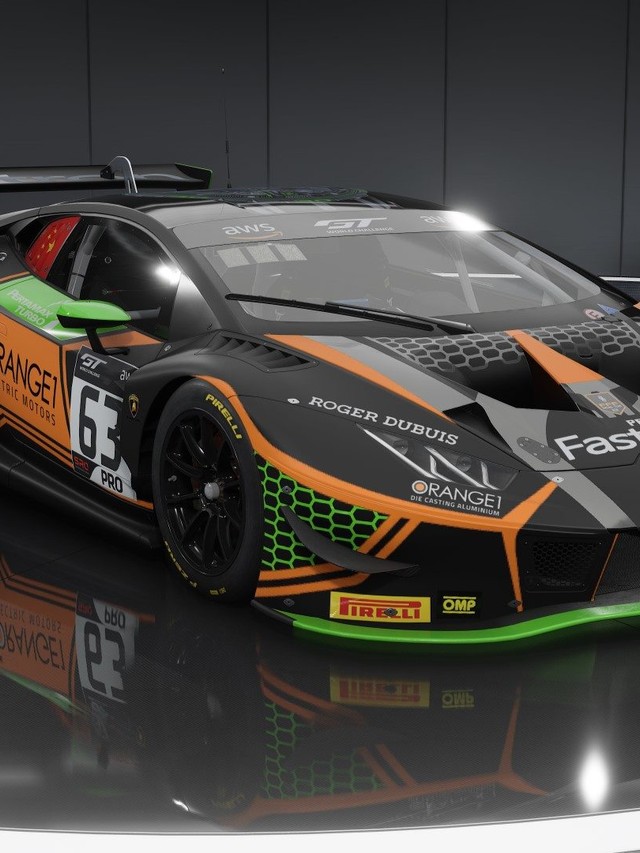
In April 2020, Lamborghini Squadra Corse committed three contracted Factory Drivers to the inaugural SRO E-Sport GT Series, marking one of the first times a major supercar manufacturer deployed its professional racing roster in a competitive online championship rather than simply lending its brand name. Andrea Caldarelli, the reigning Blancpain GT Series overall champion and 2020 Daytona 24 Hours winner, took the #63 Orange1 FFF Racing Team Huracán GT3 EVO. Dennis Lind slotted into the #563 car under the same livery, while Albert Costa, fresh off his 2019 International GT Open title, drove the #163 in Emil Frey Racing colors.
Organized by SRO Motorsports Group and powered by Assetto Corsa Competizione, the series opened at a virtual Silverstone on April 24th. Lamborghini says the championship would run five rounds plus a Grand Final, visiting digital versions of Spa, Nürburgring, and Barcelona before a final circuit chosen by public vote. Former Formula 1 driver Vitantonio Liuzzi, who competed in 81 Grands Prix between 2005 and 2011, joined as a wildcard entry in the #19 Orange1 FFF Racing Team Huracán GT3 EVO, adding a cross-discipline element to the grid.
Beyond the headline names, a deeper bench of Lamborghini-affiliated racers filled out the Pro category: former Super Trofeo Europe champion Mikaël Grenier, Alberto di Folco, Jeroen Mul, 2019 World Finals runner-up Sandy Mitchell, and Dan Wells. FFF Esports, the newly formed digital arm of FFF Racing (where Caldarelli serves as Team Principal), entered the Silver Cup class with dedicated sim racers Jaroslav Honzik and Kamil Franczak. Lamborghini was not simply sponsoring a few gamers. It placed real racing professionals alongside specialist sim drivers in a tiered competition that mirrored its real-world GT3 program’s hierarchy, a structure that would prove to be the blueprint for everything the brand did in digital motorsport afterward.
Real Racers, Virtual Nerves: What the Drivers Actually Said
The most revealing dimension of Lamborghini’s entry was the candor from its own drivers about how different sim racing felt from the real thing. Albert Costa admitted he felt more nervous behind a sim rig than in an actual GT3 car, citing the high competitive level and the unfamiliar feedback loop. Professional drivers spend years calibrating their instincts around physical g-forces, tire feel through the steering column, and peripheral vision cues. Remove all of that and replace it with a monitor and a force-feedback wheel, and even a GT Open champion can feel like a rookie.
Caldarelli acknowledged that this was his first online competition and that he had only recently received his home sim rig. For a driver who won at Daytona, the idea of cramming practice sessions on consumer hardware before a broadcast race carries a certain dry humor. Lind struck a more pragmatic tone, framing the series as a productive way to fill what he called an “exceptionally long off-season,” a polite nod to the reality that the 2020 global lockdown had grounded every professional racing calendar.
What none of the drivers said explicitly, but what the entire exercise demonstrated, is that Assetto Corsa Competizione occupies a unique position in the sim-racing ecosystem. Lamborghini’s own Squadra Corse test and race drivers use the platform for real-world preparation, which means the virtual Huracán GT3 EVO is not a casual arcade representation. The physics model is close enough that a factory driver’s lap-time instincts translate, even if the sensory feedback does not. That credibility gap between “game” and “tool” is exactly what made the SRO E-Sport GT Series viable for a manufacturer like Lamborghini rather than a marketing risk. The drivers’ willingness to compete publicly on an unfamiliar medium, and to talk openly about the discomfort, lent the whole venture an authenticity that a polished press release never could.

The Lamborghini Huracan GT3 EVO race car showcases its striking black, orange, and green livery in a pristine studio environment.
The Strategic Calculation Behind a Sim-Racing Grid Slot
Lamborghini did not enter the SRO E-Sport GT Series because sim racing was trendy. The company entered because it solved a specific problem: keeping its factory driver relationships active, its team partnerships visible, and its brand in front of an audience during a period when every physical racetrack on the calendar was dark. SRO Motorsports Group’s decision to launch an official online championship gave manufacturers a sanctioned, broadcast-quality platform rather than the informal charity races and one-off streams that had popped up across social media.
The three-class structure reinforced the blueprint Squadra Corse was testing. Factory drivers like Caldarelli and Costa competed in the Pro class, lending legitimacy. FFF Esports’ Silver Cup entry with Honzik and Franczak tested whether a real-world racing team’s brand could translate into the sim-racing community. The Am class opened a door for fans to compete on the same virtual circuits, in the same virtual cars, as their favorite professionals. That layered approach is more sophisticated than it looks on the surface, because it created a natural funnel from casual fan engagement all the way up to factory-level competition.
Rival manufacturers were pursuing different paths in the same window. Ferrari had invested heavily in its own branded e-sports series, and Porsche ran the Porsche Esports Supercup as a standalone championship on iRacing. Lamborghini’s approach differed: rather than building a proprietary series from scratch, Squadra Corse embedded its drivers into an existing, manufacturer-neutral SRO championship. The advantage was immediate credibility through the SRO brand and direct competition against other GT3 marques. The trade-off was less control over the format and less exclusive branding. Whether that was the right call depends on what came next.
From SRO Guest Appearance to a Lamborghini-Owned E-Sports Platform
What came next suggests Lamborghini treated the SRO E-Sport GT Series as a proof of concept rather than a destination. Within weeks of the SRO series, Squadra Corse launched “The Real Race,” its own one-make sim-racing championship on Assetto Corsa Competizione. One report indicates that inaugural season attracted over 2,500 drivers from 109 countries, a reach that no physical Super Trofeo round could match. The series evolved into “The Real Race, Super Trofeo Esports” and, as of its most recent seasons, continues to run annually.
The FFF Esports pipeline proved the concept worked in both directions. Following the virtual championship, FFF Esports’ top sim racers, including Silver Cup competitor Kamil Franczak, earned a real-world test outing in a Huracán EVO ST with FFF Racing. That sim-to-tarmac pathway is the kind of tangible outcome that separates a marketing exercise from a genuine talent identification program, and it traces directly back to the tiered structure Lamborghini first tested in the SRO series.
According to one report, Lamborghini formally established its own Esports Team in April 2022, naming Jordan Sherratt, Gianfranco Giglioli, and Giorgio Simonini as official sim drivers for that season. The trajectory is clear: the 2020 SRO entry was not an isolated pandemic pivot. It was the first step in building a permanent digital motorsport infrastructure that now sits alongside the Super Trofeo, GT3, and (until its recent pause) the SC 63 hypercar program in Squadra Corse’s portfolio.
For Lamborghini fans who followed the brand primarily through showroom launches and track-day videos, this evolution matters because it expanded who gets to interact with Squadra Corse’s racing ecosystem. A 19-year-old sim racer in São Paulo now has a documented pathway to a real Lamborghini cockpit. That was not true before April 2020.
The Huracán GT3 EVO’s Digital Legacy and What Comes Next
The Huracán GT3 EVO served as the exclusive virtual weapon for Lamborghini’s SRO campaign, and its selection was deliberate. The car had already proven itself across global GT3 championships, giving it a competitive baseline within Assetto Corsa Competizione’s physics engine that sim racers and real drivers alike could trust. Within the sim-racing community, the Huracán GT3 EVO is widely regarded as one of the more balanced and rewarding cars to drive on the platform, a reputation that benefits Lamborghini’s brand whether or not anyone buys a real one.
The real-world Huracán GT3 program ran for a full decade before Lamborghini confirmed its successor. As Road & Track reported, the Temerario GT3 is now ready for global racing, marking the first time Lamborghini’s customer GT3 car will move away from the naturally aspirated V10 to a twin-turbo V8 architecture. When that transition reaches Assetto Corsa Competizione or its successor platform, it will reshape how Lamborghini’s e-sports programs feel and sound. The V10 wail that defined the virtual Huracán was part of its appeal in streams and broadcasts. Whether the Temerario’s turbocharged character translates with the same visceral impact in a digital environment is a question Squadra Corse will eventually need to answer.
For prospective buyers of Lamborghini’s customer racing cars, the e-sports pipeline now functions as a discovery tool. Drivers who fall in love with the Huracán GT3 EVO in Assetto Corsa Competizione can progress through The Real Race, potentially earn a real-world test, and eventually enter the Super Trofeo ladder. That is a more structured and accessible entry point than the traditional route of showing up at a dealer with a racing budget and hoping for the best.
What Lamborghini’s E-Sports Play Means for Enthusiasts
Squadra Corse now treats digital motorsport as a permanent pillar of its racing strategy, not a novelty. The 2020 SRO E-Sport GT Series entry, with its factory drivers, team liveries, and structured class system, established the template. Everything that followed, from The Real Race to the official Esports Team, built on what Lamborghini learned from putting Caldarelli, Lind, and Costa behind sim rigs during a season when real tracks were silent.
The competitive landscape has shifted since 2020. Ferrari and Porsche both operate mature e-sports programs with dedicated infrastructure and prize pools. Lamborghini’s approach remains distinct in one important way: it emphasizes the sim-to-real pipeline more aggressively than most rivals, using virtual competition as a genuine scouting mechanism for real-world racing talent rather than purely as a fan engagement exercise.
Several questions remain unanswered. Lamborghini has not publicly disclosed viewership numbers or engagement metrics for its e-sports initiatives, making it difficult to assess the commercial return on investment. How the transition from the Huracán to the Temerario will affect the virtual racing experience is also unclear, as no timeline for updating the in-game car has been confirmed. And whether the recent pause of the SC 63 hypercar program will redirect any resources toward customer racing and digital motorsport is pure speculation at this point.
What is concrete is the pathway. A sim racer who qualified through The Real Race can now point to predecessors who earned real seat time in a Huracán EVO ST. For a brand built on aspiration and exclusivity, making the racing ladder slightly more meritocratic, even through a screen, is a meaningful shift. The SRO E-Sport GT Series was where that shift started.
| Round | Circuit | Date |
|---|---|---|
| 1 | Silverstone | April 26th |
| 2 | Total 24 Hours of Spa | May 10th |
| 3 | Nürburgring | May 17th |
| 4 | Barcelona | May 31st |
| 5 | Public Vote | June 14th |
| Grand Final | TBD | TBD |


