Squadra Corse’s First LMDh Driver Picks: Two Names from the GT Trenches
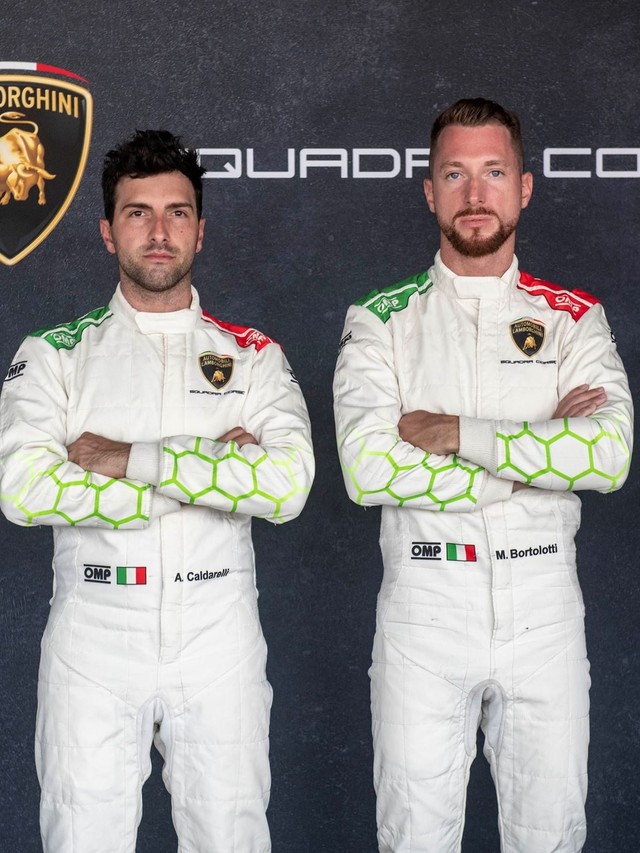
In July 2022, Lamborghini Squadra Corse named Andrea Caldarelli and Mirko Bortolotti as the first two factory drivers for its LMDh program, confirming that both would race and serve as test drivers when the SC63 prototype entered the FIA World Endurance Championship (Hypercar class) and the IMSA WeatherTech SportsCar Championship (GTP class) in 2024. The announcement carried a clear subtext: Lamborghini’s most ambitious motorsport project would be entrusted to the two drivers who defined its GT3 era, not to outside recruits with prototype pedigrees.
When a manufacturer steps into top-tier endurance racing for the first time, the instinct is often to shop for experienced prototype hands or recently displaced single-seater talent. Lamborghini chose differently. Giorgio Sanna, Lamborghini’s Head of Motorsport, framed the decision as a reward for sustained commitment, noting that both drivers contributed substantially to the brand’s historic GT results. The underlying message was strategic: the people who understand how a Lamborghini race car communicates with its driver are more valuable during a development phase than someone who already knows the Mulsanne Straight but not the brand’s engineering culture.
Bortolotti: From Italian Formula 3 to DTM Points Leader
Born in Trento in 1990, Mirko Bortolotti arrived at Lamborghini through single-seater credentials that most GT specialists lack. Lamborghini says he won both the Italian Formula 3 Championship and the FIA Formula 2 title before pivoting to GT racing, a background that gave him an unusually analytical approach to car setup. His first victories with Lamborghini came in Italian GT in 2014, driving the then-new Huracán GT3. By 2017, he had won the Blancpain GT Series championship. Back-to-back GTD class victories at the 24 Hours of Daytona in 2018 and 2019, plus the 12 Hours of Sebring in 2019, cemented his status as Squadra Corse’s most decorated endurance driver.
At the time of the LMDh announcement, Bortolotti was leading the DTM championship standings at the season’s halfway mark, proving his adaptability across formats. That versatility is precisely what a prototype development program demands. A driver who can articulate the difference between a GT3 car’s mechanical grip limitations and a prototype’s aerodynamic platform gives engineers data they can act on, not just lap times. For a team building its first Hypercar, that skill matters more than raw speed.

Mirko Bortolotti, a Lamborghini Squadra Corse driver, poses confidently in his racing suit.
Caldarelli: Japan, the Triple Crown, and an Unbeaten American Season
Andrea Caldarelli’s path to the LMDh cockpit took a more unconventional route. Born in Pescara in 1990, he left European formula racing early to build a career in Japan’s Super GT series, one of the most technically demanding and underappreciated championships in global motorsport. That experience gave him exposure to hybrid powertrains and high-downforce machinery years before most GT drivers encountered either.
Lamborghini recruited Caldarelli as an official driver in 2017, and he immediately delivered, sharing the Blancpain GT Series title that year with Bortolotti and Christian Engelhart. His 2019 season was remarkable: the GT World Challenge Europe “triple crown” at the wheel of the Huracán GT3 EVO. A GTD class victory at the 2020 24 Hours of Daytona with Paul Miller Racing followed, and by 2021 he claimed the Fanatec GT World Challenge America drivers’ title with K-PAX Racing. At the time of the LMDh announcement, Lamborghini says Caldarelli had won every race of the 2022 American season and was tracking toward a second consecutive championship. He also won both heats of the Road to Le Mans at the Circuit de la Sarthe with the Huracán GT3, giving him firsthand knowledge of the track where Lamborghini’s prototype would eventually compete.

Andrea Caldarelli, a Lamborghini Squadra Corse driver, poses confidently in his racing suit.
The Strategic Bet: Loyalty Over Prototype Experience
Most LMDh and Hypercar manufacturers approached their driver lineups differently. Porsche and Ferrari, both entering the same regulations, drew heavily from Formula 1 alumni and established prototype specialists who already understood the energy management systems, tire degradation curves, and traffic management unique to top-class endurance racing. Lamborghini’s initial announcement went the other direction: two GT lifers whose entire professional identity was tied to the Huracán platform.
The logic becomes clearer when you consider the dual role. Caldarelli and Bortolotti were not just hired to race. Lamborghini says they would contribute to the development of the SC63 prototype as test drivers, feeding engineering data back into a car that existed only in simulation and early physical testing at the time of the announcement. For a manufacturer building its first top-tier prototype, the value of a driver who already speaks the same technical language as the engineering team in Sant’Agata is difficult to overstate. A hired gun from another program brings speed but also habits, expectations, and reference points shaped by someone else’s car. Bortolotti and Caldarelli brought institutional memory.
The program later expanded to include former Formula 1 drivers Daniil Kvyat and Romain Grosjean, along with GT specialist Matteo Cairoli and veteran Edoardo Mortara. According to one report, Sanna explained that the F1 alumni were specifically chosen to help engineers fine-tune the hybrid system and steering wheel controls, leveraging their familiarity with energy recovery from single-seater racing. The full lineup blended prototype-relevant experience with Lamborghini loyalty, but the foundation remained Caldarelli and Bortolotti.

Lamborghini Squadra Corse drivers Andrea Caldarelli and Mirko Bortolotti with a team member.
What the SC63 Program Delivered, and Where It Stands Now
The SC63 made its competitive debut in 2024, and the results reflected the reality of a first-year program competing against manufacturers with deeper prototype experience. The car finished seventh at the Mobil 1 Twelve Hours of Sebring in its IMSA debut. During the 6 Hours of Spa-Francorchamps, a terminal rear suspension issue forced retirement. Caldarelli stepped in at Spa after Edoardo Mortara was called away for Formula E duties, racing alongside Bortolotti and Kvyat in a pairing that underscored how central the original two drivers remained to the effort.
Road & Track reported that Lamborghini’s SC63 program was paused for the 2026 season. Multiple enthusiast communities online expressed mixed feelings about that decision: appreciation for the car’s striking appearance and the ambition it represented, alongside frank acknowledgment that the program struggled with reliability and pace against more established Hypercar entries.
The driver foundation, though, was never the weak link. Caldarelli and Bortolotti brought exactly the development feedback and race-day composure the program needed. Whether Lamborghini returns to the Hypercar class with a revised prototype or a next-generation challenger, the institutional knowledge those two drivers built during the SC63’s development and racing life remains an asset that does not depreciate. Their selection in July 2022 was not sentimental. It was the first strategic decision in a program that, for all its growing pains, proved Lamborghini serious about endurance racing at the highest level.
Gallery


