How One Decision in 2003 Gave Lamborghini Total Control Over Its Design Destiny
Twenty years of in-house design, three directors, and a vocabulary that stretches from V12 supercars to hybrid flagships.
October 2025 marks 20 years since Lamborghini's Centro Stile completed its first car, and the sheer volume of consequential designs that followed makes the anniversary worth revisiting.
The Temerario's design DNA, mapped by Centro Stile
Lamborghini's angular vocabulary and proportional experiments are expected to filter into future production models, much as the 2017 Terzo Millennio concept influenced later designs.
Six decades of the wedge silhouette, refined but never abandoned
Luc Donckerwolke established a grammar of muscular surfaces, sharp creases, and unmistakable family resemblance across two very different platforms that every successor would build on.
The Reventón: where the few-off pipeline began
The Reventón established a template Lamborghini still follows today, using limited-edition models as design laboratories whose ideas migrate into the next generation of production cars.
Heritage reinterpreted under Borkert's direction
Mitja Borkert's conceptual output pushed Centro Stile into new territory, with projects like the Countach LPI 800-4 blending heritage with contemporary hybrid performance.
Centro Stile's design language, tested at speed
The Temerario's design infographic reveals specific elements including a sharknose front, an S-duct borrowed from GT3 race cars, exposed tire surfaces, and a high-position exhaust inspired by MotoGP motorcycles.
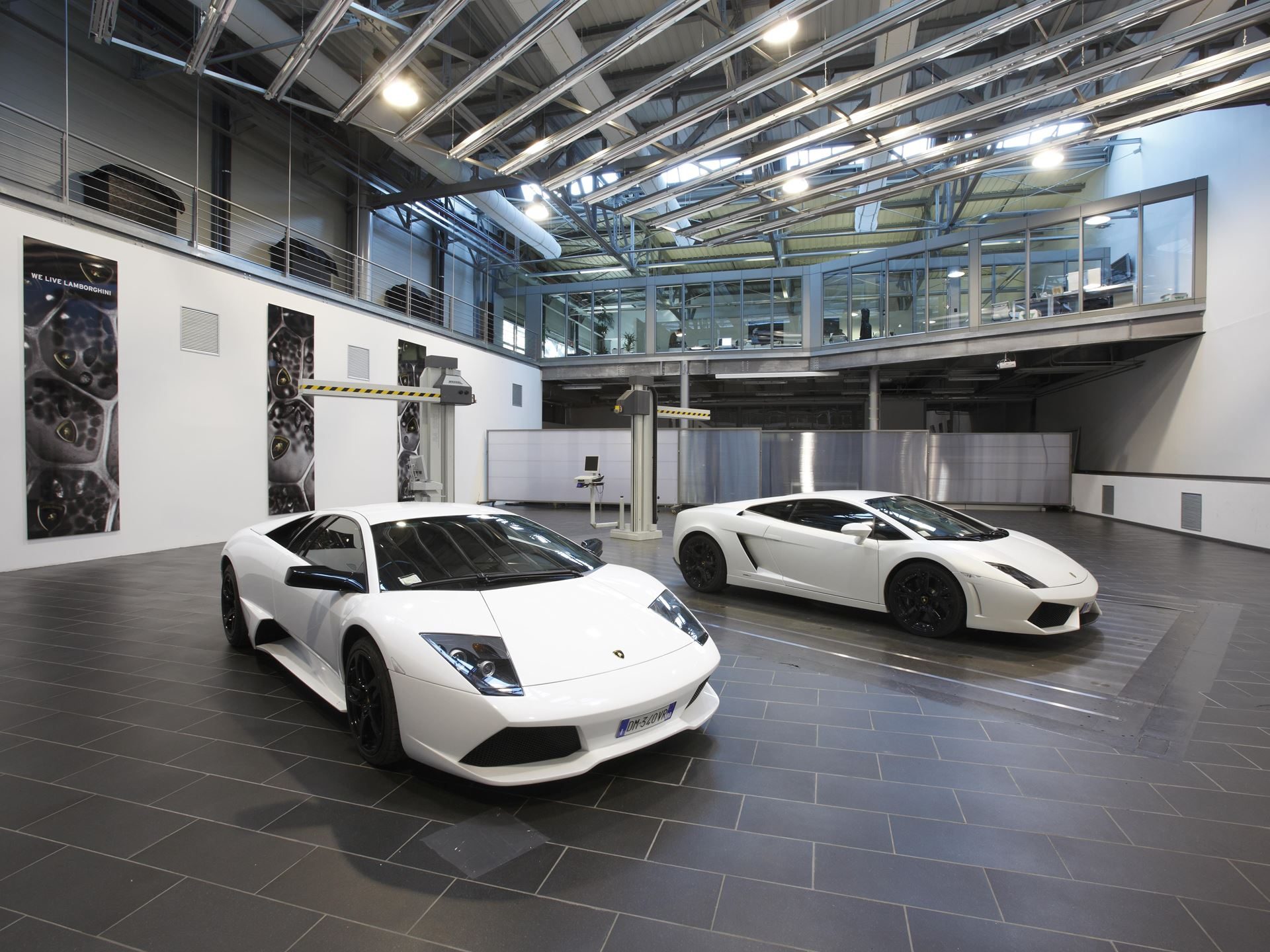
Inside the studio where every future Lamborghini takes shape
Centro Stile expanded from seven designers in Perini's early days to 25 international team members under Borkert, creating more bandwidth for derivatives, special editions, and Ad Personam customization.
Every special edition, directed from Sant'Agata
From the moment Centro Stile opened, every production model, concept, special edition, and few-off would be directed by Lamborghini's own heads of design.
The Fenomeno few-off, a Centro Stile anniversary celebration
The Manifesto concept is presented as a pure design vision, a declaration of future aesthetic direction rather than a preview of any specific production car.
Stephan Winkelmann and the legacy that launched Centro Stile
Donckerwolke oversaw the restyling of the final Diablo versions and created the two models that defined Lamborghini's modern era: the V12 Murciélago in 2002 and the V10 Gallardo in 2004.
The studio where Perini's era took shape
Perini's tenure produced the 2010 Sesto Elemento, the 2013 Veneno coupé and roadster, and concepts like the 2008 Estoque four-seat GT and the 2014 Asterion PHEV study.
Design DNA traced across three generations
Borkert's early work at Centro Stile included the Aventador S and SVJ, the Huracán Performante, and finalizing the Urus Super SUV, which was unveiled in 2017.
The hexagon and wedge, traced from 1967 to today
The hexagon motif, which Lamborghini's historical account traces to the 1967 Marzal prototype, appears everywhere from brake cooling ducts to daytime running lights.
The Revuelto: Borkert's most complete statement
Lamborghini's sales and marketing chief Federico Foschini hinted at "crazier" new models ahead, potentially including off-road versions of the Revuelto and Temerario.