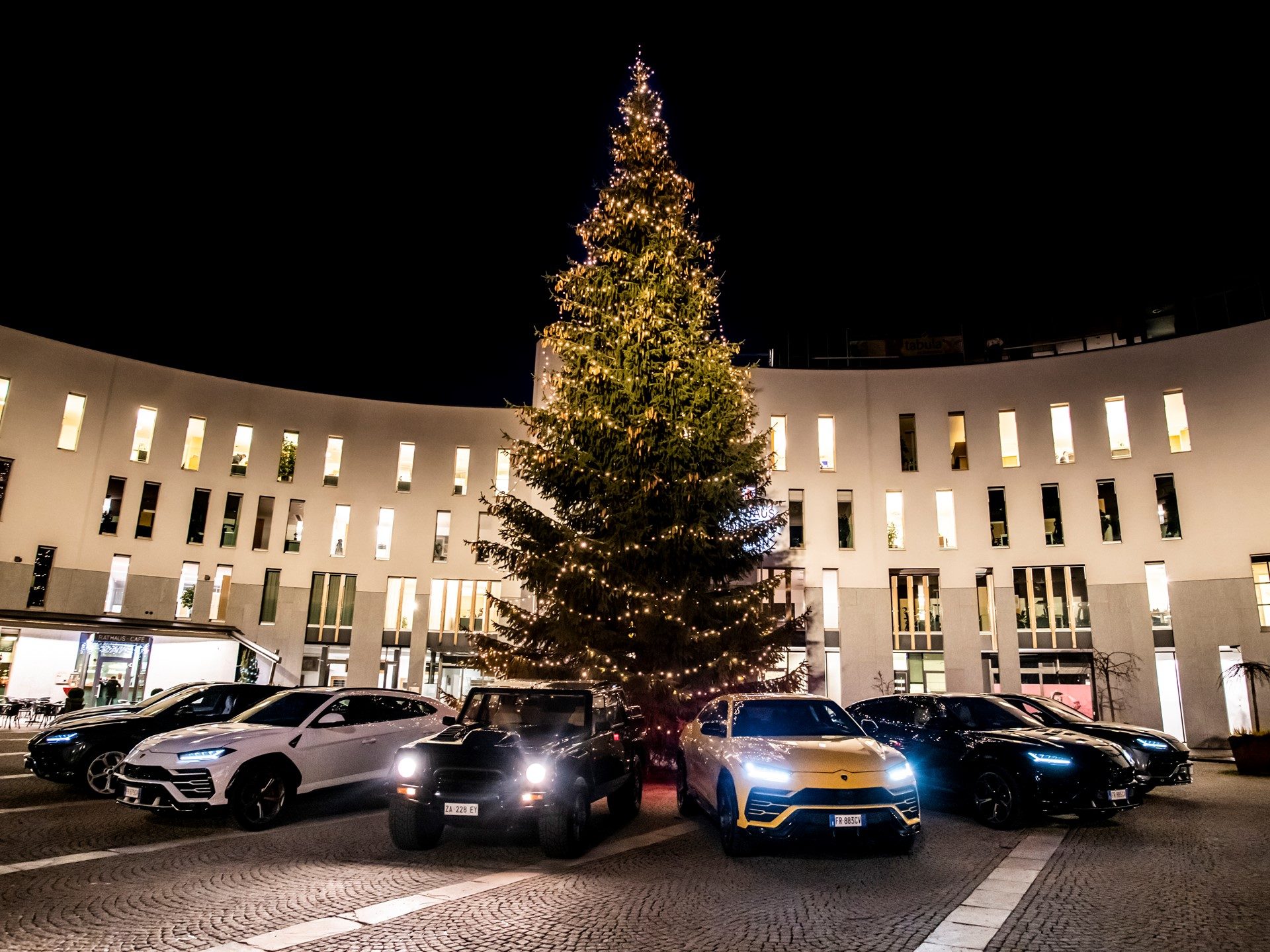
Lamborghini's Christmas Drive Put the Urus and a Restored LM002 on Frozen Alpine Roads
A 750-kilometer winter convoy through the Dolomites closed out the Urus's transformative first year on the market.
On December 13 and 14, 2018, Lamborghini sent a fleet of Urus SUVs and a single restored LM002 on a 750-kilometer route through South Tyrol's mountain passes, stopping at Bruneck's Christmas market before pushing on to frozen Lake Braies.
Frozen roads instead of a press conference.
Lamborghini chose icy alpine conditions over a conventional press event to demonstrate that the Urus's ANIMA drive-mode system, adaptive air suspension, and permanent all-wheel drive could handle real-world winter scenarios.
The Countach V12 that powered the Rambo Lambo.
No rival in the performance SUV segment can point to a predecessor that stuffed a Countach's 5.2-liter V12 into a military-derived chassis and earned the nickname Rambo Lambo in the process.
Lamborghini hardware in winter conditions.
The Urus's permanent all-wheel-drive system with active rear torque vectoring distributes power continuously across all four wheels, while dedicated NEVE and TERRA modes recalibrate throttle response, transmission mapping, and stability intervention for low-grip surfaces.
Old and new SUVs sharing the same snowy road.
Lamborghini says the Urus prompted a doubling of its production facility from 80,000 to 160,000 square meters and the addition of 500 employees, turning the car's first birthday into a company-wide milestone rather than a marketing footnote.
Chassis #12231, restored by Polo Storico.
Polo Storico's complete restoration of chassis #12231, a third-series LM002 built in 1990, made the truck roadworthy enough to tackle 750 kilometers of winter alpine roads alongside a modern Urus.
The strategy that followed the 2018 milestone.
The 2018 Christmas Drive reads as an early indicator of the strategy Lamborghini would pursue through the next decade: broaden the customer base without abandoning the heritage that makes the brand worth buying into.
A Urus convoy on snow-covered roads.
The route wound through South Tyrol's mountain passes before stopping at the old town center and Christmas market in Bruneck, a city with longstanding ties to Lamborghini.
The dual mandate the Urus had to fulfill.
The Urus arrived carrying a burden no other Lamborghini had shouldered: it needed to be simultaneously the fastest, most aggressive SUV available and a credible daily companion for buyers who would never consider a Huracán for the school run.
The Countach, whose V12 gave the LM002 its voice.
Parking the Urus beside the Rambo Lambo on a frozen Dolomite lake was Lamborghini's rebuttal, a visual argument that the company's SUV ambitions predated the modern luxury-SUV gold rush by thirty years.
The LM002's legendary bulk on rough terrain.
The Urus's four-wheel steering tightens the turning radius at low speeds, a practical advantage in tight alpine villages that the LM002, with its ocean-liner turning circle, could never match.
Skepticism answered by sales.
The Urus faced initial skepticism from purists, but its sales trajectory vindicated the strategy decisively, funding development of successors like the Urus Performante and the hybrid Urus SE.
Urus models on a winding alpine road.
Polo Storico's ability to source original parts and perform factory-correct restorations for models out of production for at least a decade remains one of Lamborghini's quieter competitive advantages over rivals with less formalized classic-car support.
A brand identity elastic enough for all of them.
The Christmas Drive was a celebration, but it was also a proof of concept for a brand identity elastic enough to encompass a V12 supercar, a twin-turbo SUV, and a Countach-powered military truck, all on the same frozen road.