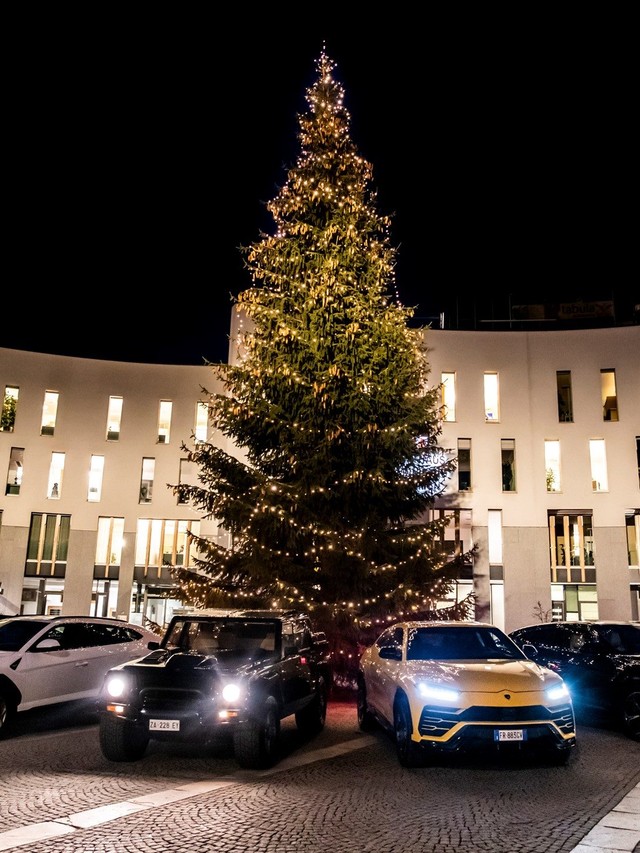
A Festive Convoy Through the Dolomites
On December 13 and 14, 2018, Lamborghini organized what it called the “Christmas Drive,” a 750-kilometer winter tour through the Italian Alps that paired a fleet of Urus SUVs with a single, meticulously restored LM002. The route wound through South Tyrol’s mountain passes before stopping at the old town center and Christmas market in Bruneck, a city with longstanding ties to Lamborghini. Bruneck supplies the Christmas tree that stands on the Sant’Agata Bolognese factory grounds each year, and the relationship ran both ways during the event: local businesses reportedly joined the celebration with themed window displays and biscuits baked in the shapes of both vehicles. From Bruneck, the convoy pushed on to Lake Braies, frozen solid and blanketed in snow, where both the modern Urus and the vintage LM002 were put through their paces on ice.
Lamborghini staged the drive to close out what it described as a transformative year, one defined by the Urus’s commercial debut and a surge in orders that exceeded internal projections. The format mattered as much as the destination. Placing the Urus next to its spiritual ancestor on genuinely challenging winter roads was a deliberate argument that the Super SUV belongs in Lamborghini’s lineage, not beside it as an afterthought. That single editorial choice, pairing old and new on frozen alpine tarmac, turned a corporate celebration into something more revealing: a statement about what kind of company Lamborghini intended to become.
Why Lamborghini Chose Frozen Roads Over a Press Conference
Most manufacturers celebrate a record sales year with a press event and a slide deck. Lamborghini chose frozen lake roads, and the distinction reveals how Sant’Agata wanted the Urus perceived at the end of its first calendar year on the market.
The Urus arrived carrying a burden no other Lamborghini had shouldered: it needed to be simultaneously the fastest, most aggressive SUV available and a credible daily companion for buyers who would never consider a Huracán for the school run. Staging a winter drive through genuine alpine conditions, complete with sub-zero temperatures and icy surfaces, addressed the second half of that equation directly. Lamborghini was not simply showing off straight-line speed (the Urus’s 3.6-second sprint to 100 km/h was already well documented). It was demonstrating that the car’s ANIMA drive-mode system, adaptive air suspension, and permanent all-wheel drive could handle the kind of real-world winter scenario that owners in northern Europe, the American Midwest, or the Canadian Rockies face every December.
For a brand whose identity was built on mid-engine supercars and Mediterranean sunshine, sending a convoy into the Dolomites in mid-December was a quiet but meaningful statement of intent. The Urus was not a fair-weather experiment. It was a year-round vehicle, and Lamborghini wanted photographic proof on frozen roads rather than applause in a conference hall.
From the Rambo Lambo to the Super SUV: A Lineage No Rival Can Claim
Including the LM002 in the Christmas Drive was the shrewdest decision Lamborghini made about the event. Every competitor in the performance SUV segment, from Porsche’s Cayenne Turbo to Bentley’s Bentayga, can point to engineering excellence. None of them can point to a predecessor that stuffed a Countach’s 5.2-liter V12 into a military-derived chassis and earned the nickname “Rambo Lambo” in the process.
The LM002 originated from Lamborghini’s earlier Cheetah program, a failed bid for a U.S. military contract that evolved into one of the most improbable production vehicles of the 1980s. Only 301 units rolled out of Sant’Agata between 1986 and 1992, each one weighing a reported 5,720 pounds and riding on massive 345/60R17 Pirelli Scorpion tires custom-developed for the application. Commentators who drove the LM002 describe its steering as requiring considerable physical input and its turning radius as comically wide. Daily driving was, by all accounts, out of the question.
Yet the LM002 established something no spreadsheet could quantify: the idea that Lamborghini could build a vehicle outside the supercar template and make it unmistakably, defiantly Lamborghini. When the Urus concept surfaced decades later, skeptics called it a rebadged platform exercise. Parking it beside the Rambo Lambo on a frozen Dolomite lake was Lamborghini’s rebuttal, a visual argument that the company’s SUV ambitions predated the modern luxury-SUV gold rush by thirty years.

Lamborghini Urus and LM002 models gather for a festive Christmas drive, illuminated by a grand Christmas tree at night.
Winter Capability: What the Urus Actually Brings to Icy Roads
The Urus’s 4-liter twin-turbo V8 produces 650 horsepower and 850 Nm of torque, figures that matter most on a dry autobahn but become secondary on a frozen alpine lake. What counts in those conditions is chassis management, and the Urus was designed with winter in mind from the outset. Its permanent all-wheel-drive system with active rear torque vectoring distributes power continuously across all four wheels, while the ANIMA selector includes dedicated off-road modes (NEVE for snow, TERRA for loose surfaces) that recalibrate throttle response, transmission mapping, and stability intervention for low-grip environments.
Adaptive air suspension adjusts ride height on the fly, and Lamborghini fitted what were, at launch, the largest carbon-ceramic brake discs ever developed for an SUV. Four-wheel steering tightens the turning radius at low speeds, a practical advantage in tight alpine villages that the LM002, with its ocean-liner turning circle, could never match.
Multiple Urus owners on enthusiast forums describe the car as a genuinely capable winter vehicle, with one common thread being that it rides better than expected and handles snow with surprising composure. For buyers considering the Urus as a year-round driver rather than a garage ornament, that real-world feedback carries more weight than any spec sheet. The Christmas Drive, staged in exactly these conditions, let Lamborghini underscore the point with its own hardware on roads that would humble a lesser all-wheel-drive system.
The Urus Effect: How One SUV Reshaped Lamborghini’s Business
The commercial impact of the Urus on Lamborghini’s operations explains why Sant’Agata treated the car’s first birthday as a company-wide milestone rather than a marketing footnote. Lamborghini says the Urus prompted a doubling of its production facility, expanding from 80,000 to 160,000 square meters in just over a year. The company added 500 employees to support the ramp-up and projected a doubling of total sales volumes by 2019 compared to the period before the Urus existed.
Those numbers represent a structural transformation, not a seasonal sales bump. Before the Urus, Lamborghini was a two-model company building supercars in relatively modest volumes. After the Urus, it became a manufacturer with the physical plant and workforce to compete at an entirely different scale. As CarBuzz noted, the Urus faced initial skepticism from purists who dismissed it as a rebadged Audi RS Q8, but its sales trajectory vindicated the strategy decisively.
The practical takeaway for current and prospective Lamborghini owners is straightforward: the Urus’s commercial success funds the development of cars like the Revuelto and Temerario. Every V12 hybrid and twin-turbo V8 supercar in Lamborghini’s current lineup benefits from the engineering investment and financial stability the Urus made possible. Dismissing the Super SUV as a dilution of the brand misses the economic reality that sustains it.
Polo Storico and Chassis #12231: Keeping the Past Road-Ready
The specific LM002 that accompanied the Urus fleet through the Dolomites carries its own story, and it reinforces the event’s central theme of heritage earning its place on modern roads. Lamborghini identifies it as a third-series model, chassis #12231, built in 1990 and originally delivered through the Mediterranea dealership in Nice to a first owner based in Monte Carlo. The car was later reacquired by Automobili Lamborghini and sent to Polo Storico for a complete restoration between 2016 and 2017, covering bodywork, interior trim, and a full mechanical overhaul.
Lamborghini’s Polo Storico division specializes in the restoration and certification of models out of production for at least a decade, from the 350 GT through the Diablo. The division also preserves the company’s historical archives and manages the supply of original spare parts for classic Lamborghinis. Its involvement in the Christmas Drive was not decorative. Polo Storico’s work on chassis #12231 made the LM002 roadworthy enough to tackle 750 kilometers of winter alpine roads alongside a modern Urus, a practical demonstration that Lamborghini’s heritage program produces functional vehicles rather than static museum pieces.
For collectors and long-term owners, Polo Storico’s existence addresses a real concern: parts availability and factory-correct restoration for aging Lamborghinis. The program remains one of the quieter competitive advantages Lamborghini holds over rivals whose classic-car support infrastructure is less formalized. When an automaker can pull a 28-year-old SUV out of its own collection, restore it in-house, and drive it across frozen mountain passes without incident, the message to owners of aging Diablos and Murcielagos needs no elaboration.
What the Christmas Drive Signaled for Lamborghini’s Direction
Viewed from several years’ distance, the 2018 Christmas Drive reads as an early indicator of the strategy Lamborghini would pursue through the next decade: broaden the customer base without abandoning the heritage that makes the brand worth buying into. The Urus proved that a Lamborghini could be a winter-capable, family-friendly, daily-drivable vehicle and still feel like an event every time it started. The LM002’s presence proved that this ambition was not new, just newly achievable.
Lamborghini’s subsequent moves, including the Urus Performante, the hybrid Urus SE, and the broader electrification of its supercar range, all flow from the confidence the original Urus’s first year provided. The Christmas Drive was a celebration, certainly. But it was also a proof of concept for a brand identity elastic enough to encompass a V12 supercar, a twin-turbo SUV, and a Countach-powered military truck, all on the same frozen road.


