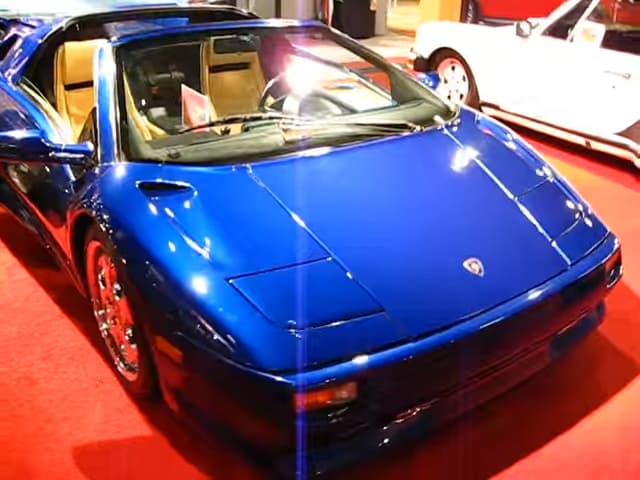
The Lamborghini Diablo at 30: How a Raw V12 Flagship Evolved Through Three Owners and Nine Variants
One model absorbed more corporate upheaval, engineering reinvention, and philosophical change than any other car in Lamborghini's history.
The Diablo transformed from a rear-wheel-drive, power-steering-free V12 brute into a refined all-wheel-drive grand tourer equipped with variable valve lift and ABS.
Gandini's wedge versus corporate revision
Collectors and enthusiasts split sharply on whether the pre-facelift or post-facelift Diablo represents the car's purest expression, a debate rooted in the real consequences of corporate ownership on a car's identity.
The variant family expands
Lamborghini introduced the VT Roadster in December 1995, describing it as the company's first mass-produced 12-cylinder open-roof model, offered exclusively with four-wheel drive and slightly revised styling.
2,903 units across a complex collector landscape
The Diablo's 2,903-unit production total, spread across numerous variants with distinct specifications, creates a collector landscape where condition, variant, and provenance matter far more than the model name alone.
The Diablo's philosophical lineage in today's V12s
Every all-wheel-drive system, every electronic aid, and every variable valve timing strategy in a contemporary Lamborghini V12 traces at least part of its philosophical lineage back to decisions made during the Diablo's production run.
Bridging the Countach and Murciélago eras
The Diablo sits squarely between two of Lamborghini's most celebrated eras: the analog wildness of the Countach and the more technologically ambitious approach that defined the Murciélago and, later, the Aventador.
The original V12's raw specification
The original Diablo carried a 5.7-liter V12 with four overhead camshafts, four valves per cylinder, and multi-point electronic injection, rated at 485 HP and 580 Nm of torque, mounted longitudinally behind the cabin.
Donckerwolke's 1999 restyling previews the Murciélago
Luc Donckerwolke's 1999 restyling of the Diablo SV, followed by updated VT and VT Roadster models, brought modernized exterior lines and interior appointments that essentially previewed the design language of the Murciélago.
Two driving philosophies in one silhouette
The gap between a 1991 base model with no power steering and a 2001 VT 6.0 with ABS and variable valve lift represents two fundamentally different driving philosophies packaged in the same silhouette.
From analog defiance to the Revuelto's hybrid arc
The company that built a 485 HP rear-drive car with no power steering in 1990 was, by 2001, building a 529 HP all-wheel-drive car with ABS and variable valve lift — the same arc from analog defiance to measured technological adoption that the brand continues to navigate with the Revuelto's hybrid V12.