The LM002 Gave Lamborghini a Super SUV Claim Nobody Else Can Make
A Countach V12 in a truck chassis created a heritage advantage no rival can replicate.
The LM002 was genuinely radical, and its story reveals how placing a Countach V12 inside a truck chassis gave Lamborghini a heritage advantage no rival can replicate.
The Rambo Lambo among its supercar siblings
The same engine that screamed behind the driver's head in one of the most iconic supercars ever built now sat under the hood of a 2.7-tonne off-road truck, according to one independent report.
The Urus inherited the LM002's off-road ambition
Polo Storico's restoration of the museum car signals that Lamborghini itself considers the LM002 worth preserving to factory standards, a statement that carries weight in a collector market where provenance and condition matter enormously.
Heritage vehicles at the Sant'Agata Bolognese headquarters
Polo Storico draws on an archive of over 30,000 original technical documents, drawings, and photographs, consulting with former employees through the "Comitato dei Saggi," or Experts Committee.
The LM002 in its element: V12 power on open roads
Lamborghini is drawing a direct line between a 450 hp V12 truck that could float across dunes on bespoke Pirellis and a modern Super SUV designed to dominate both the Nurburgring and the school run.
Built for deserts: the LM002's natural habitat
The LM002 used a 5,167 cc Countach Quattrovalvole V12 producing 450 hp at 6,800 rpm, four-wheel drive with a transfer case, three self-locking differentials, and could exceed gradients of 120% while reaching speeds beyond 200 km/h.
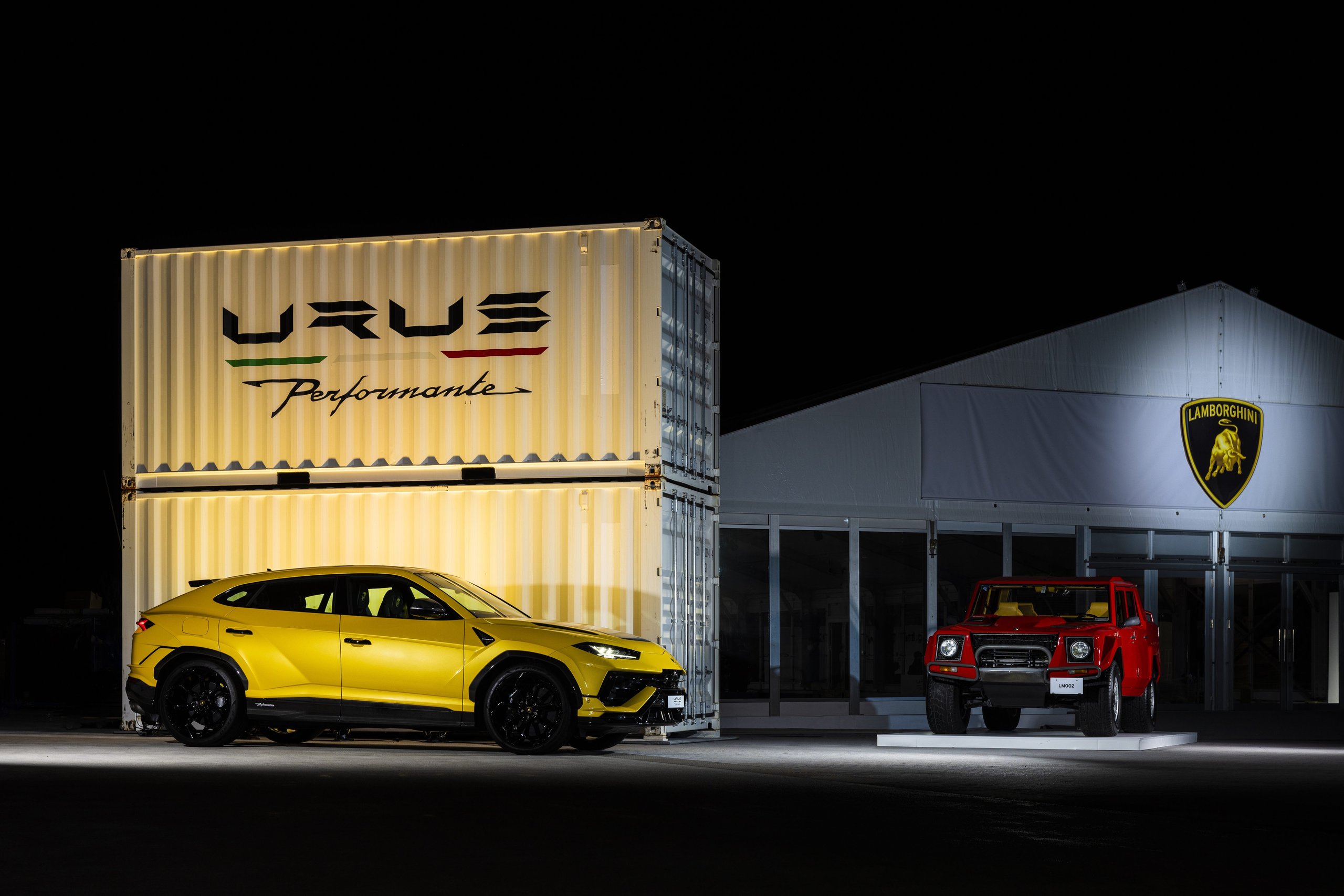
LM002 and Urus: three decades apart, one lineage
Lamborghini spotlighted chassis #12231, brought back to factory condition by Polo Storico, constructing a lineage rather than simply celebrating an anniversary.
The Countach: donor of the LM002's heart
Mating a high-revving naturally aspirated V12 to a heavy-duty off-road drivetrain was a considerable engineering challenge, and Lamborghini pulled it off in the mid-1980s with a workforce primarily experienced in building low-slung supercars.
Approximately 300 built between 1986 and 1992
Road & Track reported that a unique LM002 Wagon variant was commissioned for the Sultan of Brunei, one of the most prolific collectors of exotic automobiles in history.
The deliberate pairing: LM002 beside its successor
Showcasing Polo Storico's work on the LM002 just weeks before the Urus launch physically manifested the connection between old and new, turning a restored truck into proof that Lamborghini's Super SUV ambitions had roots stretching back three decades.
From "epic miscalculation" to visionary precursor
Some contemporary observers considered the LM002 a "freak" and an "epic miscalculation," yet that same vehicle is now celebrated as a visionary precursor to one of the most profitable segments in the luxury automotive industry.
The bet that took 25 years to pay off
Lamborghini bet on the idea that performance and luxury could coexist in an SUV body, and when it paid off 25 years later with the Urus, the company had receipts.