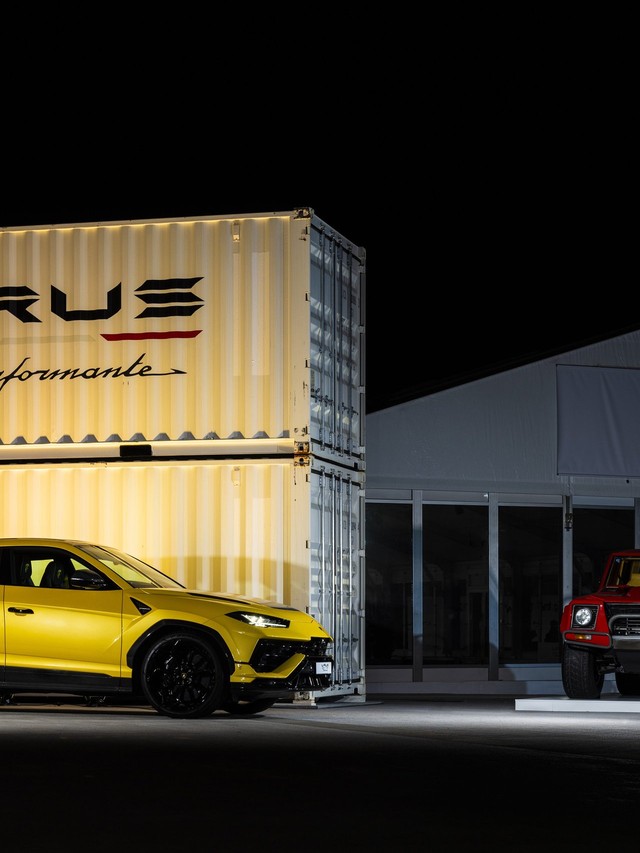
Lamborghini’s LM002 Retrospective Is Timed for a Reason
Weeks before the Urus was scheduled to debut on December 4, 2017, in Sant’Agata Bolognese, Lamborghini rolled out a detailed historical retrospective on the LM002. The timing was anything but coincidental. By spotlighting its freshly restored museum example, chassis #12231, brought back to factory condition by Lamborghini Polo Storico, the company was constructing a lineage rather than simply celebrating an anniversary.
The message was plain enough for anyone paying attention: when the Urus arrived, it would not be Lamborghini’s first attempt at an SUV. It would be the continuation of a tradition the company started decades before Ferrari, Aston Martin, or Bentley ever considered putting their badges on anything with ground clearance. Lamborghini said the Urus would create a new “Super SUV” class, and the LM002 retrospective existed to make that claim feel earned rather than invented.
Viewed from the vantage of the Urus becoming one of the best-selling vehicles in Lamborghini’s history, the strategy worked. Yet the LM002 itself deserves more than a supporting role in someone else’s marketing pitch. The car was genuinely radical, and its story reveals how a single audacious bet, placing a Countach V12 inside a truck chassis, gave Lamborghini a heritage advantage no rival can replicate.
The Rambo Lambo: Military Ambitions, Supercar Heart
The LM002’s origin story begins in the late 1970s with a prototype called the Cheetah, designed as a high-performance military off-road vehicle. The U.S. military contract never materialized, and the project stalled until engineer Giulio Alfieri revived it in 1981 with the LM 001, an innovative concept featuring a rear-mounted engine. The LMA prototype followed, moving the powertrain to the front, and the production LM002 finally debuted at the Brussels Auto Show in 1986. By any reasonable standard, it was absurd.
The absurdity was the point. Powering the LM002 was the 5,167 cc V12 from the Countach Quattrovalvole, producing 450 hp at 6,800 rpm. The same engine that screamed behind the driver’s head in one of the most iconic supercars ever built now sat under the hood of a 2.7-tonne off-road truck, according to one independent report. Lamborghini says the vehicle used an aluminum and fiberglass body, a four-wheel drive transmission with a transfer case, and three self-locking differentials. It could exceed gradients of 120% and reach speeds beyond 200 km/h.
Put differently: this was a vehicle that could climb a sand dune steeper than a ski slope, then cruise the autostrada at supercar velocities. Nobody else was building anything remotely like it. Custom-developed Pirelli Scorpion tires gave the LM002 what Lamborghini described as “floating” capabilities on soft surfaces like sand, with durability engineered for extreme heat. Mating a high-revving naturally aspirated V12 to a heavy-duty off-road drivetrain was a considerable engineering challenge, and the fact that Lamborghini pulled it off in the mid-1980s with a workforce primarily experienced in building low-slung supercars says something about the company’s appetite for risk.
The “Rambo Lambo” nickname was honestly earned. With its aggressive stance, prominent grille, round headlights, and squared-off fender flares, the LM002 looked like something designed to invade a small country, then park at the Monte Carlo Casino for dinner.

The legendary Lamborghini LM002, an early pioneer in the luxury SUV segment, stands ready for adventure on a rugged terrain.
Only 300 Built, and a Sultan Got a Wagon
Between 1986 and 1992, approximately 300 LM002 units left the factory. Body production started near Bilbao, Spain, with semi-assembled parts shipped to Sant’Agata Bolognese for final assembly, powertrain installation, finishing, and delivery. Each interior was tailored to the individual customer’s specifications, which in the 1980s supercar world meant leather, wood, and whatever else a buyer with sufficient imagination and budget could request.
The clientele matched the car’s personality. Road & Track reported that a unique LM002 Wagon variant was commissioned for the Sultan of Brunei, one of the most prolific collectors of exotic automobiles in history. That a customer could convince Lamborghini to build a station wagon version of an off-road V12 truck speaks to the era’s willingness to indulge the eccentric. Enthusiast forum discussions frequently highlight the LM002’s cult following among collectors, with the car’s rarity and sheer oddity driving sustained interest decades after production ended.
Lamborghini has not published current collector market values for the LM002, and pricing data remains scattered. What the production numbers confirm is genuine scarcity: 300 units over six years, many of which saw hard use in Middle Eastern deserts, means well-preserved examples are uncommon. Polo Storico’s restoration of the museum car signals that Lamborghini itself considers the model worth preserving to factory standards, a statement that carries weight in a collector market where provenance and condition matter enormously.
Polo Storico and the Business of Authenticated Heritage
The restoration of chassis #12231 by Polo Storico deserves attention beyond the surface detail, because it reveals how Lamborghini turns heritage into a strategic asset. The in-house classic car department draws on an archive of over 30,000 original technical documents, drawings, and photographs to ensure period-accurate restorations, consulting with former Lamborghini employees through what the department calls the “Comitato dei Saggi,” or Experts Committee. One source indicates that comparable full restorations, such as a 350 GT project, can require over 780 hours of mechanical work and 1,150 hours of body and interior work.
For the LM002, this level of attention served a dual purpose. It preserved a museum-quality example for Lamborghini’s own collection, and it demonstrated to private owners that factory-correct restoration is available and supported. In a collector market where authenticity documentation increasingly drives value, Polo Storico functions as both a preservation workshop and a brand asset. Choosing to showcase the department’s work on the LM002 just weeks before the Urus launch was no accident: it physically manifested the connection between old and new, turning a restored truck into proof that Lamborghini’s Super SUV ambitions had roots stretching back three decades.
Why the LM002 Lineage Matters for the Urus and Beyond
When Lamborghini says the Urus will deliver exceptional road dynamics, performance, luxury, and off-road capability including sand, the echo of the LM002’s spec sheet is intentional. The company is drawing a direct line between a 450 hp V12 truck that could float across dunes on bespoke Pirellis and a modern Super SUV designed to dominate both the Nurburgring and the school run.
The competitive context makes this lineage valuable. Ferrari’s Purosangue, Aston Martin’s DBX, and Bentley’s Bentayga all arrived in the high-performance SUV segment years after Lamborghini had already sold the Urus in significant volume, and decades after the LM002 proved the concept was viable. Lamborghini cannot claim to have invented the luxury SUV in any strict sense, but it can credibly argue that it built the first one audacious enough to deserve the “super” prefix. A Countach V12 in a truck chassis remains a more compelling origin story than a committee decision to chase market share.
Some contemporary observers considered the LM002 a “freak” and an “epic miscalculation.” That the same vehicle is now celebrated as a visionary precursor to one of the most profitable segments in the luxury automotive industry says more about the LM002’s legacy than any retrospective ever could. Lamborghini bet on the idea that performance and luxury could coexist in an SUV body. The bet took 25 years to pay off, but when it did, the company had receipts.
LM002 Key Specifications
| Specification | Detail |
|---|---|
| Engine | 5,167 cc V12 (Countach Quattrovalvole) |
| Power | 450 hp at 6,800 rpm |
| Body Construction | Aluminum and fiberglass |
| Drivetrain | Four-wheel drive, transfer case, three self-locking differentials |
| Top Speed | Over 200 km/h |
| Gradient Capability | Exceeds 120% |
| Tires | Custom Pirelli Scorpion (sand-flotation capable) |
| Production | Approximately 300 units, 1986 to 1992 |
| Body Production | Near Bilbao, Spain; final assembly in Sant’Agata Bolognese |
| Debut | Brussels Auto Show, 1986 |


