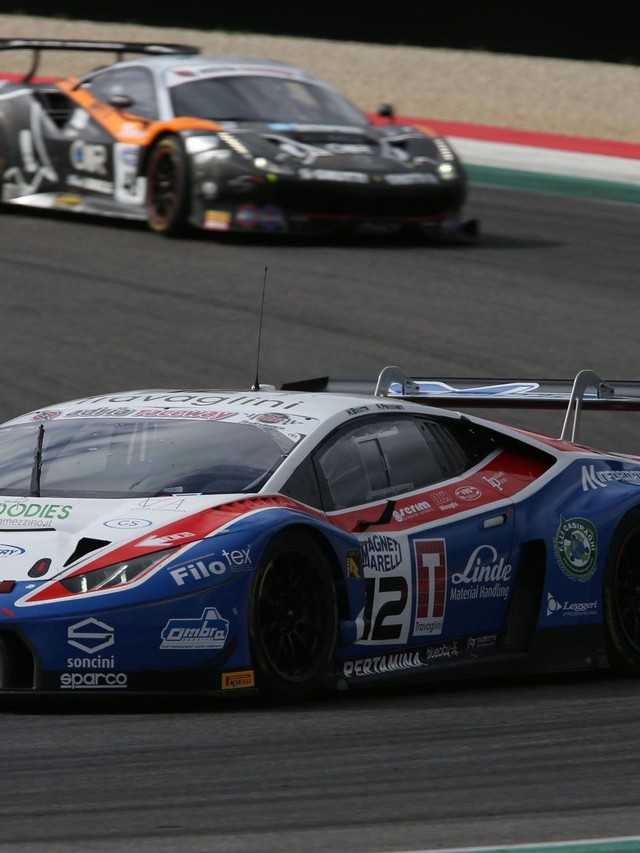
Eight Points Down, One Race Left: The Huracán GT3’s Italian GT Finale at Mugello
Michele Beretta and Alex Frassineti arrived at the Mugello circuit trailing Ferrari’s Stefano Gai by eight points in the Super GT3 PRO class of the Italian GT Championship. One race remained. According to Lamborghini, the Ombra Racing pair erased that deficit in the season’s final round, winning the decisive race and claiming the Huracán GT3’s first championship in Italy’s premier GT series.
Eight points in a sprint-format GT championship is not a trivial gap to close in a single weekend, particularly against a Ferrari driver on home soil in one of Italy’s most competitive national series. Lamborghini says the result came down to the last race of the last round, the kind of scenario that either validates a car’s pace under maximum pressure or exposes its limits. For the Huracán GT3, it proved to be the former.
Both drivers came through the Lamborghini Squadra Corse GT3 Junior Program, a pipeline designed to develop young talent specifically for customer racing. Beretta had already won the Silver Cup title in the 2016 Blancpain GT Series Sprint Cup, bringing genuine pedigree into the partnership. Frassineti, whose career spans Formula Renault and various GT categories, provided the complementary experience that made the pairing work.
The Season That Built the Championship
A title decided on the final lap makes for a good story, but Beretta and Frassineti did not conjure this result from nothing. Lamborghini confirms their 2017 campaign included three victories at Misano, Imola, and Vallelunga, two runner-up finishes at Imola’s opening round, and the clinching win at Mugello. That is a remarkably consistent season across some of Italy’s most demanding circuits.
Another Lamborghini entry reinforced the car’s competitiveness. The Antonelli Motorsport Huracán GT3, shared by Daniel Zampieri and Riccardo Agostini, actually finished ahead of the Ombra car in that final Mugello race. Zampieri claimed third overall in the championship standings and took the season’s last pole position. Two Lamborghinis finishing the year in the top three of the Super GT3 PRO class, in a series where Ferrari competes aggressively on home turf, speaks to the platform’s breadth of capability rather than one team’s lucky weekend.
For anyone following customer racing closely, the fact that two independent teams extracted championship-level performance from the same car tells you something important about the Huracán GT3’s accessibility. A well-sorted GT3 car should reward competent teams regardless of their factory connection, and the Ombra and Antonelli results suggest the Huracán delivered exactly that.
A Global Trophy Case: The Huracán GT3 Beyond Italy
The Italian GT title sat alongside a growing collection of international results that season. The same year brought a Blancpain GT championship, while Thomas Biagi and Fabrizio Crestani secured the International GT Open title for Orange 1 Team Lazarus. The GT Asia Series had already fallen to Andrea Amici and Edoardo Liberati with FFF Racing Team by ACM the previous season.
The thread connecting these results is geography. The Huracán GT3 was not winning in a single region or a single regulatory environment. It proved competitive across European sprint and endurance formats, Asian series, and the Italian national championship, all with different customer teams. That kind of cross-continental consistency is difficult to achieve with a GT3 platform, because Balance of Performance regulations, climate conditions, and circuit characteristics vary enormously between series.
Ferrari and Porsche both field formidable GT3 entries in these same championships, bringing deeper motorsport histories to the grid. Lamborghini’s ability to compete at this level with the Huracán GT3 represented a genuine shift in the brand’s racing credibility. Before the Huracán program, Lamborghini’s competition record was sporadic at best. By 2017, the conversation had changed.
What Made the Huracán GT3 Work
One source reports the original Huracán GT3 was developed by Squadra Corse in collaboration with Dallara, drawing on the road car’s aluminum and carbon fiber hybrid construction while widening the body and adding substantial aerodynamic hardware. The naturally aspirated 5.2-liter V10 reportedly produced approximately 576 horsepower in race trim, paired with a curb weight around 2,712 pounds.
Those numbers, regulated by GT3 Balance of Performance rules, gave customer teams a predictable and durable powertrain. Naturally aspirated V10 engines deliver linear throttle response, which matters enormously in endurance stints and wet conditions where turbo lag can catch a driver out. The Huracán GT3’s evolution through Evo and Evo2 specifications kept the platform competitive for a full decade, an unusually long competitive life in a class where rivals cycled through multiple entirely new chassis designs in the same period.
As Road & Track noted in its coverage of the successor program, eleven brands introduced entirely new GT3 cars during the Huracán’s competitive lifespan. Lamborghini stuck with iterative updates to the same fundamental package and kept winning. That longevity is arguably the most impressive engineering story of the entire program.
From Mugello to the Temerario: What the Huracán GT3 Built
The Huracán GT3’s Italian GT title was one chapter in a story that now stretches across a full decade of customer racing. Its successor, the Temerario GT3, represents a fundamentally different approach: the first race car entirely designed and developed by Lamborghini at Sant’Agata Bolognese, using a modified twin-turbocharged engine stripped of the road car’s hybrid system to comply with GT3 regulations.
For customer teams evaluating their next commitment, the transition from a naturally aspirated V10 to a twin-turbo V8 changes everything: throttle response characteristics, heat management, weight distribution, and the entire tuning philosophy. The Huracán GT3 earned its reputation partly because its V10 was so forgiving and communicative for gentleman drivers and professionals alike. Whether the Temerario GT3 can replicate that quality with forced induction remains the open question defining Lamborghini’s next decade in GT racing.
What is not in question is the foundation. Results like the 2017 Italian GT Championship, won by junior program drivers in a customer team car against Ferrari on Italian soil, gave Lamborghini the credibility to be taken seriously when it asks teams to invest in a new platform. The Huracán GT3 did not just win races. It built the infrastructure of trust that every customer racing program depends on.
Gallery


