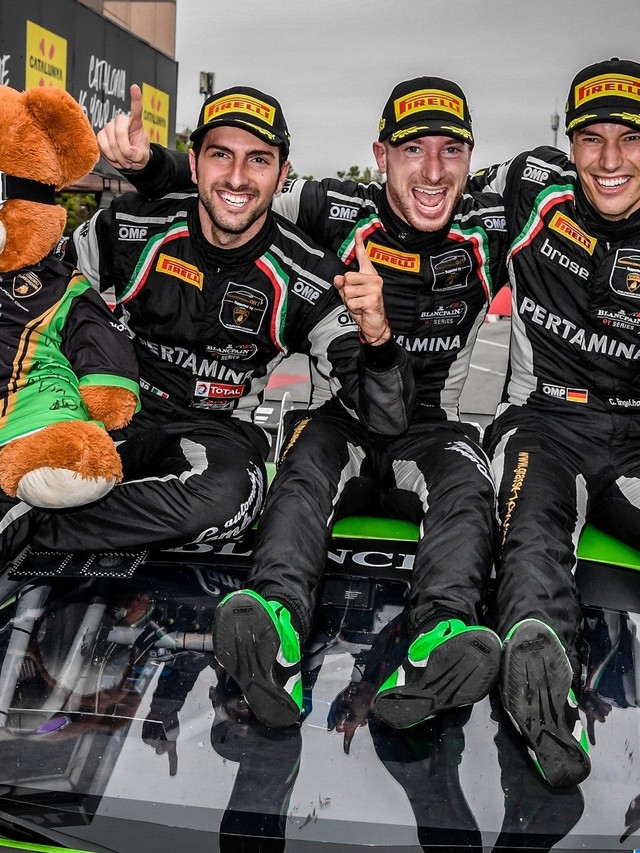
Four Titles, One Season: The Huracán GT3 Claims the 2017 Blancpain Crown
When the #63 Lamborghini Huracán GT3 crossed the line in third place at the Barcelona season finale, the Austrian Grasser Racing team and its three Lamborghini Squadra Corse factory drivers secured something far more valuable than a single podium. Mirko Bortolotti, Christian Engelhart, and Andrea Caldarelli clinched the 2017 Blancpain GT Series overall championship, capping a ten-round campaign that swept four titles: the Overall and Endurance Cup Team championships, plus the Overall and Endurance Cup Driver’s crowns.
Bortolotti and Engelhart collected both driver titles, with Caldarelli sharing the Endurance Cup driver’s championship. Lamborghini says the Barcelona grid featured 50 cars, a field stacked with factory entries from every major manufacturer competing in GT3 at the time. Finishing third in that crowd was more than enough, because the real work happened over the preceding nine rounds.
For a brand whose motorsport identity was still being written in the GT3 era, this result carried weight well beyond the trophy cabinet. It proved the Huracán GT3 could win across formats, against deep-pocketed rivals, over a full season. And it set in motion a chain of development decisions that still shapes Lamborghini’s racing program today.
A Season Built on Consistency, Not Just Speed
Championships in endurance-heavy GT3 series reward the car that finishes, scores, and avoids catastrophe across months of racing. The Grasser Racing Huracán GT3 did exactly that. Lamborghini confirmed victories at Monza and Silverstone in the Endurance Cup, plus a double win at Brands Hatch in the Sprint Cup. Between those headline results sat a long run of points finishes that kept the #63 at or near the top of the standings all year.
The campaign’s breadth made it particularly convincing. Bortolotti and Engelhart handled the Sprint Cup rounds as a duo, while Caldarelli joined for the longer Endurance Cup events. That driver rotation demanded a car comfortable enough in setup and balance for different driving styles and race formats, a quality that speaks to engineering maturity rather than raw outright pace.
Lamborghini attributed the championship to the Huracán GT3’s reliability and consistent performance, combined with the team’s operational discipline. In a series where mechanical retirements can erase weeks of accumulated points, the car’s ability to simply keep running proved decisive. Reliability is rarely glamorous, but it is the foundation every lasting GT3 program is built on, and the 2017 season demonstrated that Lamborghini had found it.
The V10 Platform That Kept Evolving
The Huracán GT3 that won in 2017 ran a naturally aspirated 5.2-liter V10, the same basic engine architecture underpinning the road car but tuned and restricted to FIA GT3 regulations. That powerplant gave Lamborghini a distinctive character on track: linear throttle response and a sound signature no turbocharged rival could replicate.
The title validated the platform convincingly enough that Lamborghini continued developing it rather than starting from scratch. The Huracán GT3 Evo arrived at the Nürburgring at the end of the 2018 season with revised aerodynamics and went on to claim the 2019 overall Blancpain championship. A further evolution, the GT3 Evo2, extended the car’s competitive life even further. For customer teams, that continuity mattered enormously. Buying into the Huracán GT3 program meant investing in a platform with a proven upgrade path and factory support, not a car that would be orphaned after two seasons.
The Huracán STJ, limited to just 10 units, recently served as the road car’s farewell. Yet the racing platform’s influence outlasted the production model by years, a rare case where the competition car defined the nameplate’s legacy more than the showroom version. That longevity traces directly back to the confidence the 2017 championship instilled in both the factory and its customers.
From Huracán to Temerario: What the 2017 Win Set in Motion
The upcoming Temerario GT3 represents a clean break. According to Car and Driver, it replaces the Huracán GT3 Evo 2 as Lamborghini’s factory-backed GT3 effort and marks the first race car entirely designed and developed in-house at Sant’Agata Bolognese. Previous Huracán GT3 variants relied on collaboration with Dallara for chassis and aero development. The Temerario GT3 brings that work under Lamborghini’s own roof, a step that would have been difficult to justify without the credibility the Huracán program earned starting in 2017.
The powertrain shift is equally significant. GT3 regulations require the race car to use a modified version of its road car engine, which means the Temerario GT3 will run a twin-turbocharged unit instead of the naturally aspirated V10 that defined a decade of Lamborghini GT3 racing. As Road & Track noted, eleven brands released entirely new GT3 cars during the period Lamborghini stuck with updated versions of the Huracán. That patience paid off in accumulated development knowledge and customer loyalty, but the competitive landscape eventually demanded a ground-up redesign.
For teams currently running the Evo2, the transition will require adapting to a fundamentally different powerband, altered weight distribution, and the complexities of turbo management in wheel-to-wheel combat. The Huracán’s linear V10 throttle response was a defining trait that drivers learned to exploit. Whether the Temerario GT3 can replicate that exploitability with forced induction remains the central question for Lamborghini’s customer racing future.
A Motorsport Result That Competitors Had to Respect
The 2017 championship arrived at a moment when Lamborghini still needed to prove it belonged in the top tier of GT3 racing. Ferrari and Porsche carried decades of motorsport credibility. Lamborghini’s GT racing history, by comparison, was thin. Winning the Blancpain title, widely regarded as one of the most competitive GT championships globally, changed the conversation and gave customer teams a concrete reason to choose the Huracán GT3 over established alternatives.
One report indicates Lamborghini ended its SC63 LMDh program for the 2026 season following two seasons of challenging performance, which makes the GT3 program even more central to the brand’s motorsport identity going forward. The Temerario GT3 carries the full weight of Lamborghini’s racing credibility on its widened shoulders.
The 2017 Blancpain title did something no press event or special edition could accomplish on its own: it gave Lamborghini a motorsport result that demanded respect. Every GT3 Evo update, every customer team contract renewal, and ultimately the decision to develop the Temerario GT3 entirely in-house traces a line back to that season when the #63 proved the platform could win against anyone, anywhere, all year long.
Gallery


