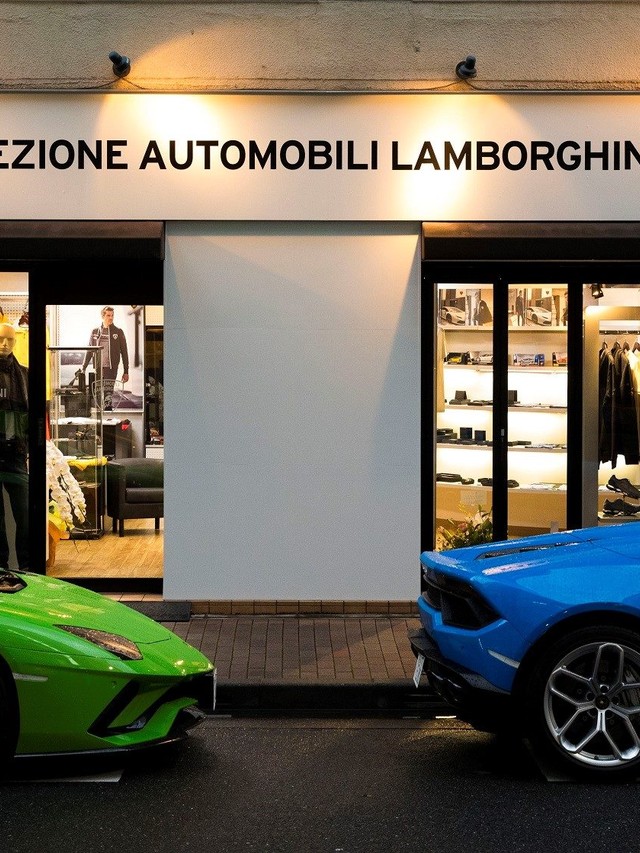
The Ginza Debut: Lamborghini’s First Collezione Store in Japan
On September 23, 2017, Lamborghini opened its first dedicated Collezione Automobili Lamborghini boutique in Ginza, Tokyo’s most prestigious shopping district. The store carries the full men’s fashion lineup and the complete accessories range, positioned alongside the neighborhood’s established luxury houses rather than inside an existing car dealership. A reception party the evening before, hosted by Michinori Okabayashi, CEO of Motorimoda Co. Ltd (the store’s operator), drew Francesco Cresci, Head of Automobili Lamborghini Japan, who framed the location as a deliberate statement: Ginza is where Japanese consumers expect to find serious luxury, and Lamborghini wanted its lifestyle brand judged on that stage.
The choice of a standalone retail space, separate from any dealership showroom, is the detail that deserves the most attention. Lamborghini already operates multiple vehicle dealerships across Japan, from Azabu to Fukuoka. Ginza is not about selling cars. It is about testing whether Lamborghini’s design language and material obsession can hold their own when divorced from a V12 entirely. That proposition, the idea that a supercar manufacturer’s aesthetic identity can survive outside the garage, is the real wager behind this storefront.
An Aventador S and a Huracán flanked the store entrance during the launch event, a visual reminder that the clothes inside owe their aesthetic vocabulary to something with 700 horsepower parked outside. Buy into the design philosophy, the display suggested, even if your driveway cannot accommodate a supercar.
Beyond Supercars: Why Lamborghini Pushed into Luxury Lifestyle
The Collezione Automobili division traces back to 1999, when Lamborghini established it initially to manage licensing and private collection projects. One source reports that the operation began with private clothing commissions before expanding into broader public collections. By 2017, the division offered five distinct lines: Event Suit, Classic, Casual, Vintage, and Pilota Ufficiale, each aimed at a different context but sharing the same design DNA.
The strategic logic is straightforward, even if the execution is tricky. Lamborghini sells roughly 3,500 to 5,000 cars per year globally (the figure has grown considerably since 2017, but even then it was a small-volume manufacturer). A fashion and accessories line multiplies the number of people who can transact with the brand by orders of magnitude. A carbon fiber carry-on from TecknoMonster or a pair of Mizuno running shoes created exclusively for Lamborghini costs a fraction of a Huracán deposit, yet each purchase reinforces brand loyalty and keeps the marque visible in contexts where supercars cannot follow: airport lounges, office lobbies, weekend errands.
Lamborghini confirmed that the collection is developed in cooperation with what it calls “top luxury partners,” though the company did not name specific fashion houses or textile suppliers beyond TecknoMonster and Mizuno. That vagueness is worth noting. For buyers accustomed to the granular transparency of Ad Personam, where every stitch color and leather hide origin can be specified, the fashion line’s supply chain remains opaque. Whether the unnamed partners include Italian ateliers with genuine haute couture credentials or volume licensees operating under the Lamborghini badge would meaningfully affect how seriously collectors take the offering, and by extension, whether the Ginza boutique earns its address.
Wearing the Raging Bull: Automotive Design Cues in the Collection
The most revealing test of any automotive fashion line is whether the design references feel earned or merely stamped on. Lamborghini says its T-shirts and jersey sweatshirts incorporate the “Y” motif drawn from the signature headlight shape found across the current car range. Leather jackets feature laser-cut inserts designed to mimic tire marks. These are not subtle nods; they are deliberate, almost literal translations of car-body sculpture into wearable form, and that boldness mirrors the cars themselves. A Lamborghini has never whispered.
For the Autumn Winter 2017 collection, the highlighted pieces included a two-button black tricot blazer paired with black jeans featuring gold stitching, plus a wool blazer with a micro kilim pattern. Gold stitching on black denim echoes the kind of interior contrast you find in a well-specced Aventador cabin, where owners routinely pair Nero Ade leather with oro detailing. That parallel is unlikely to be accidental, and it illustrates the core promise of the Ginza store: that the same design sensibility governing a supercar’s cockpit can govern a garment.
The question Lamborghini’s official material does not answer is how the tactile quality of these garments compares to what you experience inside the cars themselves. Lamborghini interiors use Alcantara, hand-stitched leather, and forged carbon fiber to justify six-figure price tags. If the fashion line delivers comparable material sophistication at its price point, the brand extension makes sense. If the fabrics feel like licensed merchandise with a premium markup, enthusiasts will notice quickly. Online customer reviews of the broader Collezione line are generally positive regarding build quality and presentation, but independent, detailed material comparisons against established fashion houses remain scarce.
Lambo vs. the Lifestyle Elite: How Rivals Play the Fashion Game
Lamborghini is not the first supercar manufacturer to open a fashion boutique, and comparing approaches reveals different philosophies about how far a car brand should stretch. Ferrari operates a sprawling lifestyle and merchandise operation that ranges from theme parks to perfume, a strategy that maximizes revenue but occasionally draws criticism from purists who feel the Prancing Horse appears on too many products. Porsche Design, meanwhile, functions as a genuinely independent design studio with its own watch, eyewear, and electronics lines, maintaining a degree of separation from the car division that lends it credibility in non-automotive luxury circles.
Lamborghini’s approach with Collezione Automobili sits somewhere between the two. The fashion line is more curated than Ferrari’s broad licensing play, but it lacks the standalone brand identity that Porsche Design cultivated over decades. Motorimoda, the Ginza store’s operator, specializes in motorsport-inspired fashion retail in Japan, which suggests Lamborghini chose a partner with relevant expertise rather than simply licensing the badge to the highest bidder.
For Lamborghini enthusiasts, this competitive context matters because it shapes perception. A tightly controlled, design-driven fashion line can reinforce exclusivity in the same way that limited-run special editions protect residual values. A loosely managed licensing program does the opposite. The Ginza boutique, by virtue of its location and standalone format, leans toward the former. Whether Sant’Agata maintains that discipline as the lifestyle division scales will determine whether Collezione becomes a genuine brand asset or a footnote.
Does Fashion Strengthen or Dilute the Lamborghini Brand?
This is the question that divides enthusiast forums whenever a supercar manufacturer ventures beyond the showroom. If anyone can walk into Ginza and buy a Lamborghini-branded blazer, does the badge lose some of its exclusivity? The counterargument carries equal weight. Lamborghini’s core product remains a low-volume, hand-built supercar that costs several hundred thousand dollars. A fashion line does not change the allocation process for a Revuelto or diminish the experience of configuring one through Ad Personam.
What the fashion line can accomplish, if executed well, is cultivate a broader community of people who identify with Lamborghini’s design values. The teenager who buys a “Y” motif sweatshirt today might become the buyer who specs a Huracán successor in fifteen years. That pipeline matters for a brand whose long-term survival depends on cultivating new generations of customers, particularly in markets like Japan where automotive enthusiasm runs deep but supercar ownership remains rare relative to population.
Dedicated Collezione stores also exist in Dubai and Taipei, alongside the factory store at Sant’Agata Bolognese. The Ginza opening expanded that footprint into one of Asia’s most important luxury retail corridors. Pricing details for the collection were not disclosed in the official material, and Lamborghini did not share sales targets or revenue projections for the fashion division. Those omissions make it difficult to assess the commercial scale of the venture, though the choice of Ginza real estate suggests confidence.
The practical takeaway for Lamborghini fans: this boutique represents a calculated bet that the brand’s design language translates beyond carbon fiber and naturally aspirated engines. Whether you view that as a welcome extension or an unnecessary dilution probably depends on how broadly you define what Lamborghini means to you. The cars remain the foundation. Everything sold in Ginza is commentary, and commentary, when done with the right materials and the right restraint, can be worth wearing.
Gallery


