A Weekend of Extremes at Spa-Francorchamps
Lamborghini’s 2018 Spa 24 Hours campaign compressed every emotion endurance racing can inflict into a single Belgian weekend: elation, catastrophe, red flags, and hard-won silverware. The headline result was a double class victory, the Huracán GT3 winning both the Silver Cup and the AM Cup. Reducing the story to that scoreline, though, misses the drama that gave those trophies their real weight.
The #63 GRT Grasser Racing entry, Lamborghini’s strongest Pro category contender, started eighth and climbed to third in the opening hours before a collision ended its race. A separate incident at Raidillon triggered a one-hour red flag and sent two drivers to the medical center. A Lamborghini Super Trofeo car that dominated the Group National category for most of the race lost everything to a late incident. Taken together, the weekend tested every layer of Squadra Corse’s customer racing operation and revealed both its vulnerabilities and its depth. The class victories mattered precisely because they emerged from that chaos, proof that the Huracán GT3 and the teams behind it could absorb punishment and still deliver results.
Why Spa Breaks Cars and Reputations
Spa-Francorchamps is a uniquely punishing venue for 24-hour racing. The 7-kilometer circuit threads through the Ardennes forest, where microclimates can deliver rain on one sector while another stays dry. Eau Rouge and Raidillon demand full commitment at speeds that leave almost no margin for error, and the long straights of Kemmel and Blanchimont reward raw aerodynamic efficiency while exposing any mechanical fragility.
For GT3 machinery, the challenge is compounded by the sheer density of the field. The Spa 24H regularly attracts more than 60 entries spanning Pro, Silver, AM, and national categories, all sharing the same tarmac. Managing traffic, tire degradation, and driver fatigue across a full day and night cycle turns even a well-prepared car into a survival exercise. That context matters when evaluating what Lamborghini’s customer teams accomplished and what went wrong for those that did not finish.
Pro Category Heartbreak: The #63’s Rise and Fall
Mirko Bortolotti set the tone early. Starting the #63 GRT Grasser Racing Huracán GT3 from eighth on the grid, the Squadra Corse factory driver carved through the field during his opening stint, reaching third position before handing the car to teammate Christian Engelhart. The pace was genuine, and for a few hours the Pro category looked like it might deliver Lamborghini a result to build on.
Then the fourth hour arrived. Andrea Caldarelli, now at the wheel, made heavy contact with the #58 McLaren of Garage59. The front of the #63 sustained severe damage, and race stewards compounded the blow with a 30-second stop-go penalty for causing the collision. The Grasser crew managed to repair the car and send it back out, but it returned to the circuit seven laps behind the leader. The damage proved terminal; not long after rejoining, the #63 pitted for the final time and retired.
The retirement stung because the pace had been real. Bortolotti’s opening stint demonstrated that the Huracán GT3 could fight at the front of the Pro class against the full weight of manufacturer entries from Porsche, Audi, Mercedes-AMG, and BMW. What the car lacked in 2018 was the fortune that 24-hour racing demands in equal measure to speed. The raw performance existed, but converting it into a Pro result at this level would require more than one clean run through the Ardennes. That gap between pace and outcome became the defining tension of Lamborghini’s weekend, and it made the class victories that followed all the more significant.
Silver Cup: Squadra Corse’s Junior Drivers Deliver
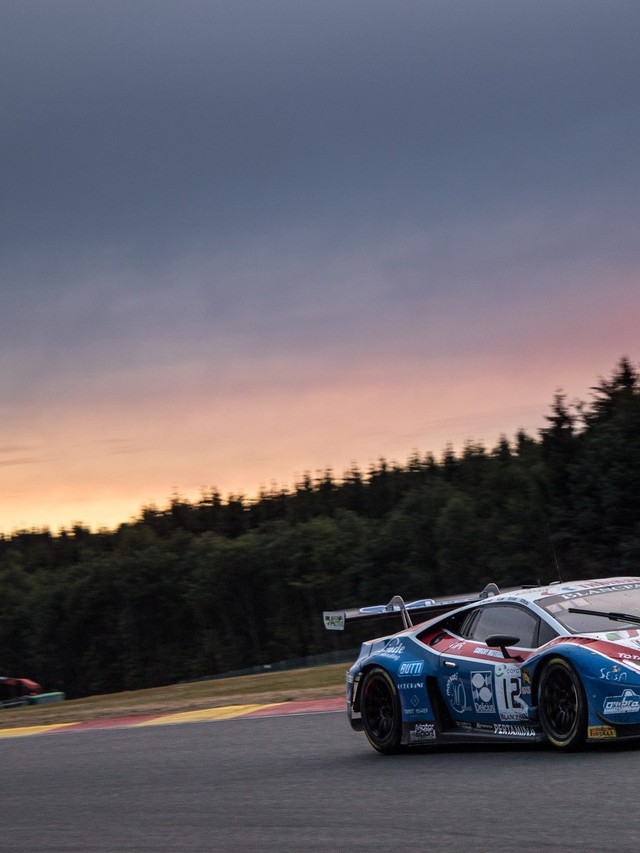
If the Pro category story was one of frustration, the Silver Cup told a different tale entirely. The #12 Ombra Racing Huracán GT3, shared by Alex Frassineti, Kang Ling, Romain Monti, and Andrea Rizzoli, led the class for the majority of the race. Their dominance was not the comfortable, unchallenged kind. Late in the event, the #78 Barwell Motorsport Huracán GT3, with Michele Beretta, Rik Breukers, Martin Kodric, and Sandy Mitchell aboard, applied sustained pressure that forced the Ombra crew to defend every lap. The Ombra car held on. Narrowly.
Lamborghini confirmed that every driver on the Silver Cup podium was a member of the Squadra Corse GT3 Junior Driver program, a detail that deserves more than a footnote. Junior driver programs in GT3 racing serve a dual purpose: they develop talent for future factory campaigns, and they demonstrate to prospective customer teams that buying a Huracán GT3 comes with a pipeline of competitive, well-coached drivers. Locking out the Silver Cup podium at one of the world’s most demanding endurance races validated the entire program’s structure. These were developing drivers proving they could execute under extreme pressure, in the middle of the night, on a circuit that punishes every lapse in concentration. Where the Pro retirement exposed the limits of fortune, the Silver Cup result showed that Squadra Corse’s investment in people was already paying dividends.

A blue Lamborghini Huracán GT3 race car with sponsor decals speeds along a racetrack.
AM Cup: Barwell Motorsport’s Commanding Run
The AM Cup victory belonged to the #77 Barwell Motorsport Huracán GT3, driven by Adrian Amstutz, Leo Machitski, Richard Abra, and Patrick Kujala. Barwell, a British outfit with deep experience in GT racing, seized the class lead early and never relinquished it. Lamborghini says the car finished five laps clear of the #9 Target Racing Huracán GT3, which took second in class with Alberto Di Folco, Stefano Costantini, Bernard Delhez, and Sylvain Debs sharing the driving duties.
A five-lap margin in a 24-hour race is decisive by any standard, speaking to consistent pace, clean pit stops, and the kind of reliability that customer teams need from their machinery. Both the winning and second-place cars were Huracán GT3s, meaning Lamborghini owned the top two positions in the AM Cup outright. Endurance racing exposes weaknesses that sprint formats can hide, and finishing 1-2 in class at Spa after 24 hours is a powerful endorsement of the car’s durability.
Barwell’s success also highlighted the strength of Lamborghini’s customer racing ecosystem in the UK. The team’s ability to manage a four-driver lineup across day, night, and variable weather conditions reflected the operational maturity that Squadra Corse actively cultivates among its partner teams. Combined with the Silver Cup lockout, the AM result painted a clear picture: even on a weekend when the Pro bid collapsed, the broader Huracán GT3 customer network proved its resilience across the field.
Red Flags and Raidillon: The Incident That Stopped the Race
At the 13-hour mark, the race was red-flagged following an incident at Raidillon involving the #666 Attempto Racing Lamborghini and the #31 Team Parker Racing Bentley. The stoppage lasted one hour while medical crews and marshals attended to the scene. Lamborghini confirmed that driver Jürgen Krebs and Bentley’s Andy Meyrick were both conscious when transported to the medical center.
Raidillon’s reputation precedes it. The uphill left-hander that follows Eau Rouge is one of the most visually spectacular corners in motorsport, and one of the most dangerous when things go wrong at speed. Incidents at this point on the circuit tend to be high-energy because cars arrive carrying significant velocity from the compression at the bottom of the hill. The red flag was a sobering reminder that GT3 endurance racing, for all its professionalism and safety improvements, still operates at the edge of acceptable risk. That both drivers were conscious was the most important detail from the entire weekend.
The Super Trofeo’s Near-Miss in Group National
Beyond the GT3 classes, GDL Racing entered a Lamborghini Super Trofeo car, the #67, in the Group National category. Driven by Sarah Bovy, Andrew Haryanto, Andres Josephsohn, and Beniamino Caccia, the car dominated its class for most of the race, surviving two collisions during the night hours and maintaining a commanding position. A late-race incident ended the team’s bid for a class win before the checkered flag.
The Super Trofeo’s presence at Spa deserves context. These cars are designed for Lamborghini’s one-make championship series, not for mixed-class endurance events against GT3 and GT4 machinery. Running one at the Spa 24H is an ambitious undertaking, and the fact that GDL Racing led the Group National category for the vast majority of the race demonstrated genuine pace and preparation. Car and Driver later tested a Super Trofeo Evo2 at Virginia International Raceway and reported a $360,000 base price for the race car, which offers some sense of the investment level involved in campaigning these machines. Even without the class win, the 2018 Spa effort showed that the Super Trofeo platform could endure far beyond its intended competitive environment, another thread in the broader story of Lamborghini machinery proving its toughness through the Ardennes.
From 2018 Class Wins to a Broader Endurance Ambition
Viewed in isolation, Lamborghini’s 2018 Spa 24H results look like a mixed bag: two class victories, one dramatic Pro retirement, one red-flag incident, and one heartbreaking late withdrawal. Viewed as a chapter in a longer story, they look like necessary groundwork.
The race proved that the Huracán GT3 could win classes at Spa, that Squadra Corse‘s junior driver program could produce results under genuine pressure, and that customer teams like Barwell and Ombra Racing could execute at the highest level of endurance competition. It also exposed the gap between class competitiveness and Pro category contention, a gap that Lamborghini would spend subsequent seasons working to close.
For LamboCars readers following the brand’s motorsport trajectory, the 2018 Spa 24H represents a pivot point. The speed was evident. The infrastructure was maturing. The customer base was delivering. What remained was translating all of that into a headline result at the front of the overall classification, a goal that would require continued development of both the car and the operational depth behind it. The practical takeaway for anyone considering a Huracán GT3 as a customer racing platform in that era was straightforward: the car could survive Spa, it could win classes against serious opposition, and the support network from Squadra Corse offered something that not every GT3 manufacturer could match. The 2018 results did not produce the kind of headline that dominates social media, but they built the kind of credibility that matters when a team is deciding where to spend its racing budget.
Gallery


