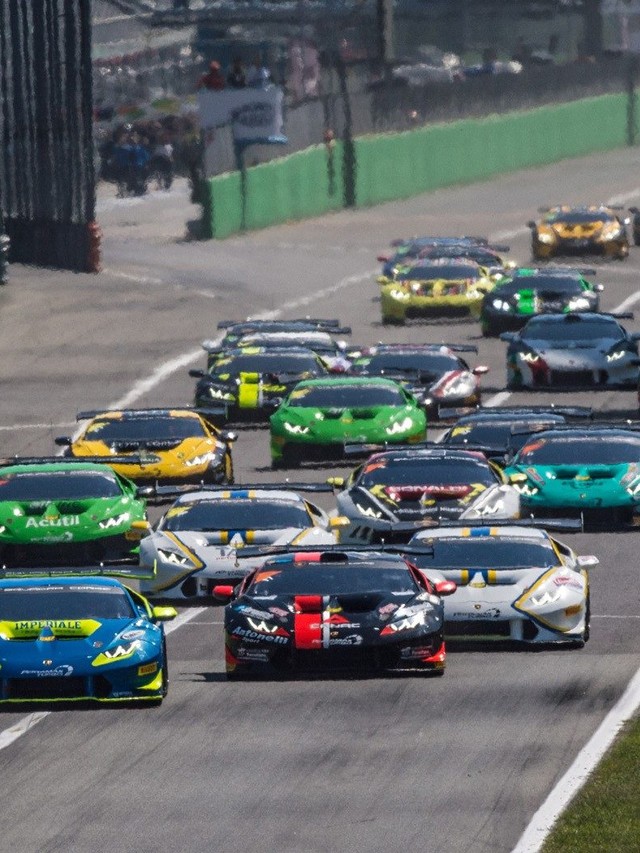
GDL Racing’s Young Guns Own the Monza Opener
Rik Breukers, eighteen years old, and Axcil Jefferies, twenty-three, drove the GDL Racing Huracán Super Trofeo to an unchallenged victory in Race 1 of the 2017 Lamborghini Super Trofeo Europe at Monza on April 22, opening the ninth edition of the championship with a statement about who belongs at the front. Breukers locked down pole position in qualifying and controlled the opening stint, building a gap that survived a safety car period ten minutes from the finish. When the field compressed behind the pace car, Jefferies held station on the restart and brought the car home first.
The pair had already secured the Super Trofeo Middle East title in early March, making this Monza result a continuation of genuine momentum rather than a one-off weekend. GDL Racing collected a second win on the day as well: Argentinian Andrés Josephsohn and Sri Lankan Dilantha Malagamuwa took the Lamborghini Cup class. Two victories from one squad, spanning the professional and gentleman-driver ends of the grid, illustrated both the team’s depth and the breadth of competition the series supports.
The overall result was shaped by a pit lane penalty that reshuffled the podium. Loris Spinelli and newcomer Mikaël Grenier, running for Antonelli Motorsport, crossed the line in second but were demoted to third after an unsafe release during their mandatory stop. That promoted the VS Racing pairing of Brazilian Raphael Abbate and Japanese Yuki Nemoto to the runner-up position. In PRO-AM, Shota Abkhazava and Kelvin Snoeks won for Artline Team Georgia, finishing eighth overall. The AM category belonged to Polish duo Andrej Lewandowski and Teodor Myszkowski of VS Racing.
The Huracán Super Trofeo as a Competitive Instrument
Every car on the Monza grid ran identical specification hardware, and that parity is the point. The Lamborghini Huracán LP 620-2 Super Trofeo is built on the bones of the road car but stripped to its competitive essentials: rear-wheel drive only, a deliberate contrast to the all-wheel-drive layout of most road-going Huracáns that puts a premium on driver skill under braking and on corner exit. Its naturally aspirated V10 engine, bespoke aerodynamic package with a prominent rear wing, and significant weight reduction through carbon fiber and aluminum make it a fundamentally different proposition from the showroom Huracán.
Because the machinery is equalized, results come down to driver talent, team preparation, pit stop execution, and race craft. The Antonelli Motorsport penalty proved that cleanly: a car fast enough to finish second lost a podium position because of a procedural error in the pit lane. In a formula where the hardware is identical, the human element decides everything, and that is precisely what makes the series a useful proving ground for young drivers.
The Huracán Super Trofeo served as Lamborghini’s customer racing backbone for years, eventually evolving into the Super Trofeo EVO specification. Autoblog reported on a nearly unused 2020 EVO Collector edition appearing on the collector market, a sign of how these cars retain desirability well beyond their competitive shelf life. The road-to-track pipeline also worked in reverse: the STO and Tecnica variants that followed on the road car side borrowed heavily from the lessons Squadra Corse learned running these machines in anger.
A Talent Pipeline Disguised as a One-Make Series
The most striking detail from the Monza entry list was the age column. Breukers at eighteen, Jefferies at twenty-three, and seventeen-year-old Jonathan Cecotto making his European Super Trofeo debut. Cecotto, the son of former Formula 1 driver Johnny Cecotto, posted the fastest time in Q2 and finished fourth overall alongside experienced co-driver Vito Postiglione at Imperiale Racing. His older brother, Johnny Cecotto Jr., also competed at the same event, sharing the Bonaldi Motorsport car with Milos Pavlovic and finishing fifth.
Two brothers from a racing dynasty, a Dutch teenager already holding a regional title, and a Zimbabwean-born driver building an international career: this is exactly the demographic the Super Trofeo was designed to attract. Inaugurated in 2009, the series functions as an entry point into the world of GT3 racing. Drivers learn racecraft, teams learn pit stop discipline, and Lamborghini identifies which young talents merit further investment through Squadra Corse‘s broader programs.
That pipeline now extends all the way to prototype endurance racing. The Temerario GT3, which Autoblog reported as Lamborghini’s first fully in-house competition car, represents the next rung on the ladder for drivers who cut their teeth in Super Trofeo machinery. The connection between a one-make series at Monza and a factory GT3 program is not abstract. It is the same organizational structure, Squadra Corse, managing both ends of the funnel.
For aspiring racers, the practical question is always cost. Lamborghini does not publish a single entry fee for the Super Trofeo, and the total budget depends on team affiliation, testing, travel, and spare parts consumption. One-make supercar racing is expensive by any measure, though the equalized machinery removes the arms-race spending that plagues open-regulation categories. What the series offers in return is seat time in a genuine race car, structured competition across multiple global regions, and visibility within a manufacturer’s official motorsport ecosystem.
The Moments That Defined the Race
Breukers described the Monza win as “the most beautiful race since the beginning of the season,” crediting GDL Racing’s preparation and noting that the team maintained a comfortable margin both at the original start and after the safety car restart. That restart, coming with roughly ten minutes remaining, compressed the entire field and gave pursuers a free shot at the leaders. Jefferies, handling the second stint, held firm.
AM class winner Teodor Myszkowski offered a different perspective, calling it “a difficult race” and pointing to the safety car restart as the most critical moment. His teammate Lewandowski’s qualifying performance gave them a buffer that proved decisive when the pack bunched up. PRO-AM winner Shota Abkhazava kept his summary simple: Kelvin Snoeks built the position in the first stint, and Abkhazava defended it in the second. Lamborghini Cup winner Josephsohn thanked GDL Racing for “a perfect car,” a nod to the team’s ability to run competitive entries across multiple classes simultaneously.
The Leipert Motorsport pairing of Jan Kisiel and Morgan Haber also deserves mention. On their debut in the series, they finished sixth overall, slotting in behind the more established Bonaldi Motorsport entry. For a new team finding its feet in the Super Trofeo paddock, sixth on the first attempt signals competent preparation and hints at the kind of team-building the series is designed to encourage.
Where Super Trofeo Fits in Lamborghini’s Motorsport Architecture
Lamborghini’s competition strategy operates on multiple tiers, and the Super Trofeo sits at the foundation. It is the widest part of the pyramid: the most accessible form of factory-backed Lamborghini racing, running regional championships in Europe, Asia, and North America before culminating in a World Finals event. Above it sits GT3 competition, where Huracán GT3 cars (and soon the Temerario GT3) race in multi-manufacturer grids against Ferraris, Porsches, and Mercedes-AMGs. At the apex, the SC63 LMDh prototype program represents Lamborghini’s return to top-level endurance racing.
The Super Trofeo’s role in this structure is to generate drivers, teams, and operational knowledge that feed upward. A team that masters pit stop procedures in a one-make series is better prepared for the complexity of a GT3 endurance race. A driver who learns tire management and race craft against identical machinery arrives at the GT3 level with fundamentals already embedded. The Antonelli pit lane penalty at Monza was a small lesson, but the kind of lesson that sticks.
Rival manufacturers run analogous programs. Ferrari’s Challenge Trofeo Pirelli and Porsche’s Carrera Cup serve similar functions, creating customer racing ecosystems that build loyalty, develop talent, and keep the brand visible at circuits worldwide. The competitive question for Lamborghini is whether its pipeline produces drivers and teams that perform at the GT3 and prototype levels. The 2017 Monza grid, packed with teenagers and early-career professionals racing alongside gentleman drivers, suggests the intake end of that pipeline was functioning as intended.
For enthusiasts who follow Lamborghini primarily through its road cars, the Super Trofeo matters because it validates the engineering. Every weakness in the Huracán platform, every strength in its chassis balance and powertrain response, gets exposed across thousands of competitive laps each season. The STO, the Tecnica, and the Performante all carry DNA refined through this kind of punishment. When Lamborghini claims track capability for its road cars, the Super Trofeo is where that claim gets tested under conditions no press launch can replicate.
What the Monza Opener Signaled for 2017 and Beyond
The ninth edition of the Super Trofeo Europe started with a grid diverse enough to tell multiple stories at once, and every one of them reinforced the same thesis: this series exists to build racers, not just entertain them. GDL Racing proved it could dominate across class boundaries. The Cecotto brothers brought a famous surname and genuine pace. Artline Team Georgia, VS Racing, Leipert Motorsport, and Bonaldi Motorsport all demonstrated that the privateer team model remained healthy. The safety car and pit lane penalty reminded everyone that one-make racing, despite equalized machinery, still produces unpredictable drama.
The results confirmed that the series continued to attract an international driver pool spanning at least nine nationalities across a single race, from Argentina and Sri Lanka to Poland and Venezuela. That geographic spread matters commercially. Every regional driver brings sponsors, media attention, and brand exposure in markets where Lamborghini sells road cars.
The broader takeaway for anyone tracking Lamborghini’s motorsport trajectory is structural. The Super Trofeo was not, and is not, a vanity exercise. It is infrastructure. The drivers who raced at Monza in April 2017 were the raw material for Squadra Corse’s ambitions at higher levels of competition. Some would advance. Some would remain gentleman racers enjoying the best track experience money can buy within the Lamborghini ecosystem. Both outcomes serve the brand, and both depend on the series continuing to deliver weekends like this one: competitive, multinational, and decided by human skill rather than engineering advantage.
Gallery


