A Last-Lap Pass Seals Altoè’s Silverstone Sprint Win
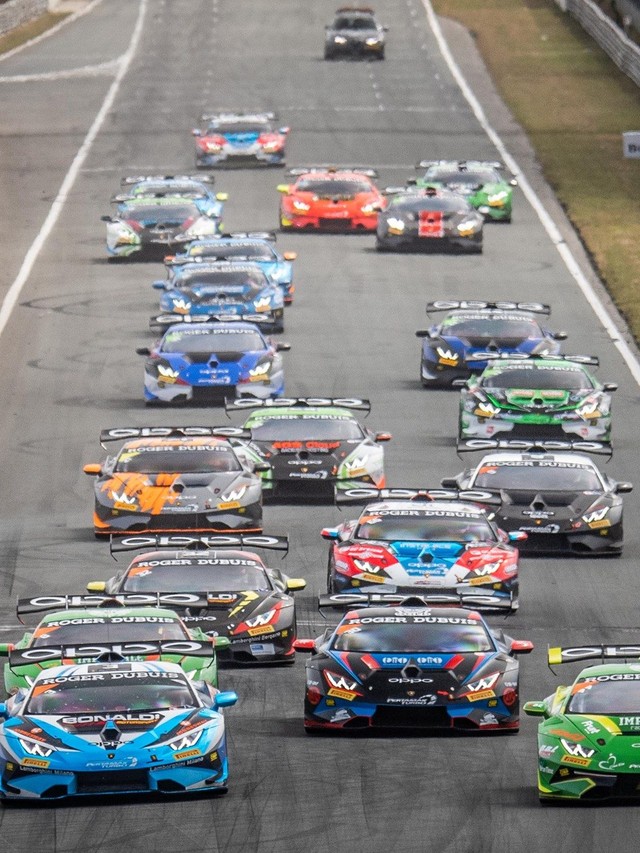
On May 20, 2018, with just over two minutes remaining in Race 2 of the Lamborghini Super Trofeo Europe at Silverstone, Giacomo Altoè found himself staring at the rear wing of Gerhard Tweraser’s Huracán Super Trofeo. Altoè, then 17 years old and a freshly enrolled member of Lamborghini Squadra Corse‘s Young Drivers Program, was racing a circuit he had never seen before that weekend. His co-driver Daniel Zampieri had done the hard work during the opening stint, handing the Antonelli Motorsport car over in third position. Altoè climbed to second, then waited.
On the penultimate lap, Tweraser made a small mistake. Altoè did not need a second invitation. He seized the lead, threaded through lapped traffic in the closing moments, and sprinted to the finish ahead of the Austrian. It was his second overall victory in the series and his first of the 2018 season alongside Zampieri, solidifying his lead in the PRO class standings at the second round of the European championship.
The result was more than a promising weekend for a teenage prodigy. It was an early, visible proof point for the talent pipeline Lamborghini had been building through its Young Drivers Program, a pathway that would carry Altoè from one-make racing to factory driver status and a world championship within two years.
Why the Young Drivers Program Made Silverstone Matter
Lamborghini’s Young Drivers Program is designed to identify promising drivers early, embed them in the brand’s racing ecosystem, and develop them into assets capable of representing the marque at GT3 and endurance level. The Super Trofeo series, which Lamborghini established in 2009, serves as the primary proving ground. Every car on the grid runs the same Huracán Super Trofeo specification, stripping away the engineering variable and forcing the competition to revolve around racecraft, consistency, and the ability to manage a co-driver relationship across a timed pit-stop format. For a manufacturer evaluating raw talent, that controlled environment is more useful than a mixed-class GT field where car performance can mask or exaggerate a driver’s actual ability.
Altoè’s Silverstone weekend illustrated the program’s logic perfectly. Lamborghini says he had never driven the circuit before arriving for practice. He relied on Zampieri’s knowledge and coaching throughout the weekend to learn the track, a detail Altoè himself acknowledged after the race. The program did not just hand him a seat; it surrounded him with experienced teammates and team infrastructure designed to accelerate his development under competitive pressure. That kind of structured mentorship, inside a one-make series the manufacturer controls, is difficult to replicate through conventional sponsorship or pay-driver arrangements.
The speed of Altoè’s progression after Silverstone underscored the pipeline’s effectiveness. Later in November 2018, Altoè and Zampieri went on to claim the Super Trofeo world championship honours at Vallelunga, winning the World Finals and earning Altoè the “Best Lamborghini Young Driver” award. He was still a teenager. By 2020, at just 19 years old, Altoè became a Lamborghini factory driver. Giorgio Sanna, Lamborghini’s head of Squadra Corse, described him at the time as a “perfect example of how our young driver programs help to train up-and-coming drivers and offer them real career opportunities.” The trajectory from Silverstone to factory contract took roughly 18 months, compressed because the Super Trofeo series sits closer to the GT3 machinery the brand actually races in professional competition. A driver who excels in the one-make car already understands the Huracán platform’s behavior, reducing adaptation time when stepping up to GT3 or endurance roles.
How the PRO Race Unfolded: Penalties, Pit Strategy, and the Final Attack
The PRO class race was shaped well before Altoè’s decisive pass. Dennis Lind of Target Racing grabbed the lead at the start but received a drive-through penalty for anticipating the green flag, having already passed both poleman Edoardo Liberati and Axcil Jefferies of Konrad Motorsport. That penalty reshuffled the order and set up the sequence of pit-stop strategy that ultimately put Tweraser in the lead and Altoè in a position to attack.
With Lind removed from contention, the race became a contest of pit-stop timing and second-stint pace. Zampieri’s disciplined opening stint, handing the car over in third, gave Altoè clean air and fresh tires at the right moment. The teenager’s ability to close on Tweraser and capitalize on a single mistake in the penultimate lap showed the composure that had caught Squadra Corse’s attention in the first place. Altoè acknowledged after the race that learning Silverstone from scratch made the weekend more demanding, but the result confirmed that the Antonelli Motorsport operation and the Young Drivers Program support structure could extract performance even on unfamiliar ground.

A group of five male race car drivers in black racing suits and hats stand on a podium with their trophies.
Class Winners Across the Grid: PRO-AM, AM, and Lamborghini Cup
Altoè’s last-lap heroics dominated Race 2, but the supporting classes told their own stories about the depth of competition on the Super Trofeo Europe grid.
Antonelli Motorsport swept two class victories. Juan Perez and Loris Spinelli claimed their third consecutive PRO-AM win after Spinelli executed a late-race recovery drive, overtaking Hans-Peter Koller in the closing laps to finish fifth overall and first in class. Perez, racing at Silverstone for the first time, noted the high standard of competition in PRO-AM. The Perez-Spinelli pairing moved to the top of the PRO-AM ranking with the result. Koller and Liberati finished second in class, with Francesca Linossi and Stefano Colombo of Iron Lynx Motorsport Lab completing the PRO-AM podium.
In the AM class, Andrej Lewandowski and August MacBeth repeated their Race 1 victory for VS Racing. MacBeth, on his debut weekend, held off Raffaele Giannoni of Automobile Tricolore in the final laps to secure back-to-back wins. Manuel Lauck and Florian Scholze of Dörr Motorsport rounded out the AM podium.
The Lamborghini Cup produced a statistic worth noting: four races into the season, four different winners. Gerard Van der Horst, the 2017 champion, took his first win of the year in Race 2 and moved to the top of the Cup standings. Van der Horst described it as his best race in two years, fought under intense heat and constant pressure from Joseph Collado. That kind of parity, where no single driver can dominate across weekends, is exactly what a one-make series needs to remain commercially attractive to the gentleman drivers and amateur racers who fund much of the grid.
The Super Trofeo Ladder and What Comes Next
One-make racing series occupy a slightly awkward commercial space. They need paying customers to fill the grid, which means the cars and the experience must appeal to wealthy amateur drivers. But they also need competitive credibility, which means the series must produce drivers good enough to graduate into professional GT racing. Get the balance wrong in either direction and the series either becomes a country-club parade or loses the customer base that funds it.
Lamborghini’s Super Trofeo manages this tension through its class structure, splitting PRO, PRO-AM, AM, and Lamborghini Cup so that factory-backed young guns like Altoè can race wheel-to-wheel against seasoned professionals while gentleman drivers compete on their own terms in the same field. The Silverstone grid demonstrated this range clearly: a 17-year-old future factory driver winning overall, a debuting co-driver taking two AM victories in his first weekend, and a reigning champion battling heat and close competition to reclaim the Lamborghini Cup lead.
The drivers who prove themselves in the one-make car become candidates for GT3 seats. The gentleman drivers who enjoy the series become long-term brand loyalists who buy road cars, attend events, and fund racing programs. Both sides of that equation matter, and Altoè’s career arc from Silverstone sprint winner to factory driver remains the clearest illustration that the pipeline works.
The Lamborghini Super Trofeo Europe’s third round was scheduled for Misano, Italy, on June 23-24, 2018, continuing a season that would ultimately validate Silverstone’s early promise when Altoè and Zampieri claimed the world championship at Vallelunga five months later.


