The Raging Bull on Two Wheels
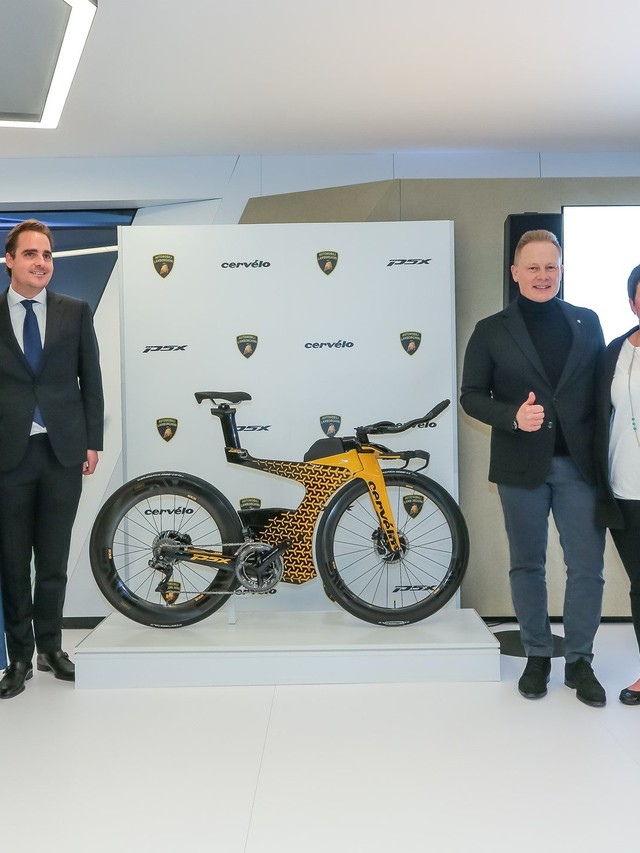
At the 2018 Geneva International Motor Show, Automobili Lamborghini and Cervélo Cycles pulled the cover off something that looked nothing like a supercar but carried unmistakable Sant’Agata DNA: the Cervélo P5X Lamborghini edition, a triathlon bicycle limited to 25 individually numbered examples and priced at $20,000. The bike sat on a white pedestal between the two companies’ logos, its carbon frame finished in Lamborghini’s signature yellow topcoat with angular Y-shaped patterning running across the frame and fork. If you squinted, the geometry could pass for a detail lifted from a Huracán’s rear haunch.
The collaboration deserves attention not because Lamborghini suddenly cares about triathlon splits, but because it reveals how deliberately the company curates its brand beyond the factory gates. This was not a licensing deal where someone slaps a shield on a commodity product and calls it premium. Lamborghini says the artwork was created by Centro Stile, the same in-house design studio at Sant’Agata Bolognese responsible for shaping the Aventador, the Huracán, and every limited series that followed. Centro Stile involvement means the design language was translated, not merely borrowed, and that distinction threads through every aspect of the project.
Why Lamborghini Made a Bicycle (and What It Signals)
Luxury automakers extending their brands into lifestyle products is hardly new. Ferrari licenses everything from fragrances to theme parks. Porsche puts its name on watches, luggage, and an entire design studio. Lamborghini’s approach tends to be narrower and more deliberate, favoring collaborations where the partner already operates at the top of its own performance category.
Cervélo fits that profile precisely. According to GearJunkie, the P5X earned acclaim as one of the fastest and most expensive triathlon bikes in the world before Lamborghini ever got involved. The base platform already represented serious engineering, with over 180 hours of wind-tunnel testing, aerodynamically integrated storage, and what Lamborghini describes as unprecedented micro-adjustability. The collaboration started from a position of genuine performance credibility rather than cosmetic uplift.
Katia Bassi, Lamborghini’s Chief Marketing Officer at the time, offered a revealing detail: Lamborghini Accademia drivers had already been training on Cervélo bikes before the partnership was formalized. The relationship grew organically from actual use, not from a marketing brainstorm, lending the project a degree of authenticity that pure brand-licensing deals rarely possess.
The broader pattern is consistent. Lamborghini’s collaboration with Italian Sea Group on the Tecnomar yacht followed the same logic: partner with a specialist already building at the highest level, then let Centro Stile translate the visual and philosophical DNA. As Car and Driver noted in covering the Tecnomar project, the Lamborghini lifestyle play now extends to vessels making 7,800 horsepower. A $20,000 bicycle and a megayacht occupy wildly different price brackets, but the strategic thread connecting them is identical: Lamborghini chooses partners whose engineering ambitions match its own, then applies its design language with enough depth that the result reads as more than a badge exercise.
Centro Stile’s Signature: Automotive Design DNA on Carbon Fiber
The interesting question for Lamborghini enthusiasts is whether the P5X actually looks like a Lamborghini product or merely wears Lamborghini colors. Based on the available imagery, the answer leans toward the former. The Y-shaped patterning across the frame echoes the geometric motifs that Centro Stile embeds throughout current production cars, from interior stitching patterns to exterior aero surfaces. The yellow topcoat is not a generic racing yellow; it is the specific shade associated with Lamborghini’s most aggressive liveries.
Designers at Centro Stile enhanced the all-black carbon frame with these accents, applying the brand’s iconic paint scheme directly. GearJunkie also mentions a custom decal on the head tube denoting the collaboration, a small detail that reinforces the co-branded identity without overwhelming Cervélo’s own visual language.
What makes this translation work, at least on paper, is restraint. Centro Stile did not try to make the bicycle look like a car. The design cues are embedded into the bike’s existing geometry rather than imposed on top of it. Sharp angles on the frame tubes pick up light in ways that recall Lamborghini’s faceted bodywork, but the proportions remain those of a purpose-built triathlon machine. For anyone who collects Lamborghini memorabilia, the visual coherence between the P5X and the cars it references is the entire value proposition, and it holds together because the studio treated the project with the same rigor it brings to automotive paint schemes.

Six individuals pose with the new yellow and black Cervélo P5X triathlon bicycle at its official unveiling event.
Performance Credentials Behind the Paint
Strip away the Lamborghini livery and the P5X remains a formidable piece of cycling engineering. Lamborghini says the bike combines aerodynamically integrated storage with aero performance refined through more than 180 hours of wind-tunnel testing. For triathletes, integrated storage is a genuine competitive advantage because it eliminates the aerodynamic penalty of strapping nutrition and tools to a frame designed to cheat the wind.
Robert de Jonge, Cervélo’s Managing Director, framed the collaboration in performance terms, noting that triathletes using Cervélo already lead the charge in racing. The Lamborghini edition does not appear to modify the P5X’s underlying engineering. Instead, it layers Centro Stile’s visual treatment onto a platform that was already engineered for speed, which is precisely the approach that keeps the collaboration credible. A $20,000 triathlon bike that looked spectacular but compromised aero performance would undermine both brands.
The parallel to Lamborghini’s automotive philosophy is direct. When Lamborghini builds a special edition car, the visual drama typically sits on top of proven mechanical architecture. The Reventón was a Murciélago underneath. The Veneno shared the Aventador’s platform. The P5X Lamborghini edition follows the same template: proven performance bones dressed in bespoke Centro Stile clothing. That consistency is what separates a genuine design collaboration from a sticker job.
Twenty-Five Units: Collectibility for a Different Kind of Enthusiast
Each of the 25 P5X Lamborghini edition bicycles carries a seat post number stamp denoting its position in the production run, and each comes with a custom-designed P5X bike travel case. At $20,000, the price sits well above a standard P5X but remains accessible compared to Lamborghini’s automotive limited editions, where few-off programs like the Reventón occupy entirely different financial stratospheres.
That accessibility is part of the point. The P5X Lamborghini edition occupies a collector space where a passionate Lamborghini enthusiast who may not own a Huracán can still acquire an authentic, Centro Stile-designed, individually numbered piece of the brand’s output. Whether these 25 bikes appreciate in value over time is an open question Lamborghini has not addressed, and predicting the secondary market for ultra-limited cycling collectibles involves too many variables to offer a reliable answer. What can be said is that the combination of a 25-unit production run, Centro Stile provenance, and the Lamborghini name creates the kind of scarcity that collectors in adjacent luxury categories tend to reward.
For practical buyers who actually intend to race on one, the travel case is a thoughtful inclusion. Triathlon is an inherently mobile sport, and protecting a $20,000 carbon fiber investment during transit is not a trivial concern. It suggests Cervélo and Lamborghini thought about the end user’s actual life, not just the showroom moment.
A Design Philosophy That Happens to Make Cars
Every major supercar manufacturer now treats brand extension as both a revenue stream and an identity play. Ferrari operates an entire consumer products division spanning fashion, accessories, and its Maranello theme park. Porsche Design functions almost as a standalone luxury brand, producing everything from watches to kitchen appliances. Both companies cast wide nets.
Lamborghini’s strategy reads as more selective. The Cervélo collaboration, the Tecnomar yacht, and targeted fashion partnerships share a common characteristic: each partner already commands respect in its own domain. Lamborghini appears less interested in volume licensing and more interested in a curated portfolio where each product reinforces the core brand promise of extreme performance and uncompromising design. Whether that selectivity is a deliberate strategic advantage or simply a reflection of Lamborghini’s smaller scale relative to Ferrari is debatable, but the result for enthusiasts is a tighter, more coherent brand ecosystem.
The P5X collaboration also highlights a demographic truth about Lamborghini’s customer base. Triathlon attracts a high-net-worth, fitness-oriented demographic that overlaps significantly with supercar ownership. Lamborghini Accademia, the company’s driver training and experience program, already incorporates physical fitness elements. Placing the Lamborghini name on elite cycling equipment is a logical extension of that lifestyle positioning, connecting the brand to how its customers actually spend their time outside the car.
For LamboCars readers, the practical takeaway is straightforward: if Lamborghini’s lifestyle collaborations continue to follow this pattern of partnering with top-tier specialists and deploying Centro Stile for genuine design work, these limited-edition objects are likely to remain credible collector pieces rather than forgettable merchandise. The P5X Lamborghini edition is a small-volume curiosity in the grand scheme of Sant’Agata’s output, but it reveals something important about how the company thinks about its own identity. Lamborghini sees itself as a design and performance philosophy that happens to be expressed most famously through cars, not a car company that occasionally licenses its logo. The P5X, for all its two-wheeled modesty, makes that case rather convincingly.


