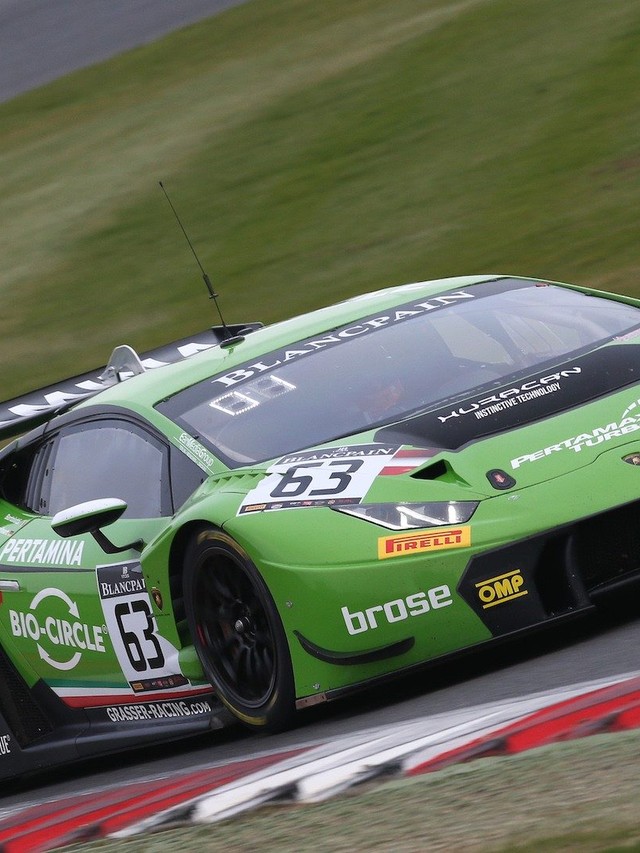
Pole, Track Record, Two Wins: GRT’s Unstoppable Brands Hatch Weekend
Mirko Bortolotti qualified the Grasser Racing Team’s #63 Lamborghini Huracán GT3 on pole at Brands Hatch in May 2017 with a lap of 1:22.891, nearly half a second quicker than the previous circuit record. What followed was comprehensive domination: Bortolotti and co-driver Christian Engelhart won both the Qualifying Race and the Main Race at the second round of the Blancpain GT Series Sprint Cup, beating BMW and Audi factory entries in a 31-car field.
The GRT sister car, the #19 driven by Norbert Siedler and Ezequiel Perez Companc, added a podium with third place in the opening race. Attempto Racing’s #66, crewed by factory drivers Marco Mapelli and Giovanni Venturini, finished ninth. Three Huracán GT3s landed in the top ten, with the winner setting the outright pace from the first timed lap to the final checkered flag. For a brand still proving itself in top-level GT racing barely two years after the car’s 2015 debut, the statement was unambiguous.
Why Brands Hatch Mattered More Than a Single Trophy
The Huracán GT3 was introduced in 2015, developed by Lamborghini’s Squadra Corse division in collaboration with Dallara Engineering. Lamborghini lacked the decades of factory GT racing pedigree that Porsche and Ferrari could claim, and the early seasons involved building trust with customer teams and proving the car’s reliability across different circuits and conditions. That background is what made Brands Hatch a threshold moment rather than just another good weekend.
GRT arrived fresh from a victory at Monza in the Blancpain GT Endurance Cup opener, then swept a sprint weekend against works-supported Audi R8 LMS and BMW M6 GT3 entries. Winning one race from pole can be attributed to qualifying pace. Winning both, with the track record, against factory opposition on a tight, unforgiving circuit like Brands Hatch, required the full package: car, drivers, team preparation, and tire management. For customer teams evaluating which GT3 car to buy, weekends like this one shifted the calculus. The Huracán GT3 was no longer a promising newcomer. It was a proven winner.

The green Lamborghini Huracan GT3 race car, number 63, navigates a turn on the track during a high-speed race event.
The Engineering That Made It Possible
At the core of the Huracán GT3 sits a racing-optimized version of Lamborghini’s naturally aspirated 5.2-liter V10. Lamborghini states the engine produces over 550 horsepower, though actual output in any given race depends on the Balance of Performance regulations that series organizers use to equalize different manufacturers. BoP adjustments can alter air restrictors, minimum weight, and ride height, meaning raw power figures tell only part of the story. The car’s ability to extract performance from the complete package, not just peak horsepower, explains why it could dominate even when restricted.
The chassis combines a carbon fiber monocoque with an integrated roll cage and full carbon fiber body panels, delivering both rigidity and low weight. Power reaches the rear wheels through a six-speed sequential gearbox with paddle shifters. According to one source, the car tips the scales at approximately 2,712 pounds (1,230 kg) per GT3 regulations, placing it squarely in the competitive window for the class. A detail that few competitors mention: the Huracán GT3 features a Bosch ABS system with 12 settings adjustable directly from the steering wheel, giving drivers like Bortolotti granular control over braking behavior from corner to corner.
Adjustable front splitter and rear wing elements, visible on the #63 car in competition imagery, allowed GRT’s engineers to fine-tune aerodynamic balance for Brands Hatch’s mix of high-speed sweeps and tight, technical sections. Dallara’s involvement brought chassis expertise from open-wheel and prototype racing, a collaboration that gave the Huracán GT3 structural sophistication beyond what Lamborghini’s road car division could achieve alone.
From Brands Hatch to the Temerario: A Decade of GT3 Evolution
The credibility earned at Brands Hatch proved durable. The Huracán GT3 went on to accumulate victories at the Daytona 24 Hours and Sebring 12 Hours, according to one report, extending Lamborghini’s reach into North American endurance racing. Squadra Corse iterated on the platform with the GT3 EVO and GT3 EVO2, refining aerodynamics and mechanical grip while retaining the naturally aspirated V10 that became the car’s signature.
As Road & Track noted in its coverage of the successor program, Lamborghini ran updated versions of the same basic Huracán GT3 for a full decade while competitors like Porsche cycled through three entirely different GT3 platforms. That longevity speaks to how well the original car’s fundamentals were engineered, but it also created pressure to deliver a worthy replacement.
The Temerario GT3, revealed at the 2025 Goodwood Festival of Speed, represents that next chapter. Car and Driver reports it is the first race car entirely designed and developed at Lamborghini’s Sant’Agata Bolognese facility, a shift from the Dallara collaboration that defined the Huracán program. It moves to a twin-turbocharged V8 and drops the road car’s hybrid system, a regulatory requirement that strips the powertrain to its combustion essentials for competition. For teams and drivers who built their programs around the Huracán’s characteristics, this transition means adapting to an entirely new powerband, different weight distribution, and the complexities of turbo management in wheel-to-wheel racing. Whether the Temerario GT3 can match its predecessor’s competitive record remains an open question that only race weekends will answer.
Racing Credibility as a Brand Asset
Lamborghini’s road car lineup now draws openly from its racing programs. The Huracán STO and the limited, 10-unit STJ that served as the model’s farewell both borrowed aerodynamic philosophy and chassis tuning approaches refined through GT3 competition. The company’s willingness to let Squadra Corse influence road car development, rather than treating motorsport as a marketing sideshow, traces directly to the credibility earned during seasons like 2017.
The competitive landscape in GT3 racing remains fierce. Ferrari fields the 296 GT3, Mercedes-AMG competes with its own factory-backed GT3 entry, and Porsche’s 911 GT3 R program benefits from decades of institutional knowledge. Lamborghini’s position in this arena depends on results, not heritage, which makes weekends like Brands Hatch 2017 foundational rather than decorative. GRT’s double victory demonstrated that Lamborghini could compete at the front of GT3 grids on merit, a message that resonated with the customer teams who ultimately fund these programs by purchasing race cars from Squadra Corse.
The Blancpain GT Series has since been rebranded as the GT World Challenge, the Huracán has given way to the Temerario, and the competitive order keeps reshuffling. What endures from that 2017 Brands Hatch weekend is simpler: the proof that Lamborghini belongs in this fight, and the engineering foundation that made belonging possible.


