Art Basel, Miami Beach: A Deliberate Stage for an Unlikely Supercar
Lamborghini chose Art Basel in Miami Beach to debut the Huracán Sterrato, and the venue tells you almost as much as the car itself. An off-road supercar at an international art fair is a calculated provocation, the kind of move designed to frame a lifted, cladded, rally-light-equipped V10 coupe as something closer to a sculpture than a parts-bin experiment. Stephan Winkelmann, Lamborghini’s Chairman and CEO, leaned into the parallel directly, calling the Sterrato “a radical and original interpretation of the super sports car concept” that belongs alongside avant-garde art.
The subtext is hard to miss. Widely recognized as the send-off for the Huracán model line and the naturally aspirated V10 that powered every variant from the LP 610-4 through the STO, the Sterrato is not merely another derivative. Launching the final pure-combustion Huracán at an art event rather than a motor show or a racetrack signals that Lamborghini views this car less as an engineering exercise and more as a cultural statement: the last chapter of a ten-year story, written in dirt.
The Final V10: Why the Sterrato Closes a Chapter
Every Huracán that left Sant’Agata Bolognese carried some version of the same naturally aspirated 5.2-liter V10. The Sterrato keeps the formula intact: 610 CV, 560 Nm of torque peaking at 6,500 rpm, a 7-speed dual-clutch gearbox, and electronically controlled all-wheel drive with a rear mechanical self-locking differential. It reaches 100 km/h in 3.4 seconds and tops out at 260 km/h.
Those numbers matter less for what they are and more for what they represent. The Temerario, Lamborghini’s next-generation V8 hybrid, will bring forced induction and electric assistance to the brand’s “entry” supercar. The Sterrato, then, is the last time a Lamborghini buyer can order a new, naturally aspirated, mid-engine V10 and point it at a gravel road. For collectors and enthusiasts who define Lamborghini by the sound of ten cylinders breathing through individual throttle bodies, the significance is self-evident. Production is limited to 1,499 units, with assembly scheduled to begin in February 2023.

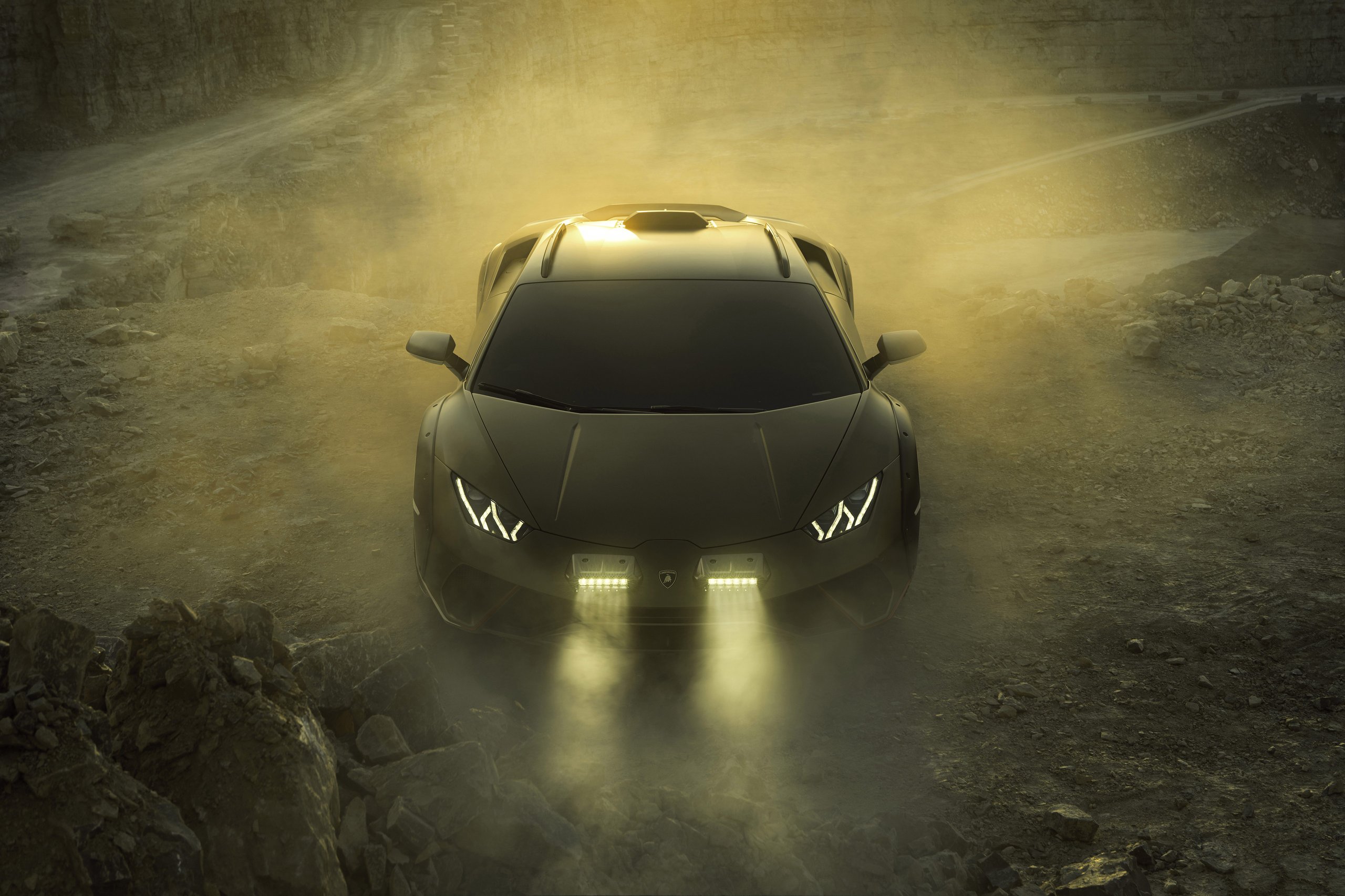
The Lamborghini Huracán Sterrato's rugged rear design is showcased against a dusty, golden-hour backdrop.
Beyond Asphalt: What the Sterrato Actually Changes
Calling the Sterrato an “off-road supercar” is catchy but slightly misleading. It is better understood as a supercar recalibrated for unpaved surfaces, loose gravel, and the kind of beaten-up back roads that would leave a standard Huracán EVO nursing cracked carbon fiber. The ground clearance increase of 44 mm over the EVO is meaningful in context but modest in absolute terms. One reviewer notes that the resulting 6.4 inches of clearance is a lot for a Lamborghini but would not impress a Jeep owner.
What genuinely transforms the driving experience, according to available reviews, is the suspension tuning. Revised electronically controlled dampers, softer springs, and softer anti-roll bars deliver a compliance the Huracán line never offered before. The front track widens by 30 mm, the rear by 34 mm, and the combination of stance and suppleness makes the car more forgiving on rough surfaces while still feeling planted through corners. One review from Car and Driver went so far as to suggest the Sterrato is the best Huracán for daily driving, a conclusion that would have sounded absurd before anyone actually drove it.

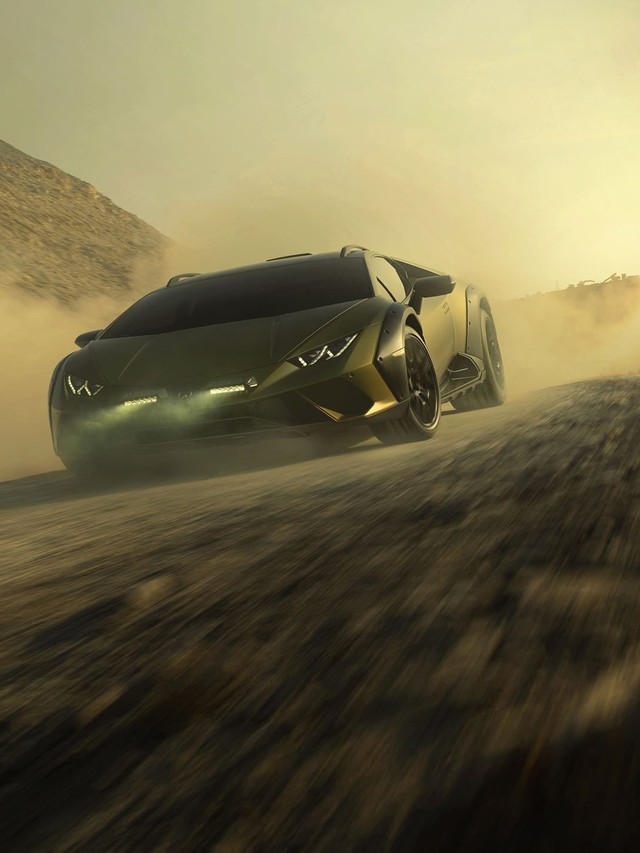
The Lamborghini Huracán Sterrato charges through a dusty desert, showcasing its off-road capabilities and distinctive rally lighting.
Engineering the Unexpected: Rally Mode, Bespoke Tires, and Underbody Armor
The hardware list reads like a rally preparation sheet filtered through a supercar lens. Aluminum front underbody protection guards the oil sump and front structure. Reinforced sills and robust wheel arches absorb the kind of debris that gravel roads throw at low-slung bodywork. A rear hood-mounted air intake, visually reminiscent of classic rally scoops, serves a practical purpose: routing clean air to the V10 when the car is trailing a dust plume.
Lamborghini’s LDVI system introduces RALLY mode to the Huracán line for the first time, joining recalibrated STRADA and SPORT settings. RALLY mode adjusts torque distribution, traction control intervention, and damper response for low-grip conditions, essentially giving the car permission to slide in a controlled, predictable way rather than fighting the driver at every input. The car rides on 19-inch rims wrapped in bespoke Bridgestone Dueler AT002 run-flat tires (235/40 front, 285/40 rear), a genuinely unusual choice for a mid-engine supercar: an all-terrain compound and tread pattern engineered to grip both gravel and tarmac, with run-flat capability rated for 80 km at 80 km/h on zero pressure. That last detail is quietly practical. A puncture on a remote dirt road in a car with no spare wheel is a very different problem than the same puncture on a highway shoulder.
Inside, the HMI picks up the adventure theme with instruments few supercar buyers expect: a digital inclinometer with pitch and roll readouts, a compass, geographic coordinates, and a steering angle indicator. Connectivity features like Amazon Alexa integration and the Lamborghini UNICA app round out the cabin technology, though the real story in the cockpit is the exclusive Alcantara Verde Sterrato upholstery, a visual commitment to the car’s identity that most owners will probably want to keep clean despite the car’s intended habitat.

The rugged Lamborghini Huracán Sterrato stands ready on a rocky landscape, its unique design highlighted by the golden hour light.
Exclusivity and the Ad Personam Question
With 1,499 units allocated globally, the Sterrato occupies an interesting middle ground: scarce enough to feel special, numerous enough that finding one on the secondary market will not require a decade of patience. Lamborghini’s Ad Personam program opens 350 exterior colors and more than 60 interior options to buyers, which in practice means most delivered Sterratos will look meaningfully different from one another. For a car designed to stand out on principle, that level of personalization matters commercially. Forum discussions on Lamborghini-Talk already reflect buyers weighing color choices with long-term resale in mind, a sign that the collector market is paying attention even at this early stage.
Reports indicate a standard-spec Sterrato with delivery mileage recently sold on Bring a Trailer for $306,000, roughly $16,000 below its original sticker price. That data point is early and narrow, but it suggests the market is still finding its footing on Sterrato values. Buyers speccing aggressively through Ad Personam, or holding low-mileage examples, may see a different trajectory as the V10’s extinction becomes more tangible with each Temerario delivery.
Sterrato vs. 911 Dakar: Two Philosophies, One Niche
The Porsche 911 Dakar arrived at roughly the same cultural moment, and the two cars inevitably get compared. The broad strokes are similar: lifted suspension, all-terrain tires, all-wheel drive, limited production. The execution diverges sharply. The Sterrato brings a naturally aspirated V10 producing over 600 CV and a top speed of 260 km/h. The Dakar, according to available comparative reporting, uses a twin-turbo flat-six producing around 473 to 480 horsepower, with a top speed of 240 km/h on summer tires. Both reach 100 km/h in 3.4 seconds, a near-identical sprint despite the Lamborghini’s significant power advantage, which speaks to the Porsche’s lighter curb weight and turbocharged torque delivery.
The character split is where things get interesting for buyers. Reviews describe the Sterrato as louder, more aggressive, and more willing to crash through rough terrain with dramatic flair. The Dakar, by contrast, is frequently characterized as more refined and composed, floating across obstacles rather than attacking them. Neither approach is wrong; they reflect the DNA of their respective brands almost perfectly. For Lamborghini buyers, the Sterrato offers something the Dakar cannot: a naturally aspirated V10 soundtrack on a dirt road, an experience unlikely to be replicated by any future production car from Sant’Agata or Stuttgart.
Lamborghini’s broader competitive position benefits from the Sterrato’s existence in a subtler way. The LM002 proved decades ago that the company would build something audacious if the idea was compelling enough. The Sterrato reinforces that willingness at a moment when the brand’s lineup is transitioning to hybrid powertrains, reminding buyers and rivals alike that Lamborghini’s instinct for provocation survived the V10 era intact.

Gallery