Three Cars, Three Arguments, One Hill
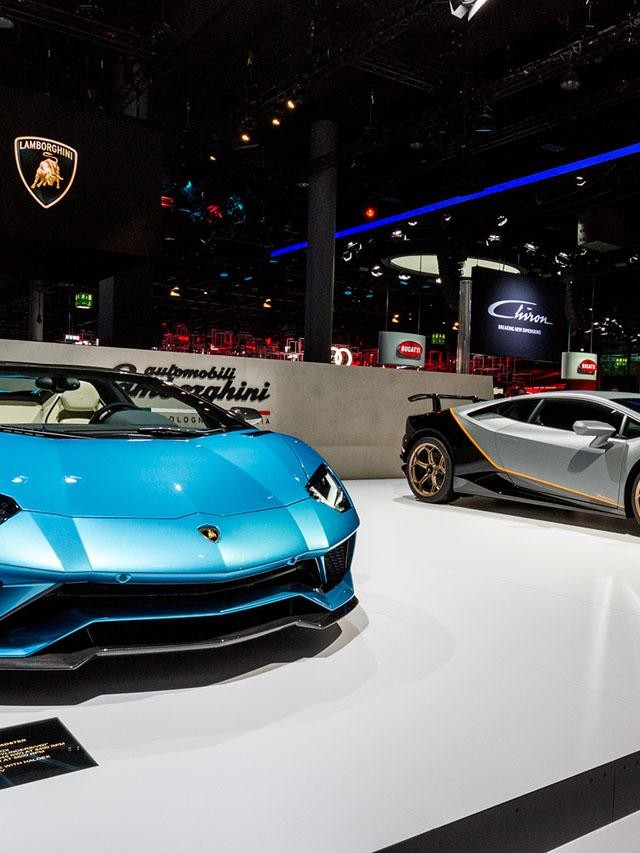
Lamborghini brought three naturally aspirated supercars to the 2017 Goodwood Festival of Speed, and each one carried a different message up Lord March’s famous driveway. The Centenario made its first public dynamic run in the supercar class. The Huracán Performante took its UK bow fresh from a Nürburgring lap record. And a one-off Aventador S, finished in matt grey and orange by Lamborghini’s Ad Personam division, sat on the brand’s stand as a physical argument for bespoke ownership.
Goodwood is not Geneva. Cars are not parked under spotlights and explained by PowerPoint. They are driven, heard, and judged in real time by crowds who can distinguish a flat-plane V8 from a crossplane one by ear alone. For a manufacturer whose identity is inseparable from the sound of naturally aspirated engines, that distinction matters. Lamborghini chose this venue to let all three powertrains speak without studio reverb: the V12 in the Centenario and Aventador S, the V10 in the Performante. Together, the trio amounted to a full-spectrum showcase of what the brand could offer a buyer in 2017, from validated lap times to singular bespoke creations to collector-grade scarcity.
The ‘Opera Unica’ Aventador S: What Ad Personam Actually Looks Like
The most quietly significant car on the Lamborghini stand was the Aventador S that nobody could buy. Crafted by the Ad Personam department alongside Centro Stile, the one-off carried a matt Grigio Acheso exterior accented by a matt orange livery running from the front bumper to the rear diffuser. A full gloss carbon fiber package covered the exterior, including a visible carbon fiber roof. Gloss black Dianthus wheels, orange calipers, and a matt black exhaust completed the look. Inside, Alcantara Nero Ade wrapped the cabin, with orange Arancio Leonis seat inserts and steering wheel stitching echoing the exterior palette. A special plate reading “Opera Unica” confirmed the car’s status as a singular creation.
Ad Personam competes directly with Ferrari’s Tailor Made and McLaren’s MSO programs, but Lamborghini’s version leans harder into the visual drama that defines the brand. Where a bespoke Ferrari might express itself through subtle leather choices and heritage paint codes, a bespoke Lamborghini tends to announce itself. The Goodwood car demonstrated this philosophy clearly: the orange stripe traced the Aventador S’s aerodynamic lines like a highlighter pen, turning a design feature into a graphic statement.
For prospective buyers, the practical takeaway is straightforward. Ad Personam allows customization of virtually any external and internal color and trim across the Lamborghini range. The program’s real value, though, lies not in the menu of options but in the collaboration with Centro Stile’s designers, who can push a specification into territory that a configurator never reaches. The “Opera Unica” plate is not decoration. It is a guarantee of singularity.
The Centenario’s Calculated Scarcity
Created to celebrate the centenary of founder Ferruccio Lamborghini’s birth, the Centenario was unveiled in 2016. Its V12 produces 770 hp, accelerates from 0 to 100 km/h in 2.8 seconds, and reaches a top speed of 350 km/h. Only 20 coupes were built, alongside 20 roadsters, and every unit was sold before production began. First deliveries were underway by the time the car reached Goodwood for its public dynamic debut.
Multiple outlets describe the Centenario LP 770-4 as featuring a special body built upon the Aventador LP 750-4 SuperVeloce platform. That shared architecture provided the safety and homologation foundation, but according to one report, the differences extended well beyond aesthetics. The Centenario debuted features new to Lamborghini at the time, including triple exhausts and rear-wheel steering, technology that subsequently appeared on later Aventador variants like the S model sitting beside it on the Goodwood stand.
The Centenario coupe carried a price of €1.75 million when new. Lamborghini’s limited-edition strategy followed a pattern the company would repeat: build fewer than demand requires, sell the allocation before the public even sees the car, and let the secondary market validate the original pricing. Ferrari and McLaren also employ this formula, but Lamborghini’s production caps on models like the Centenario tend to be among the most restrictive in the segment. At Goodwood, the car’s rarity gave it gravitational pull, drawing attention to the entire stand and, by extension, to the Ad Personam Aventador S parked alongside it.
Performante: The Record That Anchored the Lineup
The Huracán Performante arrived at Goodwood carrying the production car lap record at the Nürburgring Nordschleife, a 6:52.01 set by Lamborghini test driver Marco Mapelli. Mapelli also piloted the car up the hill at Goodwood, giving UK audiences their first live look at the V10 track weapon.
A Nürburgring record in 2017 was still a credible engineering benchmark, not yet diluted by the parade of record attempts that followed in subsequent years. The Performante’s time validated Lamborghini’s Aerodinamica Lamborghini Attiva (ALA) system, which actively managed airflow through hollow channels in the front spoiler and rear wing. Combined with forged composite construction that reduced weight without sacrificing stiffness, the Performante represented a genuine technical argument rather than a marketing exercise.
Placing the Performante alongside the Centenario and the Ad Personam Aventador S framed Lamborghini’s lineup as a spectrum: validated track performance at one end, bespoke luxury at the other, and a €1.75 million collector piece anchoring the top. Few manufacturers at Goodwood that year could present three naturally aspirated cars covering that range of buyer motivations simultaneously. The Performante’s record gave the entire stand an empirical foundation, proof that the engineering beneath the drama was serious.
Why the Naturally Aspirated Lineup Was the Real Statement
By mid-2017, the supercar industry was already deep into its turbocharging transition. Ferrari’s 488 GTB ran a twin-turbo V8. McLaren’s entire lineup relied on forced induction. Against that backdrop, Lamborghini sending three naturally aspirated cars up the Goodwood hill was less a coincidence than a declaration.
The Aventador S, with its 740 hp V12, redeveloped chassis, and new rear-wheel steering, represented the updated flagship. Customer deliveries were just beginning. Lamborghini positioned it as the entry point to the V12 experience, if “entry point” can describe a 740 hp mid-engine supercar with four-wheel steering. Its presence at Goodwood confirmed that Lamborghini was not yet ready to concede the naturally aspirated argument, even as competitors moved on.
Looking back from the vantage point of the Revuelto era, the 2017 Goodwood lineup reads like a high-water mark for Lamborghini’s pure combustion philosophy. Every car on that hill ran without turbochargers, superchargers, or hybrid assistance. The sound they made through Goodwood’s tree-lined corridor was the sound of a strategy that Sant’Agata Bolognese would eventually, and perhaps reluctantly, evolve. That the brand chose to celebrate it so openly, with a bespoke showpiece, a sold-out hypercar, and a record-holding track car all running on atmospheric intake alone, made the 2017 Festival of Speed one of the more coherent statements Lamborghini has delivered outside its own factory walls.
Gallery


