Twenty-Four Students Just Walked Onto Lamborghini’s Factory Floor
On November 3, twenty-four students traded classroom desks for Lamborghini’s dedicated teaching rooms inside the Sant’Agata Bolognese headquarters, beginning a six-month hands-on training phase under the DESI (Dual Education System Italy) program. Now in its fifth edition, DESI places young vocational students from two Bologna technical institutes directly into the environment where Huracáns and Aventadors take shape, giving them access to the tools, the materials, and the people who assemble some of the most complex road cars on the planet.
This is not an internship in the conventional sense. DESI is a structured, multi-year vocational pathway that blends classroom theory with factory-floor practice, culminating in a five-year Professional Diploma plus formal certification of the skills each student acquires along the way. Forty-five percent of the total program hours take place inside Lamborghini’s own training center, with the remainder at the participating schools. That split alone reveals the company’s priorities: nearly half the education happens where the cars are actually built.
For LamboCars readers, the interesting question is not whether Lamborghini runs a nice school program. It does. The interesting question is why a company that sells every car it makes still invests this heavily in cultivating technicians from scratch, and what that investment protects. The answer threads through every section that follows: as Lamborghini’s cars grow more technically layered with each generation, the workforce building and servicing them must be trained to a standard no outside hire can match. DESI is how the company guarantees that standard from the ground up.

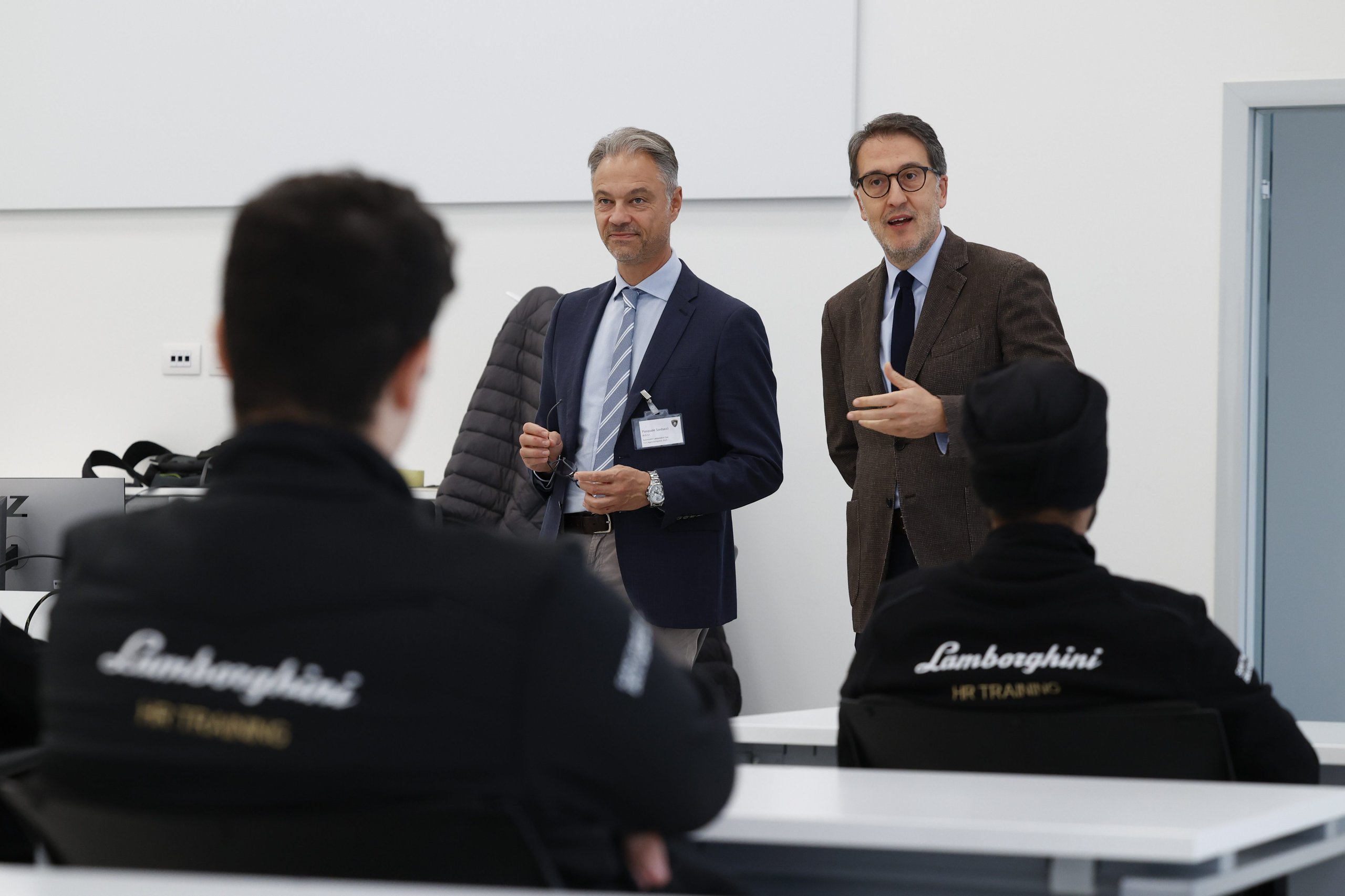
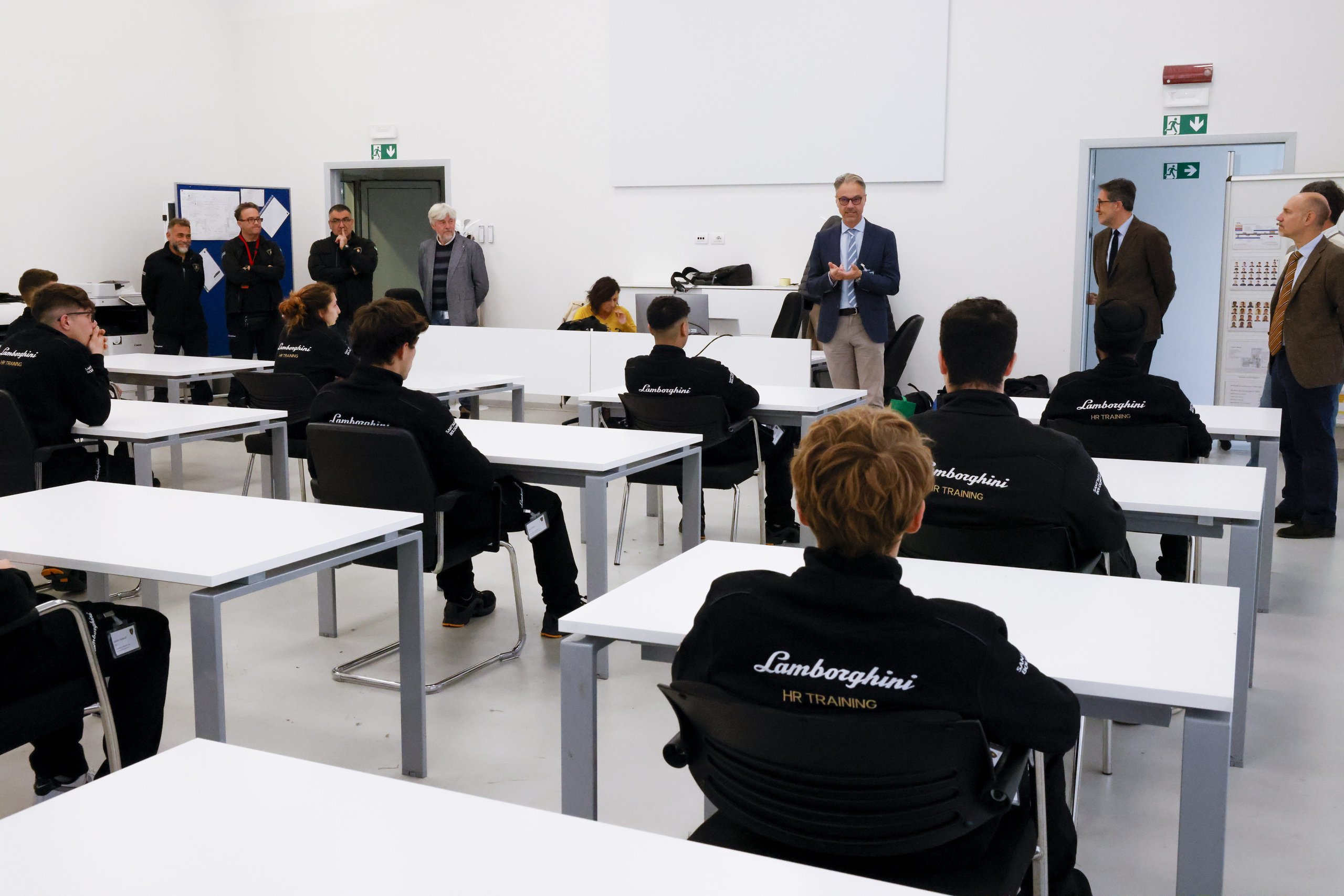
Students attend a training session in a bright classroom, listening to instructors at the front. Image: Automobili Lamborghini.
Why Lamborghini Grows Its Own Talent Instead of Hiring It
Supercar manufacturing is not something you learn from a textbook. The tolerances, the materials, the hand-finishing processes that separate a Lamborghini from a mass-produced vehicle require a specific kind of technical intuition that only develops through direct, supervised contact with the product. Carbon fiber layup, paint correction on complex body surfaces, the calibration of increasingly sophisticated hybrid powertrains: none of these skills appear on a standard vocational curriculum.
Lamborghini says the DESI initiative trains qualified technicians for both the company and the broader technology district known as Motor Valley, the stretch of Emilia-Romagna that also houses Ducati, Ferrari, Maserati, Pagani, and Dallara. The program launched in 2014 as a collaboration between Lamborghini, Ducati, the Emilia-Romagna Region, the Regional Scholastic Office of the Italian Ministry of Education, and several Bologna trade unions. Its fifth edition (DESI V) began with renewed agreements among all partners in September 2022.
Umberto Tossini, Lamborghini’s Chief Human Capital Officer, framed the program as preparation not only for immediate employment but also for further education through Italy’s Higher Technical Institutes and universities. That dual track matters. Lamborghini is not simply filling assembly-line vacancies. It is building a talent pipeline that can scale upward into engineering, quality control, and eventually R&D roles, the kind of career ladder that keeps institutional knowledge inside the company for decades. In a factory where each car reflects thousands of hours of accumulated craft, losing that knowledge to outside poaching or retirement without succession planning would be quietly devastating.
Engine Blocks and Cylinder Heads: What DESI Students Actually Learn
The program draws fourth- and fifth-year students from the “Maintenance and Technical Assistance” course offered by Bologna’s IIS Aldini Valeriani and IIS Belluzzi Fioravanti, two of the city’s most respected vocational technical institutes. Selection is competitive: admission depends on attendance records and grades, followed by interviews conducted by representatives from both Ducati and Lamborghini. Once accepted, students’ progress is monitored and evaluated by both school and company tutors throughout the program.
Official imagery from the training center shows instructors walking students through disassembled engine blocks and cylinder heads, the kind of hands-on component work that builds a tactile understanding of how high-performance powertrains function at a granular level. Students also receive English language lessons from native speakers, with opportunities to earn language proficiency certifications, a practical acknowledgment that Lamborghini’s workforce operates in a global context where technical documentation, supplier communication, and customer-facing service roles all demand fluency.
Fourth-year training involves 600 hours distributed across November, February, and the May-to-July window, while fifth-year training comprises 400 hours spread over September, December, and March. The Emilia-Romagna Region reportedly provides allowances for the extra hours students spend beyond the standard school timetable, an incentive structure that underscores the regional government’s stake in keeping Motor Valley’s talent pipeline flowing.
For this school year, two new two-year pathways focused on transversal skills and orientation are being offered to fourth-year classes at the Aldini Valeriani school. These broader skill tracks suggest Lamborghini is thinking beyond pure wrench-turning. Diagnostics, systems integration, and the ability to move between mechanical and electronic domains are increasingly what separates a competent technician from an exceptional one, and that distinction only sharpens as the cars themselves grow more complex.

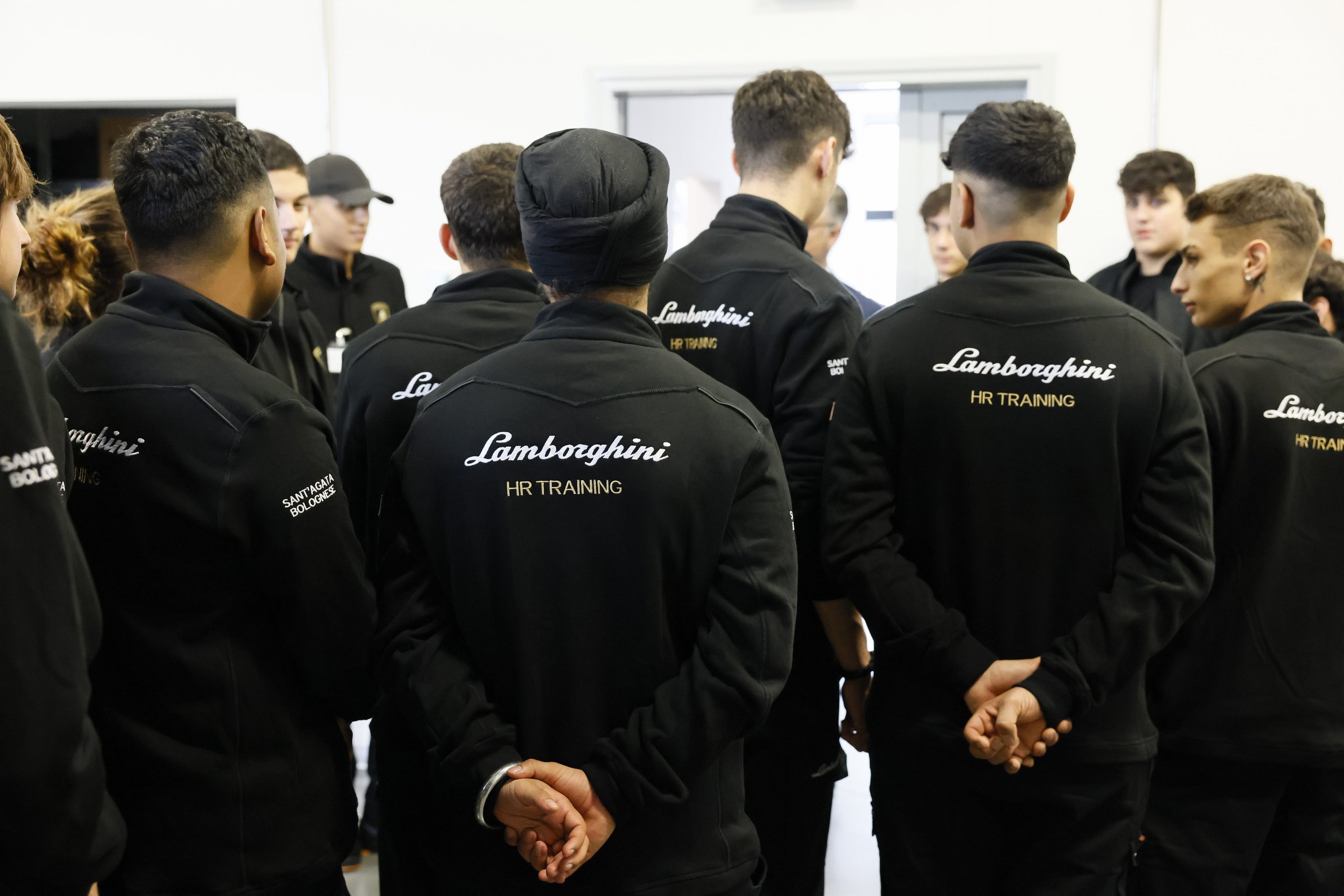
An instructor explains engine components to a group of students in a workshop, demonstrating practical automotive engineering. Image: Automobili Lamborghini.
Preparing for the Hybrid Era
The timing of DESI’s fifth edition is worth noting. Lamborghini’s entire current lineup has moved to plug-in hybrid architecture: the Revuelto pairs a naturally aspirated V12 with three electric motors, the Temerario combines a twin-turbo V8 with hybrid assist, and the Urus SE brings electrification to the SUV range. Every car Lamborghini now sells requires technicians who understand both combustion and electrical systems at a level that did not exist five years ago.
Lamborghini has not publicly detailed how the DESI curriculum adapts to hybrid and eventual electric powertrains. The company’s official material focuses on the program’s structure and partnerships rather than specific syllabus changes. But the implication is difficult to miss. A program that places students inside the factory where these hybrid cars are assembled, serviced, and tested is inevitably exposing them to the battery management systems, high-voltage safety protocols, and integrated powertrain diagnostics that define modern Lamborghini ownership.
This matters for buyers, too. The quality of after-sale service, the competence of the technician who diagnoses a fault code on your Revuelto’s e-motor, the precision of the person who replaces a carbon-ceramic brake assembly: all of that traces back to training programs like DESI. Road & Track recently reported that Lamborghini now offers up to ten years of extended warranty coverage on many models, a move that signals confidence in long-term reliability. Confidence of that kind does not materialize from nowhere. It requires a workforce that can back it up.
Anyone who has followed Lamborghini ownership forums knows that service quality varies by dealer, and the most common frustration is finding a technician who truly understands the car rather than just reading a diagnostic screen. DESI is Lamborghini’s answer to that problem at the source: train the people before they ever touch a customer’s car, and train them inside the factory where the engineering intent is still fresh.
Motor Valley’s Broader Talent Ecosystem
DESI does not exist in isolation. Emilia-Romagna’s Motor Valley operates as a self-reinforcing ecosystem where universities, vocational schools, and manufacturers collaborate to keep specialized automotive talent rooted in the region. Lamborghini participates in the MUNER (Motorvehicle University of Emilia Romagna) Summer School in Industrial Engineering for Advanced Automotive, organized with the University of Bologna, covering topics like lightweight materials, computer-aided design, and composites. A Global MBA in Supercars, Superbikes and Motorsports, developed with Bologna Business School and companies including Lamborghini, Ducati, and Ferrari, targets postgraduate students interested in the business side of high-performance vehicles. Lamborghini also offers six-month internships for students and recent graduates, providing hands-on experience with live projects that can be developed into university theses.
Vincenzo Colla, the Emilia-Romagna Region councilor for economic development, described DESI as a demonstration of how the region’s public-private educational model meets the challenges of ecological and digital transition. The political language is predictable, but the underlying point is sound: a region that produces Lamborghinis, Ducatis, Ferraris, and Paganis within a roughly 50-kilometer radius needs a deliberate, structured approach to keeping skilled labor local.
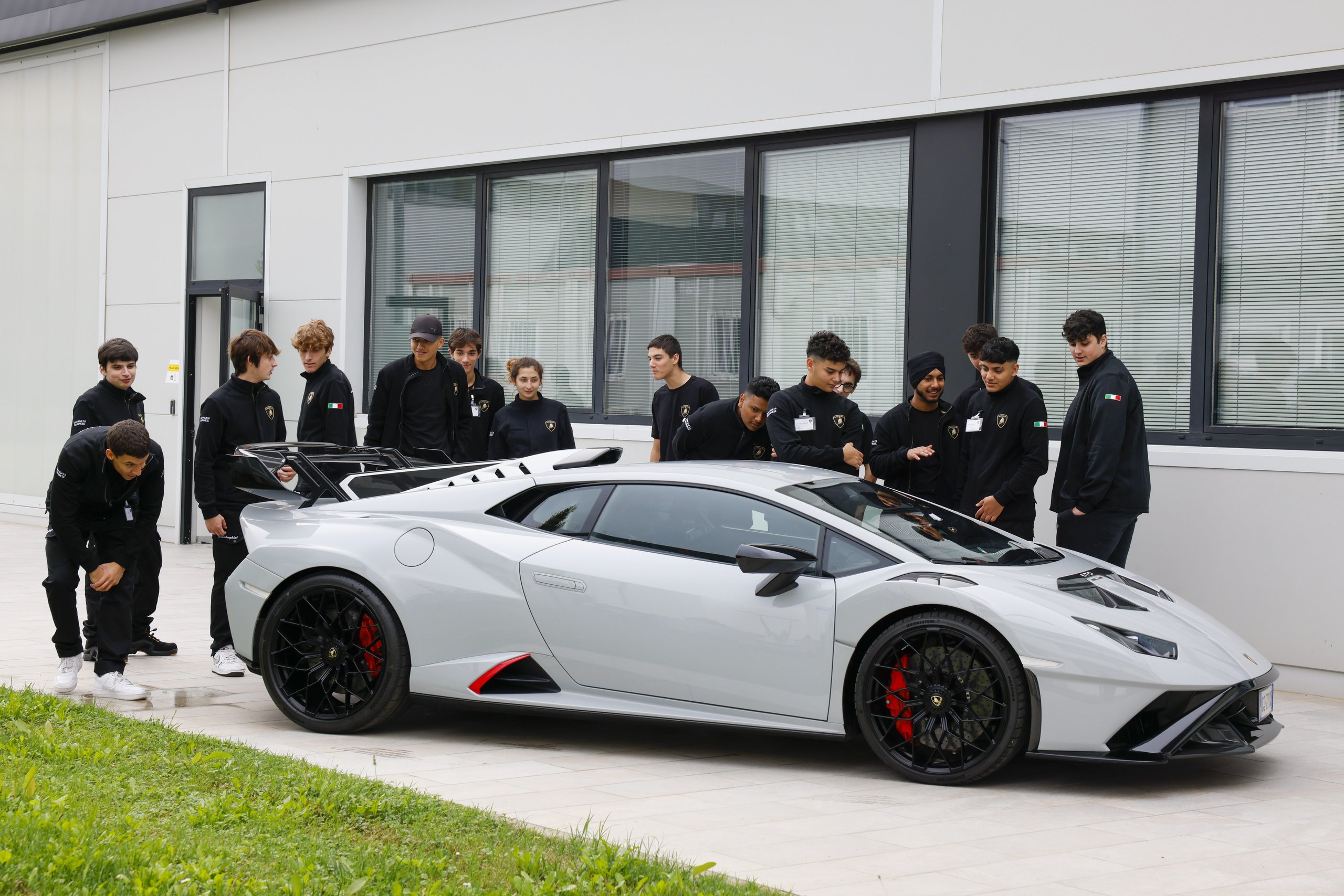
The alternative is visible in other automotive clusters around the world, where talent drifts toward tech companies or finance and manufacturers scramble to fill gaps with external hires who lack institutional knowledge. Motor Valley’s advantage is that the romance of the product still functions as a recruitment tool. Putting a teenager in a Lamborghini-branded jacket and standing them next to a Huracán on their first day is not subtle, but it works. And it feeds the same central logic: the more deeply a young technician is embedded in the culture and craft of Sant’Agata Bolognese, the harder that expertise is for any competitor to replicate.

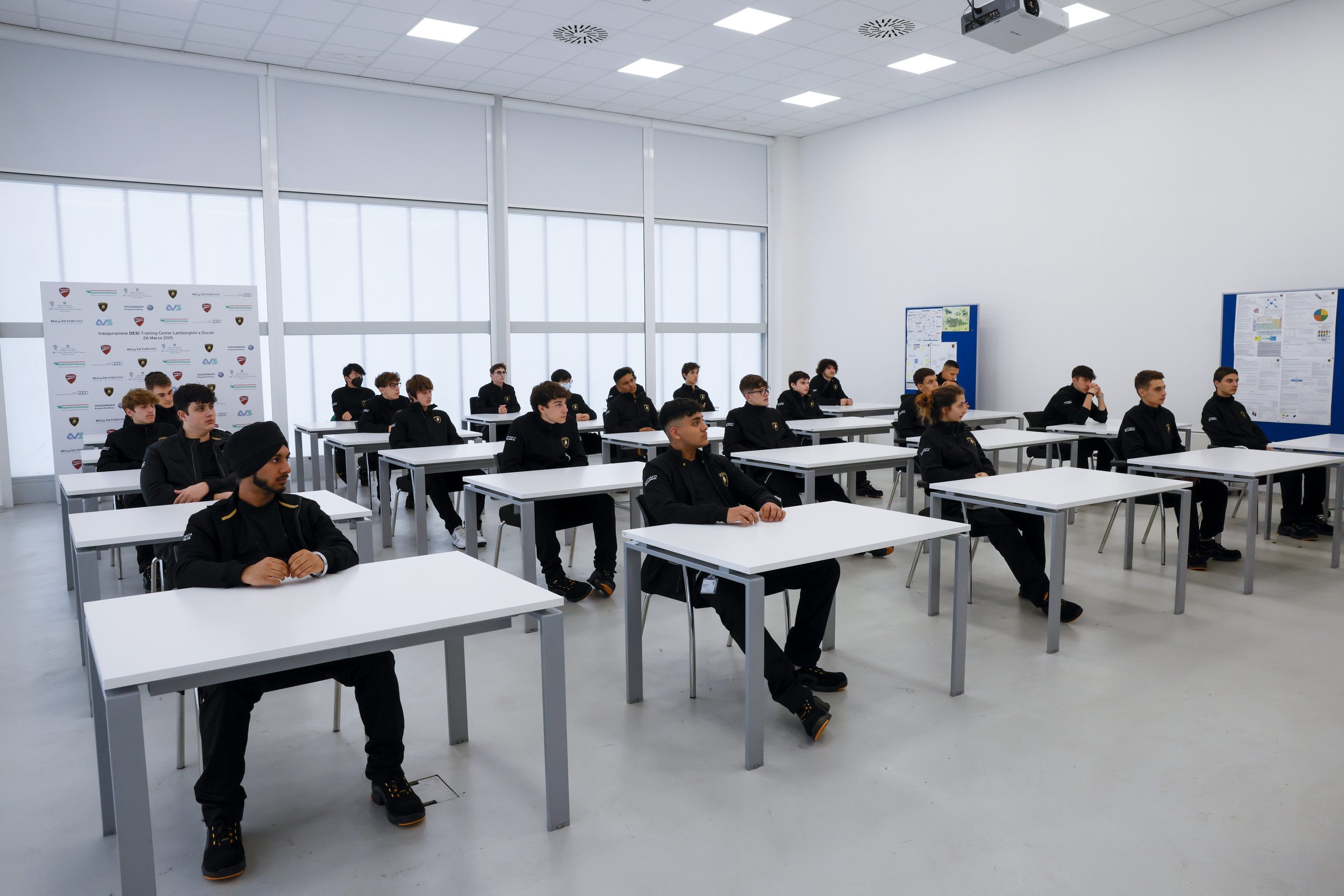
Students engage in a classroom session, with one student clapping enthusiastically during a presentation. Image: Automobili Lamborghini.
From Diploma to Career: What Comes Next
Upon completing the program, DESI graduates earn a five-year Professional Diploma and receive formal certification of the skills they acquired. Lamborghini has not disclosed specific employment rates for DESI alumni, nor has the company published starting salary figures. What the program’s structure confirms is that graduates leave with a credential recognized across Italy’s vocational system and practical experience that no competing candidate without factory time can replicate.
Alberto Cocchi, coordinator of the RSU (unitary union representation) at Automobili Lamborghini, emphasized that the training occurs under conditions designed to develop professionalism and rights in parallel. The union’s involvement is a distinctly Italian feature of the program and one that gives it institutional durability. DESI is not a marketing initiative that can be quietly shelved when budgets tighten. It is embedded in formal agreements between the company, the regional government, the education ministry, and organized labor.
Lamborghini confirmed that the DESI initiative has involved 210 students over its first ten years, with 42 currently in training across both the Lamborghini and Ducati tracks. Those are not large numbers. They are not meant to be. The point is precision, not volume: a small, carefully selected cohort, trained to a standard that matches the cars they will one day build.
For prospective buyers, the practical takeaway is straightforward. Every Lamborghini that rolls off the line in Sant’Agata Bolognese, and every one that returns for service, benefits from a workforce that includes people trained from their teenage years to understand these specific cars. As the lineup grows more technically complex with each generation, that depth of institutional training becomes harder to replicate and more valuable to the people who own the cars. DESI’s modest numbers are, in that light, perfectly Lamborghini: small-batch, hand-selected, and built to a standard that justifies the badge.

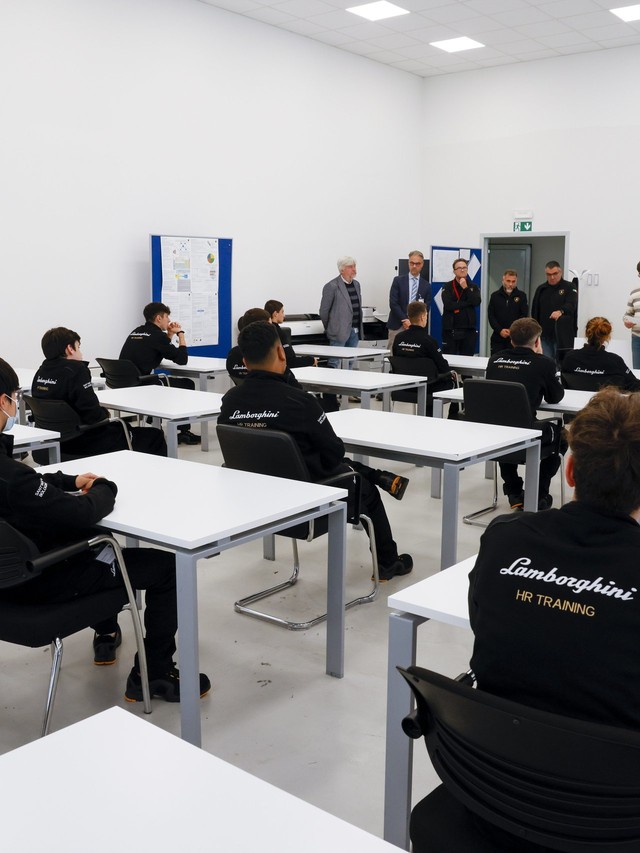
An instructor leads a hands-on session, explaining engine mechanics to a group of attentive students. Image: Automobili Lamborghini.
Gallery