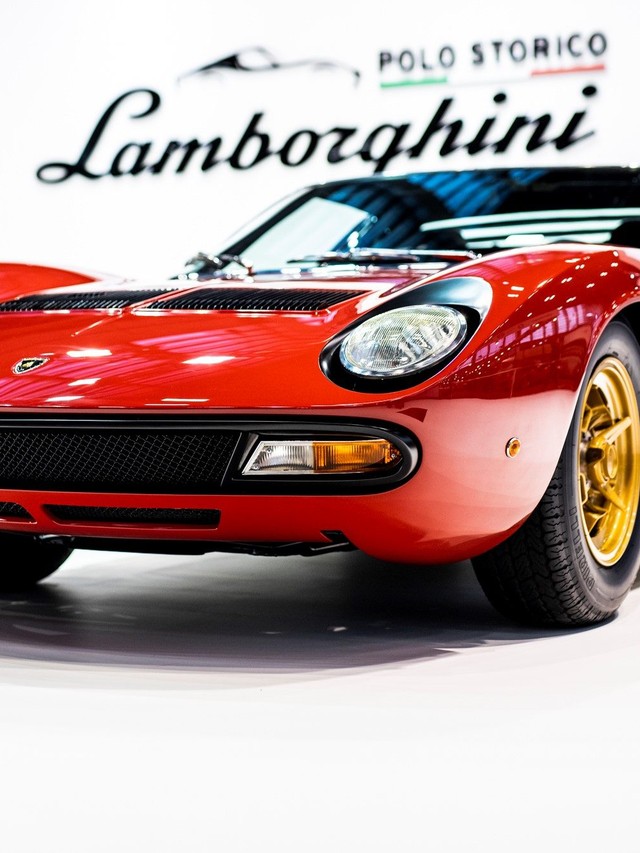
A Dedicated Class for the Car That Invented the Supercar
Pebble Beach selects its concours classes with the precision of a museum curator, so when the organizers of the 69th edition in August 2019 created a class labeled simply Lamborghini Miura, the gesture carried real weight. Not a broader “Italian sports cars” grouping, not a “mid-engine pioneers” umbrella, but a model-specific stage reserved for five examples drawn from collections around the world.
Established in 1950, Pebble Beach applies famously severe selection criteria. Earning a spot on the 18th fairway is a statement of historical significance, and a dedicated class amounts to the concours equivalent of a lifetime achievement award. Lamborghini says only five Miuras were accepted, and three of the five were restored by the company’s own Polo Storico heritage department in Sant’Agata Bolognese. The selection placed the Miura alongside the Ferraris, Delahayes, and Duesenbergs that typically anchor the event’s most prestigious categories.
The message to collectors and enthusiasts was unmistakable: Lamborghini’s first mid-engine masterpiece occupies the same tier of desirability as the most coveted postwar competition, and the factory itself is investing in keeping these cars alive. What made the 2019 class remarkable, though, was not just the honor but the five individual cars chosen to represent it, each carrying a provenance that reads more like a screenplay than a service history.
The Five Cars and Their Remarkable Provenance
Chassis #3087, a 1967 P400 owned by Tom and Gwen Price, is the 22nd of the original 25-car production series. Swiss racing driver Karl Foitek took delivery through his Zurich dealership in June 1967 and kept the car for five years before selling it to John Middleton of Lake Forest, Illinois, who held it for four decades. That kind of long, stable ownership chain is exactly what concours judges and serious collectors prize.
Chassis #3303, a 1968 P400 owned by Jon and Kim Shirley, arrived with a history that borders on geopolitical thriller. Lamborghini says this car was delivered new to the Shah of Iran, Mohammad Reza Pahlavi, who specified a chrome-plated front bumper, a bespoke steering wheel, and several cosmetic changes. The Shah reportedly took delivery on studded tires in the snow at St. Moritz. He sold the car just before the 1979 Iranian revolution, after which Ayatollah Khomeini’s government confiscated it. The Miura was eventually smuggled out of the country and remained with the Shah’s son for roughly 30 years before a full restoration in 2018.
Chassis #3586, from The Kaiser Collection in Vaduz, Liechtenstein, is the genuine movie star of the group: the Miura driven by Rossano Brazzi in the opening sequence of The Italian Job (1969). Paramount’s production team selected this specific car to match the color of a separate, badly damaged Miura used for the film’s infamous tunnel-crushing scene. After filming wrapped, the surviving car returned to the factory and was delivered to its first Italian owner in July 1968. It passed through collections in Italy, Japan, and the UK before Polo Storico certified its movie provenance and completed a restoration in 2019.
Chassis #3673, a 1972 P400 SV owned by Jean Todt, carries its own layer of intrigue. One of 150 SVs manufactured, this car wears a 1968 chassis number from a totaled and dismantled P400. Lamborghini’s official account explains that the first owner, Captain Arthur Mechin, a former RAF pilot in South Africa, requested the older chassis plate to avoid import duty on a new vehicle. Todt, the legendary rally driver, former Ferrari Formula One team principal, and FIA president, purchased the car in 2016 and entrusted Polo Storico with a complete restoration in 2018.
The most unusual entry is chassis #3781, a 1968/1975 Miura SVR owned by Shinji Takei of Japan. This one-off began life as a Miura S shown at the 1968 Turin Motor Show. In 1974, German buyer Heinz Steber returned it to the Sant’Agata factory with instructions to build him a “racing” Miura. After 18 months of factory work, Steber drove the result briefly before selling it to a Japanese collector. The car remained in Japan until its current owner acquired it in 2016 and commissioned Polo Storico to restore it to its exact 1975 factory-delivery specification.
Why Polo Storico’s Involvement Matters More Than the Trophies
Three of five Pebble Beach entries restored by a single factory department is a striking ratio, and it reveals how seriously Lamborghini has treated its heritage since inaugurating Polo Storico in 2015. The department handles restoration and certification for all Lamborghinis produced up to 2001, manages the company archives, and reconstructs spare parts for classic models. Lamborghini says the department introduced more than 200 new part numbers in 2018 alone.
That last detail matters for anyone considering a classic Lamborghini purchase. The perennial concern with vintage exotics is parts availability, and Polo Storico’s active manufacturing of new components addresses the issue directly. A Miura restored through the official channel carries factory certification, documented provenance, and access to components that simply did not exist a decade ago. For collectors weighing a Miura against a comparable-era rival, the existence of a factory-backed restoration pipeline is a genuine competitive advantage.
Enthusiast forums reflect this reality. Multiple Miura owners and followers in online communities discuss restoration details, original color codes, and chassis histories with an intensity that underscores how deeply provenance documentation affects value. Polo Storico’s certification process feeds directly into that ecosystem, giving buyers and sellers a shared reference point. The Pebble Beach class, in turn, served as the most visible possible endorsement of that process: three cars restored under factory supervision, standing on the world’s most scrutinized lawn.
The Engineering That Earned the Stage
Pebble Beach does not grant dedicated classes on aesthetics alone. The Miura earned its place because it fundamentally rewired what a road car could be. When the prototype debuted at the 1966 Geneva Motor Show, its transversely mounted 4-liter V12 with four overhead cams was a layout borrowed from racing, not grand touring. Lamborghini confirms 763 Miuras were manufactured between 1966 and 1973, each one representing a bet by a young engineering team (the eldest member was 27) that a mid-engine configuration could work in a production car.
Marcello Gandini, working at Bertone, was just 22 when he penned the body. The result, with its low-slung profile, pop-up headlights, and distinctive side air intakes visible in Polo Storico’s studio photography, became the template for every mid-engine supercar that followed. The car was the fastest production vehicle of its era, and its layout became the default architecture for high-performance road cars for the next half century.
What makes the Miura’s story particularly resonant for Lamborghini enthusiasts is the continuity. The mid-engine V12 philosophy that Giampaolo Dallara and Paolo Stanzani pioneered evolved through the Countach, Diablo, Murcielago, and Aventador. When Lamborghini launched the Revuelto with its longitudinally mounted V12 hybrid powertrain, it was building on a lineage that traces directly back to those young engineers in Sant’Agata. Pebble Beach recognized the origin point; the cars on the road today are the proof of its influence.
What This Means for Miura Collectors and Enthusiasts
Pebble Beach recognition at this level reinforces the Miura’s position at the top of the classic Lamborghini market. All 763 examples are accounted for by the collector community, and the cars with the strongest provenance, particularly those with factory restoration and certification, command the highest premiums.
For prospective buyers, the practical takeaway is straightforward: a Polo Storico-restored Miura with documented history represents the most defensible investment in the classic Lamborghini space. The factory’s willingness to manufacture new parts, certify authenticity, and actively participate in the world’s most prestigious concours events signals that Lamborghini views its heritage as a long-term asset, not a nostalgia exercise.
One source reports that the 2025 Pebble Beach Concours d’Elegance is expected to host a celebration for the Miura’s 60th anniversary, potentially assembling the largest gathering of the model ever. If the 2019 class is any indication of the standard Pebble Beach applies to the Miura, the anniversary event could further elevate collector interest for a car that, more than five decades after production ended, remains the foundation stone of every Lamborghini that followed.
Gallery


