A V12 Flagship Meets an Olympic Stage in Tokyo
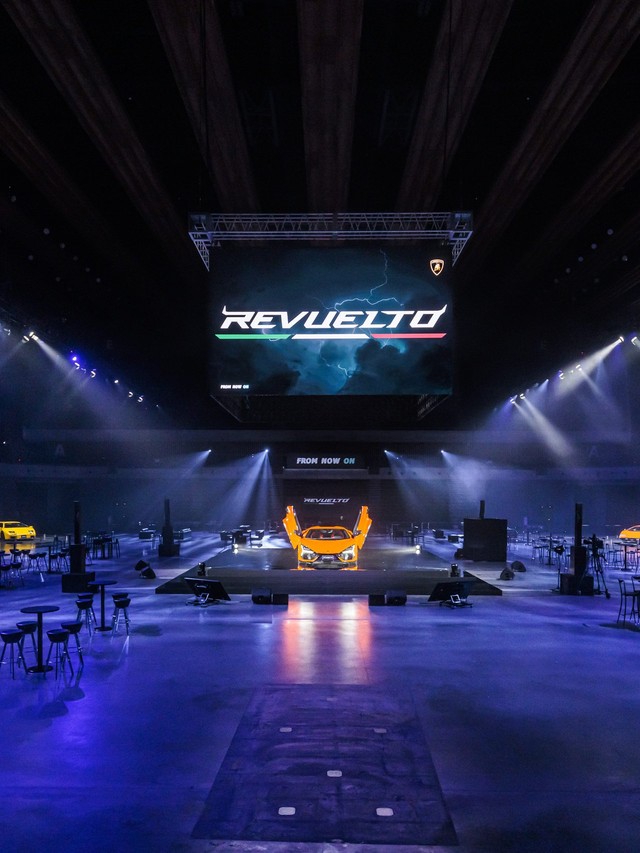
Lamborghini Japan chose Ariake Arena, the Tokyo 2020 Olympic volleyball venue, to premiere the Revuelto to more than 500 guests on June 6. The company says it was the first automaker to host an event at the arena, but the real significance lay elsewhere: Lamborghini wanted a stage large enough to hold not just its new flagship, but six decades of the cars that led to it.
The Revuelto occupied center stage under theatrical lighting, flanked by a 400 GT, a Miura, a Countach, a Diablo, a Murciélago, and an Aventador. Each represented a chapter of V12 history, and the lineup was clearly designed to answer the one question every Lamborghini enthusiast has been asking since electrification became inevitable: does the V12 survive? Lamborghini’s answer was unambiguous. The Revuelto is the company’s first V12 hybrid plug-in HPEV, and it replaces the Aventador.
Head of Design Mitja Borkert, Revuelto Product Line Director Matteo Ortenzi, and Head of Japan Davide Sfrecola all attended, lending the event a level of corporate weight that regional premieres do not always receive. The global debut had already happened during Lamborghini’s 60th anniversary year, but Japan clearly warranted its own production. That investment tells you something about the market, and about how Lamborghini intends to sell a car whose order book is reportedly filled through at least 2026: not as a transaction, but as an experience that begins long before the keys arrive.

The Lamborghini Revuelto Japan premiere showcases a stunning lineup of past and present models under vibrant lighting.
Ad Personam and the Design Corner: Selling the Ownership Experience
Most coverage of the Revuelto focuses on the powertrain numbers. The Japan premiere focused on something else entirely: what it feels like to spec one.
Lamborghini set up a dedicated Ad Personam area where guests could handle leather samples, examine exterior paint swatches, and configure trim options in person. The program offers four levels of personalization, and the range extends to bespoke paint finishes, sustainably sourced leathers, Alcantara trims, color-matched seatbelts, and custom embroidery. The most extreme tier has produced “Opera Unica” models with hand-painted liveries, according to one report, positioning the Revuelto less as a car you order and more as a car you commission.
Adjacent to the customization area, a replica of Mitja Borkert’s design studio allowed guests to watch live sketching sessions. The intent was transparent: let prospective buyers see the creative process that shaped the Revuelto’s lines, then walk them straight into the room where they choose their own. For a car with orders reportedly filled until at least 2026, this kind of event is less about generating new sales than about deepening the relationship with buyers who are already committed. Lamborghini knows that a customer who has spent an hour touching Alcantara samples and watching a designer sketch is a customer who will spend more on their build.
Japan is a particularly receptive market for this approach. Japanese collectors tend to value craftsmanship, limited production, and the ritual of specification. A Lamborghini Day Japan 2025 event later showcased a bespoke Ad Personam Revuelto with a longitudinal gradient finish transitioning from Bianco Asopo to Rosso Khonsu, a first for the brand and one clearly inspired by Japanese cultural symbolism. The premiere planted the seed; subsequent events harvested it.

Executives pose with the stunning Lamborghini Revuelto and its iconic scissor doors open at the Japan premiere.
The Naturally Aspirated V12 Hybrid, Explained for Buyers
Strip away the event staging and the Revuelto‘s engineering story is genuinely unusual in the current supercar landscape. The powertrain pairs a naturally aspirated 6.5-liter V12 with three electric motors for a combined 1,015 horsepower. Lamborghini says the combustion engine is entirely new, not a carryover from the Aventador, and it mates to a double-clutch transmission that debuts on a 12-cylinder Lamborghini for the first time.
That last detail deserves emphasis. The Aventador used a single-clutch automated manual for its entire production run, a gearbox that was characterful but brutally slow by modern standards. The switch to a DCT transforms the driving experience in ways that the horsepower figure alone does not communicate. Car and Driver tested the Revuelto and described the V12’s sound as glorious without turbochargers muffling it, while the carbon-fiber “monofuselage” structure increases rigidity compared to the Aventador’s tub. The publication also noted that the front subframe uses forged carbon fiber where the predecessor relied on aluminum.
Verified performance numbers: 0 to 100 km/h in 2.4 seconds, a top speed of 354 km/h. Car and Driver reports an MSRP of $608,358 for the 2026 model year, though real-world transaction prices for a car this heavily allocated will almost certainly exceed that figure.
Less clear is the electric-only range and how the hybrid system affects weight distribution and handling balance at the limit. Lamborghini has not published detailed figures on either point. The safer interpretation, based on the available evidence, is that the electric motors serve primarily as performance multipliers, providing instant torque fill and all-wheel-drive capability through the front axle motors, rather than offering meaningful EV commuting range. Buyers should think of the plug-in capability as a regulatory compliance tool and a low-speed maneuvering convenience, not a daily-driving range extender.
Design DNA: From Miura to Monofuselage
Borkert’s presence at the premiere was not ceremonial. His quote, delivered on stage, framed the Revuelto’s design philosophy with unusual directness: the car had to be recognizable at first glance as the next V12, while simultaneously opening a new design era.
The heritage lineup on the arena floor illustrated the challenge. Walk from the 400 GT’s restrained Touring coachwork through the Miura’s revolutionary mid-engine proportions, past the Countach’s origami angles and the Diablo’s widebody aggression, and you arrive at the Aventador’s fighter-jet surfaces. Each car redefined what a Lamborghini V12 looked like, and each was controversial in its moment. The Revuelto continues that tradition with its Y-shaped daytime running lights, deeply sculpted side air intakes, and a low-slung profile visible in the premiere images. The scissor doors remain, a signature element connecting the Revuelto to every V12 Lamborghini since the Countach.
What the design corner at the premiere quietly demonstrated is that Lamborghini now treats the Revuelto’s exterior as a canvas for owner expression rather than a fixed statement. The standard palette is already extensive, but the Ad Personam options, including gradient finishes and heritage-inspired colorways, mean that two Revueltos parked side by side may share a silhouette and little else. For a car with strong allocation demand, this level of differentiation matters to collectors who want exclusivity beyond the production number. The ownership experience, in other words, begins at the configurator, and the Japan premiere was built to make that process feel as significant as the car itself.

The new Lamborghini Revuelto takes center stage at its Japan premiere, bathed in dramatic lighting.
Where the Revuelto Sits in the Hybrid Supercar Fight
The competitive landscape for V12 hybrid supercars is remarkably thin. Ferrari’s SF90 Stradale uses a twin-turbocharged V8 with electric assist, not a V12. McLaren’s Artura pairs a twin-turbo V6 with a single electric motor. Neither competitor offers a naturally aspirated twelve-cylinder hybrid, which means the Revuelto occupies a category it essentially created.
Keeping the V12 naturally aspirated while adding electric motors is a philosophical statement as much as an engineering one. Turbocharging a V12 would have been simpler and cheaper. Breathing freely preserves the throttle response and the acoustic signature that define the Lamborghini V12 experience, while the electric motors handle the low-end torque and efficiency obligations that regulations demand.
For buyers cross-shopping at this price point, the practical question is straightforward: do you want the visceral, high-revving character of a naturally aspirated twelve, or do you prefer the turbocharged mid-range punch of the SF90? The Revuelto makes its case on emotional terms; the SF90 makes its case on outright lap-time efficiency. Both are legitimate answers, but they appeal to fundamentally different priorities. Lamborghini is betting that its core buyers will always choose the engine that sounds like the end of the world at 9,000 rpm, and the sold-out order book through at least 2026 suggests that bet is paying off.
Road & Track called the Revuelto a “hybrid V-12 supercar sensation” in its review, a characterization that captures the broader critical consensus. The hybrid system enhances rather than dilutes the V12 experience. For Lamborghini enthusiasts who feared electrification would compromise the brand’s identity, the Revuelto is the most reassuring possible answer.
What the Japan Premiere Signals for Lamborghini’s Direction
Regional premieres of this scale are expensive. Renting an Olympic arena, shipping heritage cars across continents, flying in the Head of Design and the product line director: none of this is routine dealer-event logistics. Lamborghini invested in this production because Japan represents a strategically important market for high-value, highly personalized supercars, and because the Revuelto is the template for everything that follows.
The Temerario, Lamborghini’s new V8 hybrid, sits below the Revuelto in the lineup and borrows the same electrification philosophy: combustion engine plus electric motors, performance first, efficiency as a byproduct. The Revuelto’s reception, both critically and commercially, validates this approach. If Lamborghini can sell every Revuelto it builds for three consecutive years while charging north of $600,000, the business case for naturally aspirated hybrid powertrains is settled, at least within Sant’Agata Bolognese.
For prospective buyers, the practical takeaway is blunt: if you want a Revuelto, the waiting list is real, and the Ad Personam process is where you will spend most of your pre-delivery attention. The Japan premiere was designed to make that wait feel like anticipation rather than frustration. Lamborghini understands that selling a $600,000 car is only partly about the car. The rest is about the experience of becoming its owner, and Ariake Arena was built to prove the company takes that experience as seriously as the engineering underneath.
Gallery


