Thirty-Eight Names, Two Tracks to a Factory Seat
Lamborghini Squadra Corse selected 38 drivers for its 2022 Young Driver and GT3 Junior Programs, splitting them into two categories that reveal how deliberately Sant’Agata cultivates its racing talent. Fifteen Young Drivers, all 26 or under, compete across the continental Super Trofeo championships in Europe and North America. The remaining 23 are GT3 Juniors, already racing the Huracán GT3 EVO in international GT championships from IMSA to GT World Challenge Europe.
The distinction matters because it defines two different stages of professional development. The Super Trofeo side functions as an entry point, a proving ground where drivers learn Lamborghini’s racing ecosystem in identical machinery. The GT3 Junior tier operates at a higher level of complexity, with drivers scattered across different teams, different series, and different regulations, all while piloting the same car. Together, the two tiers form a single pipeline designed to turn promising racers into complete factory professionals.
Lamborghini says the entire cohort will be assessed throughout the season on performance, consistency, technical feedback with engineers, professionalism, and attitude both at and away from the circuit. The best performers earn an invitation to a final shootout at Portimão’s Autódromo Internacional do Algarve, scheduled after the Super Trofeo World Finals in early November. The prize at the end of that shootout is direct: official Lamborghini Squadra Corse support for the 2023 season. In a sport where financial backing often determines career longevity, that factory endorsement can be the difference between a driver who fades from the grid and one who builds a lasting professional career.
Why Lamborghini Invests in Building Drivers, Not Just Cars
Customer racing programs sell cars. Driver development programs sell futures. The separation explains why Squadra Corse treats these 38 selections as a strategic priority rather than a marketing exercise.
Lamborghini’s GT3 presence depends on a network of private teams purchasing and racing the Huracán GT3 EVO. Those teams need skilled, professional drivers who understand the car’s behavior, can communicate technical feedback to engineers, and represent the brand credibly. A factory that can supply both the car and a pipeline of proven talent to drive it creates a self-reinforcing ecosystem: teams buy Lamborghini because they know the driver pool is strong, and drivers choose Lamborghini because they know the pathway to factory support exists.
Founded in 2014, the program now draws on eight years of accumulated institutional knowledge. Program Supervisor Raffaele Giammaria and his staff do not simply watch lap times. They evaluate how a driver processes a difficult weekend, how clearly they articulate setup changes to an engineer, whether they maintain composure under pressure. The assessment criteria read more like a professional evaluation than a racing report card, and that is precisely the point. Squadra Corse wants to identify complete professionals, not just fast hands. Every metric, from cockpit communication to off-track conduct, feeds the same question: can this driver sustain a factory-level career?

A Lamborghini race driver and team member discuss strategy in the pit garage, preparing for the next challenge.
Inside the Season-Long Assessment and the Portimão Shootout
What makes this pipeline credible is the rigor of its filtering. The evaluation unfolds across an entire racing calendar, not a single weekend audition. Lamborghini says drivers are monitored on single-lap pace, average race speed, consistency across a weekend, and their progression over multiple rounds. The less quantifiable metrics carry equal weight: how a driver handles media obligations, whether they arrive physically prepared, how constructively they engage with engineering debriefs.
For the GT3 Juniors, the challenge is compounded by geography and regulation. A driver racing ADAC GT Masters in Germany faces different Balance of Performance settings, different tire compounds, and different competition than one contesting Italian GT or IMSA. Giammaria’s team must normalize those variables to make fair comparisons across 23 drivers spread across at least seven different championship environments.
The season culminates at Portimão, where the top performers gather for a two-day shootout. Lamborghini describes this as a comprehensive evaluation covering physical training, attitude, and driving skill. The circuit itself, with its blind crests, significant elevation changes, and abrasive surface, rewards adaptability over raw aggression. Drivers who can process new information quickly and translate it into consistent performance tend to emerge from that kind of test.
The program’s willingness to evolve is also notable. One report indicates the shootout format continued to develop in subsequent years, with the 2025 edition bringing eight Super Trofeo performers to Jerez de la Frontera for assessment. Rotating venues and adjusting intake numbers suggests Squadra Corse actively refines the evaluation rather than running the same template year after year.
From Super Trofeo Grid to Factory Contract: The Career Ladder in Practice
A talent pipeline is only as convincing as its graduates. Lamborghini points to two 2021 shootout winners as proof of concept: Leonardo Pulcini, the Super Trofeo Europe champion, moved into a full International GT Open campaign with Oregon Team aboard a Huracán GT3 EVO. Arthur Rougier graduated into a dual program spanning GT World Challenge Europe and ADAC GT Masters with Emil Frey Racing. Both drivers transitioned from the one-make series into the more complex, multi-manufacturer world of GT3 racing with factory backing.
Pulcini’s trajectory is particularly telling. He returned to the 2022 cohort as a GT3 Junior, now being assessed at a higher level alongside former Super Trofeo teammates like Kevin Gilardoni and World Finals winner Mattia Michelotto. The program does not simply crown a winner and move on. It tracks graduates, reassesses them in new contexts, and continues to invest in their development as they climb the ladder.
More recent outcomes reinforce the pipeline’s durability. Sportscar365 reported that Enzo Geraci and Jacopo Guidetti won the Young Driver Programs shootout and secured factory support for 2025. According to IMSA, American Colin Queen earned factory backing for the 2026 season through the Super Trofeo Young Driver Program Shootout. The thread connecting all of these names is clear: consistent performance in Lamborghini machinery, combined with the professional qualities Giammaria’s team values, opens a genuine pathway to a factory relationship.

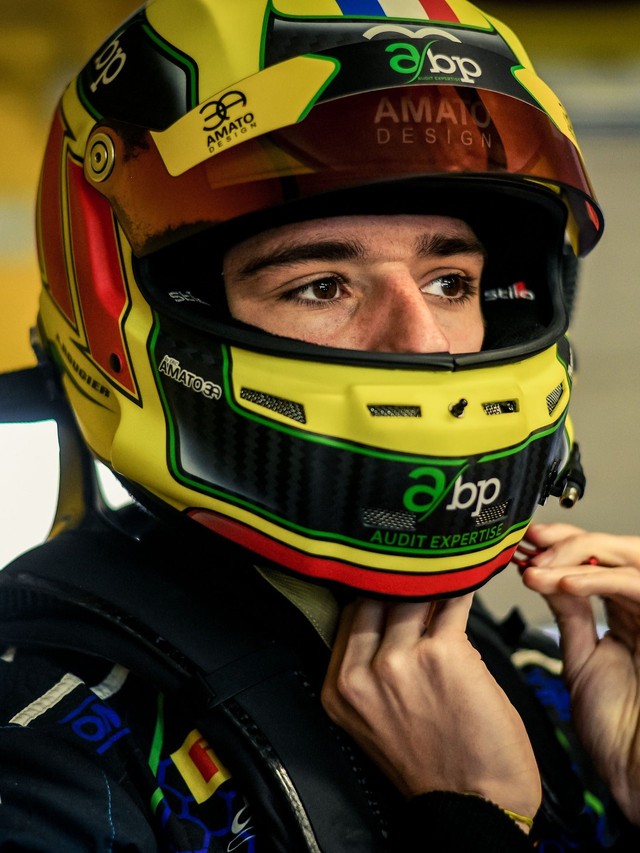
A young Lamborghini race driver prepares for the track, adjusting his helmet with focused determination.
Beyond Lap Times: Physical Training and the Drivers’ Lab
The emphasis on physical and mental conditioning is another dimension that separates Lamborghini’s approach from a straightforward talent search. Lamborghini says the program supports drivers in areas ranging from media management to on-track instruction and physical preparation. The Drivers’ Lab at Sant’Agata Bolognese, visible in official imagery with its Walker View treadmill and Lamborghini branding, represents the scientific end of that commitment.
GT3 racing places enormous physical demands on drivers. Stints can last well over an hour in cockpit temperatures exceeding 50 degrees Celsius, and the braking forces in a Huracán GT3 EVO require sustained neck, core, and leg strength. A driver who fades physically in the final 20 minutes of a stint costs their team positions, and no amount of raw talent compensates for poor conditioning. By integrating physical assessment into the selection criteria, Squadra Corse filters for durability alongside speed.
The media training component, easy to dismiss as corporate polish, serves a practical function in customer racing. GT3 teams rely on sponsor relationships, and sponsors want drivers who can represent their brands articulately. A driver who wins races but cannot conduct a coherent interview or manage social media presence is less commercially valuable to a team. Lamborghini’s willingness to develop those skills reflects an understanding that modern racing careers are built on more than lap time delta, and it reinforces the program’s central purpose: producing professionals who can sustain factory-level careers across every dimension the role demands.

An athlete trains rigorously on a specialized treadmill at the Lamborghini Drivers' Lab, enhancing physical performance.
How Lamborghini’s Approach Compares to Ferrari and Porsche
Lamborghini does not operate in isolation, and the contrast with its rivals sharpens what makes this pipeline distinctive. Ferrari’s Driver Academy, established in 2009, five years before Lamborghini’s program launched, aims at a fundamentally different target: Formula One. Ferrari’s academy funnels talent upward through single-seater categories with the explicit goal of producing future Scuderia Ferrari drivers. Charles Leclerc, Oliver Bearman, and Mick Schumacher all passed through Maranello’s system. The scope is broader, the investment larger, and the ultimate prize sits at the pinnacle of open-wheel racing.
Lamborghini’s program makes no pretense of chasing F1. Its focus on GT and sportscar racing is narrower but arguably more practical for the drivers it attracts. The 38 members of the 2022 cohort are already racing GT machinery. They do not need to climb a single-seater ladder. They need a factory that will invest in their GT careers, provide engineering support, and open doors to top-tier endurance and sprint racing.
Porsche runs its own junior programs within the Carrera Cup and Supercup ecosystems, feeding talent into its factory GT and prototype efforts. The structural parallel to Lamborghini is obvious: a one-make series serves as the initial filter, with the most promising drivers graduating into multi-manufacturer GT competition. Where Lamborghini’s position becomes interesting is in the context of its expanding prototype ambitions. The SC63 LMDh program needs drivers who understand Lamborghini’s engineering culture, and a pipeline that produces GT3 professionals today could plausibly supply hypercar endurance drivers tomorrow. Lamborghini has not confirmed any direct link between the Young Driver Program and its LMDh effort, but the logic of the talent ladder points in that direction.
For enthusiasts tracking Lamborghini’s motorsport trajectory, the practical takeaway is straightforward: the brand is investing in people with the same deliberateness it applies to car development. Whether a driver from this 2022 class eventually sits in a prototype at Le Mans remains speculative. What the program already demonstrates is that Squadra Corse treats driver cultivation as infrastructure, not decoration.
The 2022 Class: Who to Watch
The 38-driver roster spans 18 nationalities and at least seven different championship environments, a geographic and competitive breadth that reflects the global reach of Lamborghini’s customer racing network.
Among the GT3 Juniors, several names carry immediate recognition. Jack Aitken, the British driver with Formula 2 and Formula One experience, brings an unusual pedigree to the GT3 ranks. Jaden Conwright represents the IMSA contingent, racing in North America’s premier sportscar series. Mattia Michelotto, fresh off his Super Trofeo World Finals victory, competes in Italian GT with VS Racing and enters the GT3 Junior tier as one of the most decorated young drivers in Lamborghini’s ecosystem.
The Young Driver side features five Americans and Puerto Rican Sebastian Carazo from the Super Trofeo North America series, alongside a strong European contingent led by drivers from Romania, France, Belgium, the Netherlands, Norway, Switzerland, and Italy. Danny Formal, representing Costa Rica, adds further diversity to a class that already looks more internationally varied than many rival programs.
| Program | Drivers | Age Limit | Racing Platform |
|---|---|---|---|
| Young Drivers | 15 | 26 or under | Super Trofeo (Europe, North America) |
| GT3 Juniors | 23 | None specified | GT championships worldwide (Huracán GT3 EVO) |
The season ahead will determine which of these 38 names earn the trip to Portimão. For anyone following Lamborghini’s racing future, this list is worth bookmarking. The next factory driver could already be on it.
Gallery


