Rain, Contact, and a Maiden Win at Barcelona
On October 10, 2020, at the Circuit de Barcelona-Catalunya, Dorian Boccolacci and Kevin Gilardoni delivered Oregon Team its first victory in the Lamborghini Super Trofeo Europe series. They did not cross the finish line first. That distinction belonged to Dean Stoneman and Patrick Kujala of Bonaldi Motorsport, who led the race on the road but were handed a three-second post-race penalty by the stewards. In one-make racing, the margin between celebration and disappointment can be vanishingly small, and on that grey October afternoon in Catalonia, three seconds was all it took to rewrite the result sheet.
Cloudy skies and a pre-race rain shower greeted the 16-car field, and the opening ten minutes unfolded behind the safety car while the circuit drained. When racing began, Kujala pulled ahead of Boccolacci into Turn 1, leveraging the momentum from topping qualifying. The two Huracán Super Trofeo EVOs ran nose to tail until Turn 5, where Boccolacci attempted a move under braking. Contact between the pair forced the Oregon Team #11 car off the track and through the gravel trap. Boccolacci lost only one position but hemorrhaged time, a costly setback in a race where every car runs identical machinery and gaps are measured in tenths.
The stewards judged Kujala at fault. The resulting three-second penalty would not be applied until after the chequered flag, which meant the Bonaldi crew spent the rest of the afternoon unaware that their apparent lead carried an asterisk. What looked like misfortune for Oregon Team was quietly becoming the foundation of a breakthrough.
The Penalty That Rewrote the Result
Post-race penalties in the Super Trofeo series occupy an unusual psychological space. Unlike a drive-through or a time penalty served in the pits, a post-race addition leaves the offending team racing as though nothing changed. Stoneman drove the second stint believing he needed only to manage the gap. He almost succeeded.
Jonathan Cecotto of Target Racing was the immediate beneficiary of the Turn 5 incident, slotting into second and briefly seizing the lead with a sharp pass on Kujala approaching Turn 6. Kujala reclaimed the position when Cecotto overcooked the Turn 10 hairpin, and the pit window opened with Bonaldi Motorsport still nominally in control. Stoneman took over from Kujala and resumed at the front, while Gilardoni replaced Boccolacci and emerged ahead of Cecotto’s teammate Patrick Liddy.
A second safety car period, triggered when local driver Sebastian Fernandez beached his VS Racing car at Turn 1 after an earlier off at Turn 6, compressed the field and erased whatever buffer Stoneman had built. With the clock ticking down, Stoneman needed to open a three-second cushion over Gilardoni to keep the win once the penalty landed. He looked capable of doing exactly that until the final lap, when he ran wide at Turn 4 and lost the time he could not afford to give away. Gilardoni, aware of the arithmetic, simply had to shadow Stoneman home.
Lamborghini says Gilardoni “merely had to stay behind for the remainder of the lap” to claim the result. In practice, that final lap required discipline as much as speed. Pushing too hard on a drying track with wet tyres risked the same kind of error Stoneman had just made. Restraint, in this case, was the winning move, and it revealed the composure that would define Oregon Team’s trajectory in the seasons ahead.

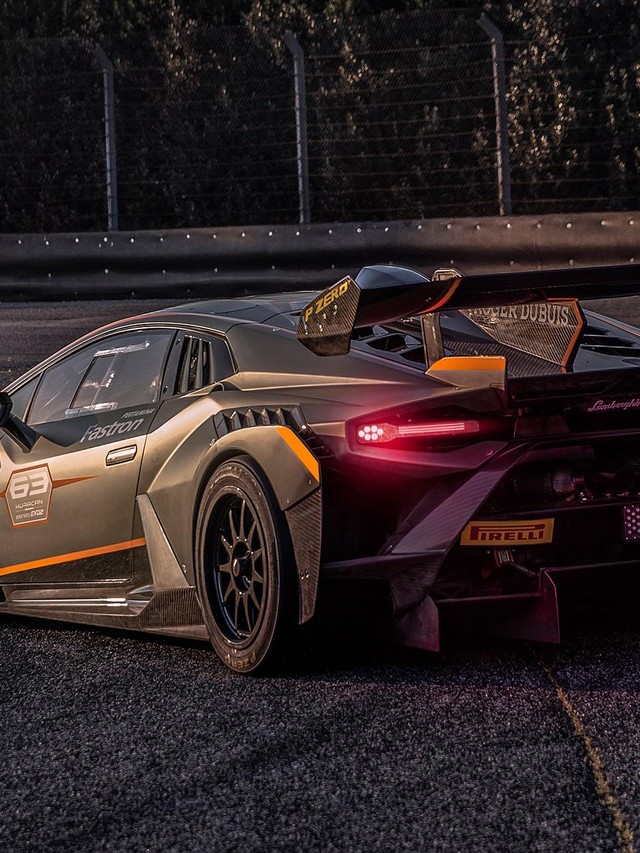
The number 11 Lamborghini Huracán Super Trofeo EVO race car navigates a wet track with vibrant livery and sponsor branding.
Wet Weather and the Tyre Gamble Nobody Took
One of the more revealing details from Barcelona was the universal decision to stay on wet tyres as the track dried. In a one-make series where the cars are mechanically identical, tyre choice becomes one of the few strategic levers a team can pull. Every crew on the grid looked at the conditions during the mandatory pit stop window and concluded the risk of switching to slicks outweighed the potential reward. On a circuit where the transition from damp to dry can happen unevenly across sectors, a premature switch to dry rubber invites the kind of sudden loss of grip that ended Fernandez’s afternoon.
The Huracán Super Trofeo EVO, a track-focused, race-ready derivative of the Huracán road car, relies on mechanical grip and aerodynamic downforce in roughly equal measure. In the wet, the aero advantage diminishes as speeds drop, and the naturally aspirated 5.2-liter V10’s power delivery becomes a liability if the rear tyres cannot find purchase. That every team chose caution over aggression speaks to how treacherous the conditions remained even as the race progressed.
The tyre question matters because it exposes the human element in what might otherwise look like a spec-series parade. Identical cars do not produce identical decisions, and Oregon Team’s ability to extract a result from those conditions, rather than simply survive them, hinted at the operational maturity that would soon translate into titles.
From Barcelona Breakthrough to Championship Contenders
Maiden victories in one-make series carry a weight that raw statistics sometimes obscure. For a team, the first win validates everything: the engineering setup, the driver pairing, the pit crew’s execution under pressure. Oregon Team, an Italian outfit with motorsport roots stretching back to 1987, entered the 2020 Super Trofeo Europe season without a series victory to its name. Barcelona changed that.
What followed suggests the 2020 breakthrough was foundational rather than fortunate. Kevin Gilardoni, the driver who held his nerve on that final lap, went on to win the 2021 Pro title with Oregon Team. The squad itself secured Pro and Team titles during the 2021-2022 cycle of Super Trofeo Europe, establishing itself as one of the series’ benchmark operations. By 2026, Oregon Team drivers Silas Lovén Rytter and Patrik Fraboni achieved a dominant double victory at Imola, piloting the updated #36 Huracán Super Trofeo EVO2.
The pattern is worth noting for anyone who watches the Super Trofeo as a talent pipeline. Lamborghini Squadra Corse established the series in 2009 as an accessible entry point into high-level GT racing, and it functions precisely that way: teams build institutional knowledge season over season, drivers graduate to higher categories, and the competitive intensity ratchets upward as the grid matures. Oregon Team’s arc from first-time winners to serial champions illustrates the ladder working as intended, and it traces directly back to the composure Gilardoni showed on that final lap at Barcelona.
Gilardoni’s Personal Redemption at Barcelona
Kevin Gilardoni’s post-race comments carried a layer of personal history that enriched the result.
“Seven years ago, I left Barcelona having lost the win on the last lap, in the Mégane Eurocup Trophée, so to come back here and win the race is something very special for us.”
Barcelona owed him one, and the circuit paid up in the most nerve-shredding fashion possible. Gilardoni’s trajectory from that 2020 win to the 2021 Pro championship reinforces a broader truth about the Super Trofeo: the series rewards drivers who combine raw pace with composure under pressure. Knowing when not to attack, as Gilardoni demonstrated on that final lap, is a skill that separates consistent championship contenders from one-race wonders.
Boccolacci, for his part, framed the result in terms of the team’s collective effort:
“We deserved this win because we work every day, from late in the evening until early in the morning. Kevin drove really, really well too. Everything went perfectly, except for the contact at Turn 5.”
The comment about the Turn 5 incident was diplomatic but pointed. In the confined world of one-make racing, where teams share garages and paddock space across a full season, how you discuss on-track incidents matters for the relationships that follow. Both drivers understood that this win was not simply a gift from the stewards. It was earned through the kind of daily preparation Boccolacci described, and it set the tone for everything Oregon Team would accomplish afterward.
Class Winners and the Chaos Further Down the Grid
Oregon Team’s celebrations extended beyond the Pro class. Victor Franzoni da Silva and Lorenzo Bontempelli won the Pro-Am category, giving the Italian squad victories in two classes from a single round, further evidence that the team’s preparation had been thorough across its entire operation.
The Pro-Am points leaders, Andrzej Lewandowski and Karol Basz of VS Racing, endured a disastrous afternoon. Lewandowski spun on his way to the grid at Turn 5 before the race even started, and Basz later received a drive-through penalty for speeding in the pit lane during the mandatory stop. In the Am class, Leipert Motorsport’s Fidel Leib and Yury Wagner recovered from a difficult previous round at the Nürburgring to take the win, finishing an impressive 11th overall. Imperiale Racing’s Hans Fabri won the Lamborghini Cup after his sole class rival, Kurt Wagner of Micanek Motorsports ACCR, spun behind the safety car before the race began.
These results underscore just how punishing the conditions were. Spinning behind the safety car, losing control on the formation lap: these are errors that speak to a circuit surface offering almost no grip margin. For prospective Super Trofeo entrants, Barcelona 2020 served as a reminder that the series demands more than a checkbook. Wet-weather racecraft separates the competitive entries from the also-rans, regardless of class, and the teams that thrived in those conditions, Oregon Team chief among them, were the ones that had done the work long before the rain arrived.
What Barcelona 2020 Tells Us About the Super Trofeo’s Value
The Lamborghini Super Trofeo occupies a specific niche in the motorsport ecosystem. It sits below GT3 in the competitive hierarchy but above most arrive-and-drive track day programs in terms of professionalism and intensity. For Lamborghini, the series serves multiple purposes: it keeps the Huracán platform visible in competition, it develops driver talent that feeds into GT3 and GT World Challenge programs, and it builds brand loyalty among the kind of wealthy enthusiasts who might otherwise race Ferraris or Porsches.
Oregon Team’s story, from maiden winners in 2020 to championship regulars, is precisely the kind of narrative Squadra Corse needs the series to produce. As Lamborghini prepares the Temerario GT3 as its first fully in-house competition car, according to Autoblog, the Super Trofeo remains the proving ground where teams and drivers earn their credentials before stepping up. The 2020 Barcelona race, decided by a gravel trap, a drying track, and a three-second penalty, was not a tidy victory. It was a better one for that reason. The messy, contested, regulation-shaped wins are the ones that build the resilience a team needs to compete at the next level.
Oregon Team’s journey from that rain-soaked afternoon to sustained championship success makes the case plainly: the Super Trofeo rewards sustained commitment over single-season spending. The teams that invest in driver development and engineering continuity, rather than simply fielding the fastest available pairing for a single round, are the ones that accumulate titles. Three seconds at Barcelona started all of it.


