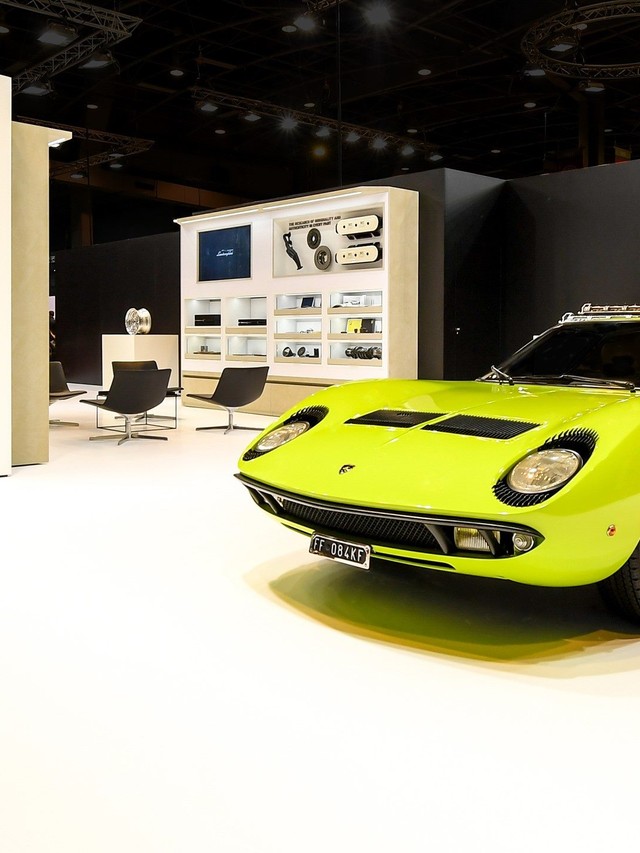
A Finished Miura, a Half-Built Countach, and Freshly Cast V12 Heads
Lamborghini’s heritage department, Polo Storico, arrived at Salon Rétromobile in Paris (February 7 to 11, 2018) with a display designed to function less like a museum exhibit and more like a working portfolio. The centerpiece was a 1967 Miura P400, chassis #3264, finished in its original Verde Scandal and fresh off a concours win. Beside it sat a 1976 Countach LP400, chassis #1120204, still mid-restoration, its bare panels and partially reassembled mechanicals laid open for inspection. On the table nearby: newly manufactured V12 4.0-liter engine heads, cast from molds reverse-engineered using original 1965 factory drawings.
The combination was deliberate. A completed triumph, an in-progress project, and a critical spare part, shown together, tell a story about capability and long-term commitment that a single polished car on a turntable cannot. For classic Lamborghini owners weighing whether to trust the factory or a third-party shop, this display was the argument.
Why Factory Certification Changes the Equation
Authenticity is the single largest variable in classic supercar pricing. For a Miura, the gap between a factory-correct car and one that is merely close can represent six figures at auction. Polo Storico certification provides a documented chain of provenance, materials sourcing, and archival research that no independent restorer can replicate, because no independent restorer owns Lamborghini’s production records.
Every Polo Storico restoration begins with the original production sheet for that specific chassis, cross-referenced against the department’s archives in Sant’Agata Bolognese. Paint codes, interior leather colors, engine specifications, even minor factory tolerances are verified against documentation rather than guesswork. The result is a car whose history is not just claimed but proven, and that proof follows the vehicle through every future sale.
Ferrari Classiche and Porsche Classic operate on similar principles, and both programs demonstrably lift resale values. Lamborghini’s version covers models from the 350 GT through the Diablo, provided they left production at least a decade ago. Where Polo Storico distinguishes itself is in parts supply: Lamborghini says the department now provides original spare parts covering over 65% of the classic car fleet, with 200 additional part numbers added in 2017 alone. For owners of rarer models like the Islero, Jarama, or Espada, that expanding catalog is the difference between a drivable car and a static display piece.
Two Restorations, Two Different Lessons
The Miura P400, chassis #3264, represents what a completed Polo Storico project looks like. Lamborghini says the ten-month restoration began in November 2016 and wrapped by August 2017. The body was returned to its original Verde Scandal lines, the chassis and all supporting systems were rebuilt, and the interior was brought back to its factory color, including a dashboard restored to the authentic Testa di Moro shade. By September 2017, the car had won first prize in its class at the Lamborghini & Design Concorso d’Eleganza in Neuchâtel, Switzerland.
The Countach LP400 tells a different, equally instructive story. Chassis #1120204, a right-hand-drive example, was displayed partway through its complete restoration. Every component, including the matching-numbers engine, was disassembled and overhauled. Lamborghini says the car is being repainted in its original yellow using PPG paint, subjected to rigorous paint tests and hand polishing before reassembly. Its Tabacco-colored interior is also being refurbished. Showing a car in this unfinished state is a bold choice: it invites scrutiny and demonstrates that the process itself is the product, not just the finished result.
One report suggests full Polo Storico restorations typically run around 18 months, though complex projects can stretch to three years. Lamborghini does not publish standard pricing, but available reporting indicates costs starting well above €200,000 and climbing depending on the model and scope of work. For a matching-numbers LP400 Countach or a concours-quality Miura, that investment is likely recouped when the car next changes hands with a factory certification letter in the glovebox.
Rebuilding the Raging Heart: The V12 Engine Head Project
The V12 4.0-liter engine heads on display at Rétromobile represent something more significant than a spare part. Lamborghini says the project was driven by direct client requests, meaning enough owners of early V12 cars (350 GT, 400 GT, and early Miura variants) needed replacement heads that the factory decided to tool up and produce them from scratch.
The process draws on Polo Storico’s archive of original 1965 engineering drawings and physical examination of surviving V12 engines. Lamborghini’s current R&D team collaborated with historical engineers to develop a single modular fusion mold, which was then rigorously tested before production. The result is a component built to the factory’s original specification through reverse engineering, not aftermarket approximation.
For owners, this kind of development keeps a classic Lamborghini V12 on the road rather than on a trailer. Independent machinists can fabricate replacement heads, but without access to the original drawings and casting data, the tolerances are educated guesses. The factory version removes that uncertainty. Because the mold is modular, it can serve multiple engine variants within the 4.0-liter family, which suggests Polo Storico designed it with long-term catalog expansion in mind.
What Rétromobile 2018 Signals for Classic Lamborghini Owners
Polo Storico’s Rétromobile display was, at its core, a confidence exercise aimed squarely at the people who own these cars and the people who want to buy them. The department operates from Lamborghini’s headquarters in Sant’Agata Bolognese and covers a broad mandate: archive preservation, vehicle certification, full restorations, and an expanding original parts catalog. The models it services span nearly four decades of production, from the 350 GT through the Diablo.
The practical takeaway is straightforward. Factory certification from Polo Storico represents the strongest provenance documentation available for these cars, and it directly affects what they are worth. If you are buying a Miura, a Countach, or even an LM002, asking whether the car carries Polo Storico documentation is now a standard part of due diligence. The expanding parts catalog, particularly projects like the V12 engine heads, also means that keeping these cars mechanically sound is becoming easier, not harder, as the years pass. That is a rare and valuable trajectory for any classic car marque, and the Rétromobile stand made the point without needing to say it out loud.
Gallery


