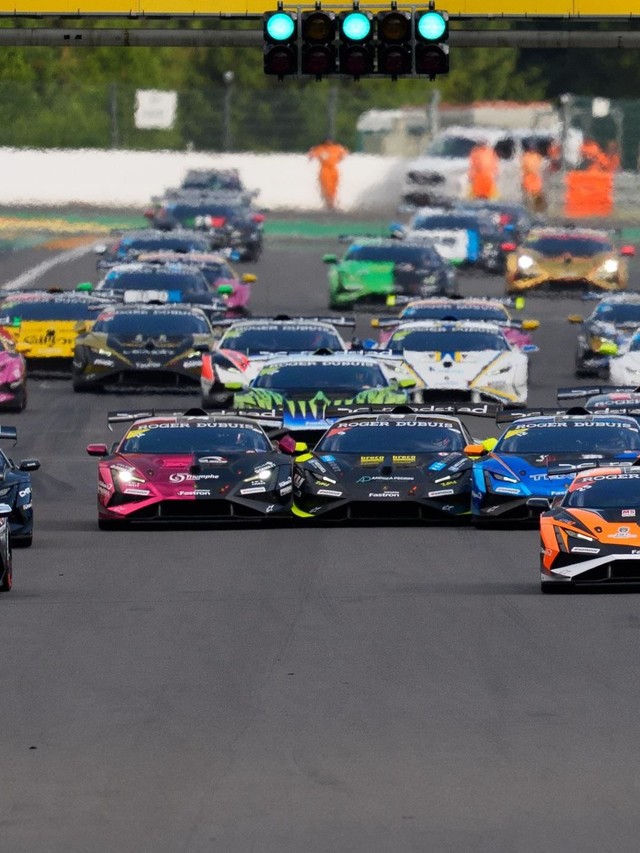
The Nürburgring Showdown: Key Battles and Drivers to Watch
Three rounds down, three to go before the World Finals, and not a single class title looks settled. That is the story heading into Nürburgring this weekend, where Lamborghini Super Trofeo Europe begins the back half of its 2025 campaign. Lamborghini says this marks the series’ 13th visit to the German circuit, a 5.148km, 15-turn layout in the Eifel Mountains that first appeared on the calendar in 2012. With only Barcelona and Misano remaining after this weekend, every point collected here carries outsized weight.
The format stays the same as every round: two 50-minute races, each with a mandatory pit window between minutes 20 and 30. What changes is the urgency. In a championship where every car on the grid is an identical 620hp naturally aspirated V10, the margins between a title push and a lost season can come down to a single qualifying lap or a botched pit stop. That parity is what makes the current standings so compelling, and it is also what makes Lamborghini Super Trofeo such a revealing test of who actually belongs behind the wheel.
Lamborghini says Oregon Team’s Enzo Geraci and Josef Knopp arrive at Nürburgring leading the Pro class. The Franco-Czech pair managed to extend their advantage at Spa despite not standing on the podium, which tells you something about consistency in a one-make series where finishing well matters as much as winning outright. Behind them, solo driver Jerzy Spinkiewicz of Uniq Racing broke through with a maiden victory at Spa, while Target Racing’s Patrik Fraboni and Giacomo Pedrini took the opening-round win at Paul Ricard but are still searching for their second.
Pro-Am looks the most lopsided on paper. CMR’s Georgi Dimitrov and Stéphan Guerin hold a 38-point cushion after winning five of the first six races, including two overall victories at Paul Ricard and Monza. The real fight in Pro-Am appears to be for second, where BDR Competition’s Anthony Nahra and Dimitri Enjalbert sit just one point clear of ASR’s Miloš Pavlović and Alessio Ruffini.
In Am, VSR’s Piergiacomo Randazzo and Stéphane Tribaudini lead, but Oregon Team’s Massimo Ciglia and Pietro Perolini trail by only 13 points. Ciglia and Perolini have three podiums from six races without a win yet. For a crew that consistent, a breakthrough at Nürburgring could reshape the class picture entirely.
The class worth watching most closely is Lamborghini Cup. Rexal Villorba Corse’s Karim Ojjeh leads with 52 points, but GT3 Poland’s Holger Harmsen sits just one point behind. Leipert Motorsport’s Gerhard Watzinger, fresh off his first victory of the season, is two points further back. Then come father-and-son duo Luciano and Donovan Privitelio, Claude-Yves Gosselin, and Adalberto Baptista, all within striking distance. Six crews separated by eight points heading into the second half. That kind of compression means a single bad qualifying session could shuffle the entire order, and it is a direct consequence of the one-make formula doing exactly what it was designed to do.

Huracán Super Trofeo EVO2: Engineering for the Track
Every car on the Nürburgring grid this weekend runs the same specification: a 5.2-litre naturally aspirated V10 producing 620 horsepower, housed in the Huracán Super Trofeo EVO2 chassis. Lamborghini says the car features aerodynamic refinements and a design by Centro Stile, but the core appeal for enthusiasts is simpler than any aero package. In an era where Lamborghini’s own road car lineup now includes hybrid V8 and V12 powertrains, the Super Trofeo grid remains one of the last places you can watch a field of naturally aspirated V10s compete wheel to wheel.
Lamborghini confirmed the EVO2 replaced the earlier EVO specification starting in 2022, bringing updated aerodynamics and braking improvements while retaining the same V10 powertrain. Specific technical details of those upgrades sit outside the official material for this weekend’s preview, but the car’s track record across three full seasons of European competition speaks for itself in terms of reliability and close racing.
The one-make format keeps costs more predictable than open GT racing. Hankook supplies tires for the entire field, and the identical car specification means teams differentiate through setup, strategy, and driver coaching rather than development budgets. For anyone considering customer racing with a manufacturer series, that parity is the selling point. It also explains why the eight-point gap in Lamborghini Cup is genuinely meaningful: when the machinery is equal, those margins are a product of driver talent and pit-wall decisions, not a faster car.

The Strategic Importance of Lamborghini’s One-Make Series
Lamborghini’s customer racing operation, Squadra Corse, structures its programs across three continental Super Trofeo series (Europe, North America, and Asia) that feed into the annual World Finals. The 2025 World Finals are scheduled for Misano, where European, North American, and Asian competitors will share the same weekend to crown global champions.
The four-class structure (Pro, Pro-Am, Am, and Lamborghini Cup) accommodates everything from aspiring professionals to gentleman racers, each fighting for a separate title. Mandatory pit-stop rules reinforce that range: solo drivers face a 63-second minimum stationary time, while two-driver entries must stop for 60 seconds. That three-second penalty for running alone is a deliberate balancing mechanism, adding a layer of strategic calculation to every race.
What makes the system work is its versatility. The series is not just a stepping stone upward. It also serves as a competitive home for experienced drivers who want close, well-organized racing in identical machinery, where results reflect driver skill and team preparation rather than budget-driven technical advantages. The arrival this weekend of Japanese drivers Hiroshi Hamaguchi and Mineki Okura, making their Super Trofeo Europe debut with Rexal Villorba Corse, illustrates the point. Lamborghini says Hamaguchi brings substantial GT3 experience, including a Road to Le Mans victory in 2020 and a European Le Mans Series win last year, both at the wheel of a Lamborghini Huracán GT3 EVO2. Okura comes from touring car racing in Japan and has made sporadic GT World Challenge Asia appearances in a Lamborghini. Stepping down from GT3 to Super Trofeo might seem counterintuitive, yet welcoming rookies and seasoned GT3 winners on the same grid is part of what keeps the series relevant 16 years after its 2009 debut.

Connecting Super Trofeo to Lamborghini’s GT3 Future
For anyone tracking Lamborghini’s competitive ambitions beyond the one-make series, the Super Trofeo grid represents the brand’s most accessible entry point into organized motorsport. Hamaguchi’s path is instructive: GT3 success in a Lamborghini, then a return to Super Trofeo for close, parity-driven competition. That two-way flow between the one-make series and higher-level GT racing is central to how Squadra Corse develops its driver and team relationships.
The broader context matters here. Lamborghini’s road car lineup has moved to hybrid V8 and V12 powertrains, and the competitive side of the business will eventually follow. Super Trofeo, with its naturally aspirated V10 grid, occupies a particular moment in that transition. The series remains the proving ground where teams learn Lamborghini’s way of working, where drivers build the track record that earns a seat in something faster, and where the brand cultivates the customer racing community that sustains its GT3 program. Two rounds remain after Nürburgring before the season wraps at Misano, so for anyone following the championship, now is the point where the title pictures start to crystallize and the pipeline toward Lamborghini’s next chapter of GT racing comes into sharper focus.

Race Weekend Format and Schedule
Round 4 runs from August 29 to 31. Friday brings two one-hour practice sessions, Saturday opens with a pair of 20-minute qualifying sessions before Race 1 at 13:25 CEST, and Sunday’s Race 2 starts at 10:30 CEST. Both races will be live streamed on the Lamborghini Squadra Corse YouTube channel.
After Nürburgring, the calendar moves to Barcelona (October 10 to 12) and then Misano (November 6 to 7), with the World Finals closing the season at Misano on November 8 to 9.
| 2025 Super Trofeo Europe Calendar | Dates |
|---|---|
| Round 1: Paul Ricard | April 11-13 |
| Round 2: Monza | May 30 – June 1 |
| Round 3: Spa-Francorchamps | June 25-28 |
| Round 4: Nürburgring | August 29-31 |
| Round 5: Barcelona | October 10-12 |
| Round 6: Misano | November 6-7 |
| World Finals: Misano | November 8-9 |
Gallery


