A PRO-AM Title Decided in the Final Minutes at Dubai
On March 3, 2018, the second and final race of the Lamborghini Super Trofeo Middle East season rolled off at the Dubai Autodrome with three crews still mathematically alive for the PRO-AM championship. Glauco Solieri, Giacomo Altoé, and the Konrad Motorsport pairing of Carrie Schreiner and Axcil Jefferies all carried legitimate title claims into a race that would be settled not by accumulated points cushions or conservative strategy, but by raw pace in the closing laps and a safety car intervention that compressed the entire field.
The PRO and AM category titles had already been wrapped up in Race 1 the previous day, which meant the PRO-AM fight was the only championship question left unanswered. That single open question turned a routine season finale into the most compelling race of the year. By the time the chequered flag fell, Schreiner and Jefferies had secured both the class victory and the 2018 PRO-AM championship, but the path to that result was anything but straightforward.
How Race 2 Unfolded: Pole Position, a Spin, and Shifting Fortunes
Daniel Zampieri, sharing the #76 Antonelli Motorsport car with Solieri, started from pole. Taylor Proto lined up alongside in the #55 FFF Racing entry, with reigning PRO champion Jack Bartholomew close behind. The opening laps looked tidy enough, until Marco Antonelli spun his #78 Antonelli Motorsport Huracán on lap two. That incident did more than cost Antonelli track position: it effectively ended his young teammate Altoé’s realistic shot at the PRO-AM title, removing one of the three contenders from the equation before the mandatory driver swap.
When the pit window opened, Zampieri handed the #76 car to Solieri, who at that point led the PRO-AM standings. James Pull climbed into the #5 FFF Racing entry from Bartholomew and took the overall lead, a position he would hold unchallenged to the finish. The real contest was playing out behind him.
Solieri began losing ground in the PRO-AM class. Jefferies, having taken over from Schreiner in the #11 Konrad Motorsport car, started picking off competitors. Lamborghini’s account of the race describes Jefferies mounting a significant recovery drive, gaining positions through the second half of the stint. Then came the moment that redefined the championship.
Schreiner and Jefferies: Recovery, Restart, Championship
A car spun off with only minutes remaining, bringing out the safety car. The intervention regrouped the entire field, erasing the gaps Solieri had built and placing Jefferies right on the tail of his PRO-AM rivals for a short, intense sprint to the finish.
For Schreiner and Jefferies, the safety car was a gift. For Solieri, it was a disaster. The restart allowed Jefferies to capitalize on the momentum he had been building through his recovery stint, and he crossed the line with the PRO-AM class victory that carried the championship with it.
Their season had not been without setbacks. Earlier in the year during a Dubai round, Jefferies was hit in the first turn by another competitor and dropped to the back of the field, costing the crew valuable points and temporarily surrendering the championship lead. That context makes the final-race recovery all the more significant: Schreiner and Jefferies did not simply inherit a title through attrition but fought back from a points deficit created by contact that was not their fault.
Schreiner, a German driver building her career through customer racing programs at the time, and Jefferies, a Zimbabwean-born racer with experience across multiple single-seater and GT categories, represented exactly the kind of international, mixed-experience crew that the Super Trofeo series is designed to cultivate. The PRO-AM class pairs a professional or semi-professional driver with a less experienced teammate, and the format rewards both raw speed and the ability to manage a race strategically across two stints.

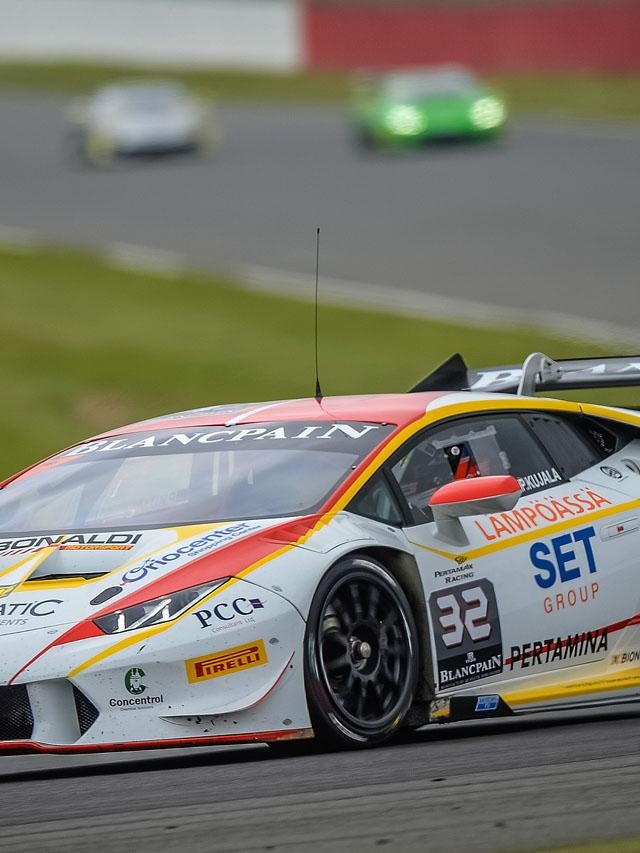
A fleet of Lamborghini Huracán Super Trofeo race cars navigates a turn on the track during a high-speed competition.
The Proto Family Double and Other 2018 Champions
One of the more unusual stories from the 2018 season involved the Proto family. Taylor Proto, racing with FFF Racing Team, clinched the AM category championship in Race 1 and added another class victory in Race 2 alongside a second-place overall finish. His father, Mark Proto, won four of six Lamborghini Cup races and took that category’s title in the same weekend. A father and son winning championships in the same one-make series, at the same event, is the kind of detail that rarely appears in race result summaries but speaks to the accessibility and family-oriented nature of Lamborghini’s customer racing ladder.
Bartholomew’s PRO title, already secured before the finale, was punctuated by yet another overall victory in Race 2 alongside Pull in the FFF Racing by ACM entry. The pair won the overall classification for the fourth consecutive race, a streak of dominance that underlined FFF Racing’s strength as a team but also highlighted how competitive the PRO-AM and AM classes were by comparison. The overall winner was never in doubt. The championship that mattered most on that final day was the one being fought three or four positions behind.
The Huracán Super Trofeo: Purpose-Built for Exactly This Kind of Racing
The car at the center of all this drama was the Lamborghini Huracán LP 620-2 Super Trofeo, a purpose-built, track-only race machine designed exclusively for the brand’s one-make series. The “620-2” designation points to the key engineering choice: rear-wheel drive only, stripping out the all-wheel-drive system found on the road car to reduce weight and put a greater premium on driver skill. In a championship format where professional drivers share cars with amateurs, that rear-drive configuration amplifies the difference between a good stint and a great one.
The Huracán Super Trofeo succeeded the Gallardo Super Trofeo as the platform for Lamborghini’s customer racing program, serving that role across multiple global series covering Europe, Asia, North America, and the Middle East for years. As Autoblog noted in a feature on a road-titled example, the car was built from the ground up for one-make competition, not adapted from a road car with a roll cage bolted in.
For prospective buyers watching the collector market, these cars occasionally surface at auction. Autoblog reported on a 2020 Huracán Super Trofeo EVO Collector with just 84 miles appearing on Bring a Trailer, described as embodying Lamborghini’s naturally aspirated racing era. That era is now closing. The Huracán platform has given way to the Temerario, and Lamborghini’s next chapter in customer competition will look fundamentally different.
From Super Trofeo to Temerario GT3: What the 2018 Season Tells Us About Lamborghini’s Racing Strategy
Lamborghini’s Temerario GT3, which debuted at the 2025 Goodwood Festival of Speed, marks the brand’s first competition car fully designed, developed, and built in-house by Squadra Corse. The Super Trofeo series served as the proving ground for that ambition. Seasons like the 2018 Middle East championship demonstrated that Lamborghini could organize, manage, and sustain competitive racing programs across multiple regions with enough drama and sporting credibility to keep teams and drivers invested.
Customer racing programs serve a dual purpose for supercar manufacturers. They generate direct revenue through car sales, parts, and entry fees, but they also function as a brand amplifier, placing the cars in competitive environments where performance claims get tested publicly. Ferrari runs its Challenge series on similar logic. Porsche operates the Carrera Cup. Lamborghini’s version, built around the Super Trofeo, distinguished itself through the V10 soundtrack and a format that genuinely produced unpredictable results, as the 2018 PRO-AM title fight demonstrated.
The transition to the Temerario GT3 represents a significant escalation. Where the Super Trofeo was a controlled, single-marque environment, GT3 racing pits Lamborghini directly against every other manufacturer on the same grid. The lessons learned from running regional Super Trofeo championships, managing customer teams, and developing race-ready hardware feed directly into that GT3 effort. A PRO-AM title that comes down to a safety car restart in the final minutes of the final race of the season is the kind of organic drama that no marketing department can manufacture, and that credibility carries forward as Squadra Corse moves into its most ambitious competitive era yet.


