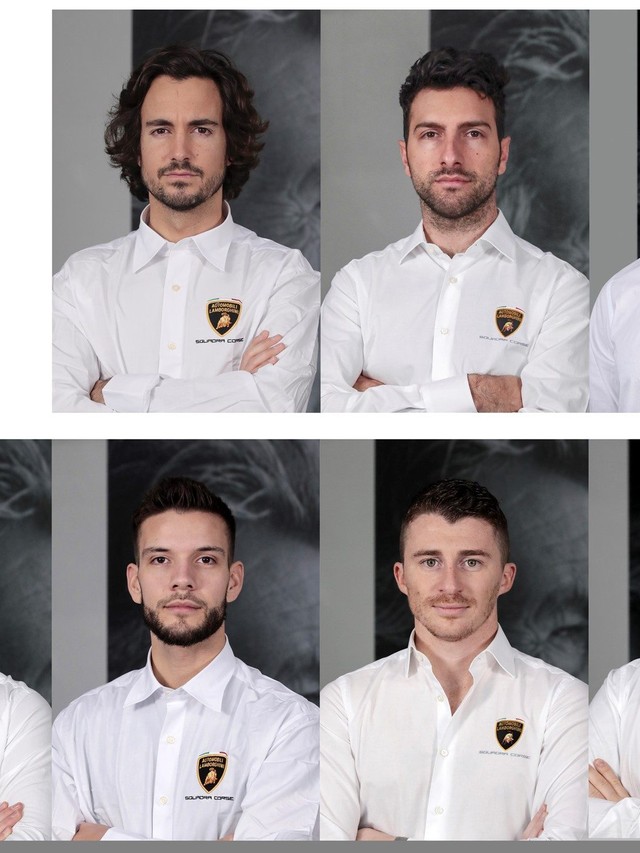
Two New Faces in Lamborghini’s Factory Driver Ranks
When Lamborghini Squadra Corse confirmed its 2020 factory driver lineup on January 8, 2020, the roster carried a message that went well beyond a list of names. Giacomo Altoé and Albert Costa, both products of the brand’s internal development programs, earned induction as official factory drivers alongside reconfirmed veterans Andrea Caldarelli, Marco Mapelli, Dennis Lind, Franck Perera, and Giovanni Venturini. The announcement was less a reshuffling and more a vindication: the pipeline Squadra Corse built to turn junior racers into factory-caliber professionals was delivering results.
Altoé, a nineteen-year-old from Veneto, and Costa, a thirty-year-old Barcelonan, represent different generations and different paths into the same seat. What connects them is the Squadra Corse ladder, a structured progression from one-make series through junior GT3 competition to full factory status. Lamborghini says Altoé is the first millennial to become an official driver for the Sant’Agata Bolognese brand, while Costa is the first Spaniard to hold the title. Both distinctions matter less for the trivia and more for what they reveal about the program’s expanding reach.
For the 2020 season, Altoé and Costa will reunite to race Emil Frey Racing’s Huracán GT3 EVO in its GT World Challenge Europe debut. That pairing already proved itself: the duo won the International GT Open championship together in 2019, a result that effectively sealed their promotions.
From Super Trofeo to Factory Contract: The Altoé and Costa Trajectories
Giacomo Altoé’s ascent through Lamborghini’s ranks reads like a case study in what the brand’s junior programs are designed to produce. In 2018, he won the Lamborghini Super Trofeo Europe, took the World Final, claimed the Italian GT Championship in GT3, and earned recognition as Best Lamborghini Young Driver. That single season generated enough evidence for Squadra Corse to back him through 2019, where he was rated first among the drivers in Lamborghini’s GT3 Junior Driver program.
Altoé recalled that his first Lamborghini race was in the 2018 Super Trofeo Middle East, where he secured pole position in the ProAm class. The detail illustrates how early the evaluation begins. The Super Trofeo series functions as a live audition, and Squadra Corse’s coaching staff watches closely. Altoé’s family owns the Adria International Speedway circuit in Italy, which he identified as his favorite track. Growing up with a racetrack in the family naturally accelerated his development, but the formal Lamborghini pathway still required him to prove himself against every other junior in the system.
Albert Costa’s route was longer and more varied. Born in Barcelona in 1990, Costa started with motorbikes before switching to karting at age nine, winning his first kart race and committing to four wheels from that point forward. He competed in karting, Formula racing, and GT categories before arriving in Lamborghini’s orbit. Costa shared that his debut race with Lamborghini was at France’s Le Castellet circuit, which he won alongside Altoé. He named the 24 Hours of Spa-Francorchamps as his favorite race, a detail that hints at his endurance-racing ambitions within the factory program.
Costa noted that speaking Italian helps him feel closer to his colleagues at headquarters, a small but practical advantage when integration into a factory team depends on communication as much as lap times. AutoHebdo reported that Costa had assisted the Caldarelli and Mapelli duo in the final of the Endurance Cup in Barcelona, suggesting he was already functioning as a de facto team resource before the official appointment. His trajectory took longer than Altoé’s, but it arrived at the same conclusion: the pipeline rewards performance regardless of how many detours precede it.

Lamborghini Squadra Corse presents its official drivers for the 2020 season in this composite portrait.
Inside the Squadra Corse Academy: How the Ladder Works
The promotions of Altoé and Costa only make sense in the context of the architecture that produced them. Lamborghini’s talent development operates on two parallel tracks. The Young Driver Program identifies promising racers competing in the Super Trofeo one-make series and evaluates them through dedicated test sessions overseen by Squadra Corse’s coaching staff. The GT3 Junior Driver program sits one rung higher, placing selected drivers into GT3 machinery with factory support while assessing their readiness for a full factory contract.
One source indicates that Squadra Corse was founded in 2013 within Lamborghini’s Research and Development department, and according to that same report, the division offers an integrated approach to driving experiences spanning road vehicle courses through to GT-class championship competition. The Super Trofeo series sits at the base of this structure, functioning simultaneously as a customer racing product, a brand spectacle, and a scouting ground.
Giorgio Sanna, Head of Automobili Lamborghini Motorsport, highlighted Altoé as a perfect example of how the young driver programs train talents and provide genuine career opportunities. The emphasis on “real career opportunities” is deliberate. Unlike arrive-and-drive customer programs where wealthy amateurs buy seat time, the Squadra Corse ladder is designed to identify and promote professional-caliber racers who will represent the brand in the most competitive GT championships on the calendar.
The practical takeaway for anyone watching Lamborghini’s racing efforts: the Super Trofeo is not a dead end. Winning the right races in the one-make series can lead directly to GT3 machinery, factory backing, and eventually a seat in GT World Challenge Europe or the Intercontinental GT Challenge. That clarity of pathway matters when young drivers and their sponsors are deciding which manufacturer ecosystem to invest in.
The Next Wave: Danny Kroes and Frederik Schandorff Step Up
Altoé and Costa are not the only graduates moving through the system, and the depth of the pipeline may be the strongest argument for its long-term viability. Dutch driver Danny Kroes, born in 1999, was named the best of the 2019 Lamborghini Young Driver Program after winning the Lamborghini Super Trofeo Europe. Lamborghini says Kroes made a very good impression on the staff during the program’s test sessions, earning him a supported entry into his first GT3 championship season in the Italian GT.
Frederik Schandorff followed a slightly different trajectory. At the beginning of 2019, he won the Lamborghini Super Trofeo Middle East, then closed the year by securing the World Champion title in the single-brand series through his victory at the World Final in Jerez de la Frontera. That performance earned him a spot in the GT World Challenge Asia with the Vincenzo Sospiri Racing team for 2020.
Both Kroes and Schandorff illustrate the system’s geographic breadth. The Super Trofeo operates regional championships across Europe, the Middle East, Asia, and North America, meaning the scouting net catches talent from well beyond Italy’s traditional racing heartland. A Dutch driver winning in Europe and a Danish driver winning in the Middle East before graduating to Asian GT racing shows how deliberately international the program’s scope has become.
It is worth noting that Mirko Bortolotti, a significant Lamborghini driver from 2015 to 2019, spent 2020 with a rival brand before returning to Lamborghini as a factory driver in 2021. Sandy Mitchell, another rising talent, was part of the GT3 Junior program in 2020 and was promoted to full factory status for the 2021 season. The pipeline kept producing even beyond the names announced in this particular roster.
Lamborghini’s Approach vs. the Competition: The Talent War in GT Racing
Lamborghini’s driver development model gains sharper definition when measured against its key rivals. Ferrari’s Driver Academy is the most famous example, a program that has fed talent into Formula 1 and the World Endurance Championship for over a decade. Porsche operates its own Junior Programme, funneling young drivers into the Supercup and then into factory GT and prototype programs. Mercedes-AMG runs a similar evaluation structure through its customer racing teams.
Lamborghini’s system differs in one critical respect: its entry point is a branded one-make series that the company owns and operates. The Super Trofeo is both a commercial product and a talent filter. Ferrari’s FDA recruits from karting and junior formula categories. Porsche’s Supercup serves a similar filtering function but operates within the Formula 1 support bill, giving it a different audience and competitive context. Lamborghini’s version is more vertically integrated, with the same division that builds the race cars also running the championship and evaluating the drivers.
The advantage of this structure is control. Squadra Corse’s staff can observe drivers across an entire season in identical machinery, eliminating the variable of car performance. When Sanna says a driver showed “the right attitude,” that assessment comes from months of direct observation, not a single shootout test. The disadvantage, historically, was visibility. Ferrari’s FDA graduates compete in televised Formula series. Porsche’s Supercup races on Grand Prix weekends. The Super Trofeo, while popular within the GT community, operates at a lower public profile. Lamborghini’s response has been to build the GT3 Junior program as a bridge, placing its best Super Trofeo graduates into the more visible GT World Challenge and International GT Open championships where results translate into broader recognition.
Sportscar365 reports that existing factory drivers Caldarelli and Mapelli claimed all three GT World Challenge Europe drivers’ accolades in the previous season, and that the same outlet noted Caldarelli, Mapelli, and Lind were confirmed as Lamborghini’s full-season Intercontinental GT Challenge powered by Pirelli lineup with Orange 1 FFF Racing Team. Those results validate the system’s output: the drivers at the top of the ladder are winning at the highest level of GT racing.
What the 2020 Roster Signals for Lamborghini’s Racing Future
Costa acknowledged the weight of expectations plainly, noting that Lamborghini won everything available in the previous season and that pressure on the incoming class would be substantial. Altoé framed his promotion as a starting point rather than a destination, expressing eagerness for the upcoming test program.
The broader signal is institutional. Lamborghini is not relying on hiring established stars from other manufacturers to fill its factory seats. Instead, it built a system that identifies talent early, develops it through progressively more demanding competition, and promotes from within. The 2020 roster, with two internal promotions and two more juniors advancing into GT3 competition, demonstrates that the pipeline is producing at a sustainable rate.
Factory drivers do more than race on weekends. They contribute to car development, represent the brand at customer events, and serve as the human proof that Lamborghini’s racing technology works at the sharp end of competition. When those drivers are homegrown rather than borrowed, the message carries more weight.
The Huracán GT3 EVO remained the weapon of choice across every series mentioned in the 2020 plans, from GT World Challenge Europe to the Italian GT to GT World Challenge Asia. Keeping the same platform while refreshing the driver roster allowed Squadra Corse to maintain technical continuity while injecting new energy and ambition into its programs. Whether Altoé and Costa could match the standard set by Caldarelli and Mapelli would become the central question of the season, but the system that put them in position to try was already proving its worth.


