A Season That Rewrote the Record Books
Lamborghini Squadra Corse closed out 2021 with a haul that would make any manufacturer’s motorsport division jealous: seven GT championship titles, 24 victories, 60 podium finishes, 29 pole positions, and 35 fastest laps, all accumulated across 13 international series. Eighty-nine drivers, eight of them Lamborghini Factory Drivers, covered more than 120,000 km of competitive racing. The numbers alone are impressive. The pattern they reveal is more telling.
Since the first-generation Huracán GT3 debuted in 2015, Lamborghini says it now holds 42 GT championship titles. That trajectory, from zero GT3 presence to a dominant force in barely six years, represents one of the fastest and most deliberate motorsport buildouts in the modern supercar world. Ferruccio Lamborghini famously refused to go racing. His successors at Sant’Agata Bolognese clearly disagreed, and 2021 was the year that argument was settled for good.
What sets this season apart from a routine trophy count is the breadth. Lamborghini did not win one series convincingly and scrape by elsewhere. The brand swept the GT World Challenge America with all three crowns (drivers’, teams’, constructors’), took both drivers’ and teams’ titles in the International GT Open, and repeated as British GT champion in both categories. That kind of multi-front dominance requires more than a fast car. It requires an ecosystem, one that Squadra Corse has spent nearly a decade building around the Huracán GT3 platform and its network of independent customer teams.
K-Pax Racing and the American Blitz
The GT World Challenge America result deserves particular attention because it was Lamborghini’s debut season in the series. K-Pax Racing, a well-established Californian outfit, fielded two Huracán GT3 EVO cars with Factory Drivers Andrea Caldarelli and Giovanni Venturini paired alongside Jordan Pepper and Corey Lewis, respectively.
Caldarelli and Pepper were ruthless. Nine wins from thirteen races, a third-place finish at the 8 Hours of Indianapolis, and 270 points in the drivers’ standings gave them a 36-point cushion over their nearest rivals, who happened to be their own teammates. Venturini and Lewis added another victory, and the combined effort handed K-Pax the teams’ title with 336 points. Lamborghini’s constructors’ margin exceeded 100 points over the second-place manufacturer.
Winning everything in your first year in a competitive North American GT series is unusual by any standard. Caldarelli was also part of the Orange1 FFF Racing crew that swept the GT World Challenge Europe triple crown back in 2019. His ability to deliver across different teams, continents, and series formats makes him one of the most effective GT3 drivers in Lamborghini’s stable, a fact that sometimes gets lost in the corporate celebration. More to the point, his results illustrate the broader thesis of 2021: the Huracán GT3 EVO and the support structure behind it allow strong drivers to dominate regardless of geography.

Jordan Pepper and Andrea Caldarelli celebrate their victory at the GT World Challenge America Sebring 2021 with their trophies.
GT Open and British GT: Consistency as a Weapon
The International GT Open tells its own story about Lamborghini’s sustained grip on European GT racing. Junior Drivers Michele Beretta and Frederik Schandorff won the drivers’ championship in the Huracán GT3 EVO no. 63 for Vincenzo Sospiri Racing, accumulating 146 points across seven rounds. Lamborghini says this was its fourth drivers’ title in six consecutive editions of the championship, with previous wins in 2016, 2017, and 2019. VSR also secured the teams’ title with 153 points and a comfortable margin. The teams’ crown itself returned to Lamborghini after previous wins by Imperiale Racing in 2017 and Emil Frey Racing in 2018.
Four titles out of six editions in a single series is the kind of consistency that separates a good race car from a great customer racing platform. The Huracán GT3 EVO is clearly both, and the fact that these results come through different private teams each year only reinforces how transferable the car’s competitiveness is.
Across the Channel, Dennis Lind and Leo Machitski repeated as British GT champions with Barwell Motorsport’s no. 63 car. A win at Spa-Francorchamps and podiums at Brands Hatch, Silverstone, Snetterton, and Oulton Park built a 9.5-point title advantage. Lind and Machitski became the first non-British pairing to win the British GT title since 2006, the year GT3 racing itself was introduced. Barwell’s teams’ tally of 314.5 points left the nearest competitor 137 points behind.
Emil Frey Racing and Barwell also collected class honors in the GT World Challenge Europe, with Alex Fontana winning the Silver Cup drivers’ and teams’ titles and the Barwell crew of Miguel Ramos and Henrique Chaves taking the Pro-Am category.

Two victorious drivers, adorned with laurel wreaths, celebrate their GT3 Drivers' Championship on the podium.
The Huracán GT3 EVO: Why the Platform Keeps Winning
A reasonable question at this point: what makes the Huracán GT3 EVO so persistently competitive? GT3 regulations use Balance of Performance adjustments to keep the field close, so raw power alone does not explain multi-year dominance. The answer lies partly in the car’s fundamental architecture and partly in how Squadra Corse supports the teams that run it.
The Huracán GT3 won on its very first outing, at Monza in the Blancpain GT Series on April 12, 2015. The platform evolved into the EVO specification while retaining the core mid-engine V10 layout that gives it predictable weight distribution and a naturally aspirated powerband that customer drivers find approachable. In endurance trim, the car proved durable enough to win the 24 Hours of Daytona in the GTD class three consecutive times (2018, 2019, 2020), a feat Lamborghini says no other manufacturer has matched. Add the 12 Hours of Sebring victories in 2018 and 2019, completing the so-called “36 Hours of Florida” double in back-to-back years, and the endurance credentials become difficult to argue with.
For context on the demands of that format: the Huracán GT3 EVO that won the 2020 Daytona race completed 765 laps at an average speed of 195 km/h. GT3 pit stop regulations allow only two mechanics to change all four tires, with a minimum stop time of 16 seconds. Compare that to Formula 1’s twelve-mechanic ballet, and it becomes clear that GT3 endurance racing places an extraordinary premium on mechanical reliability and driver-friendliness. The Huracán has excelled at both.
More than 40 Huracán GT3 cars currently compete globally. That installed base creates a feedback loop: more cars racing means more data flowing back to Sant’Agata, which feeds into development support that keeps the platform competitive, which attracts more teams. Squadra Corse, established in 2013, built this cycle deliberately, and the 2021 results are its most complete vindication.
Squadra Corse’s Customer Model: The Engine Behind the Titles
GT3 racing functions as the supercar industry’s proving ground, and every major manufacturer approaches it differently. Porsche fields the largest GT3 grid worldwide with the 911 GT3 R, leveraging sheer volume and decades of customer racing infrastructure. Ferrari runs its own program through a factory-adjacent model that emphasizes works-team performance. McLaren, Aston Martin, and Mercedes-AMG all field GT3 machinery with varying degrees of factory involvement.
Lamborghini’s approach sits in an interesting middle ground. Squadra Corse designs and produces its race cars in-house, applying road-car-grade engineering standards, but the actual racing is done almost entirely by independent customer teams. K-Pax, Barwell, Emil Frey, VSR: these are private operations that buy the car, receive technical support from Sant’Agata, and go racing under their own banners. The 2021 results suggest this model works exceptionally well, possibly because it forces the car to be robust and intuitive enough for a wide range of drivers and team setups rather than optimized for a single factory crew. When seven titles arrive through multiple independent outfits scattered across three continents, the common denominator is the machinery and the support behind it.
Squadra Corse also runs the Accademia driver training program and Young Drivers and Junior development pathways, funneling talent from karting into global GT3 competition. Beretta and Schandorff’s GT Open title is a direct product of that pipeline. The one-make Super Trofeo series, run in European, North American, and Asian editions with the Huracán Super Trofeo EVO, serves as both a feeder series and a standalone commercial product.
For buyers considering a Lamborghini road car, the racing program matters more than it might seem. The GT3 effort validates engineering decisions, builds brand credibility among performance-minded owners, and creates a community around competitive driving that extends well beyond the showroom. Owners who track their Huracán STOs or attend Lamborghini driving experiences are participating in the outer ring of an ecosystem that starts with Squadra Corse’s championship-winning machinery.

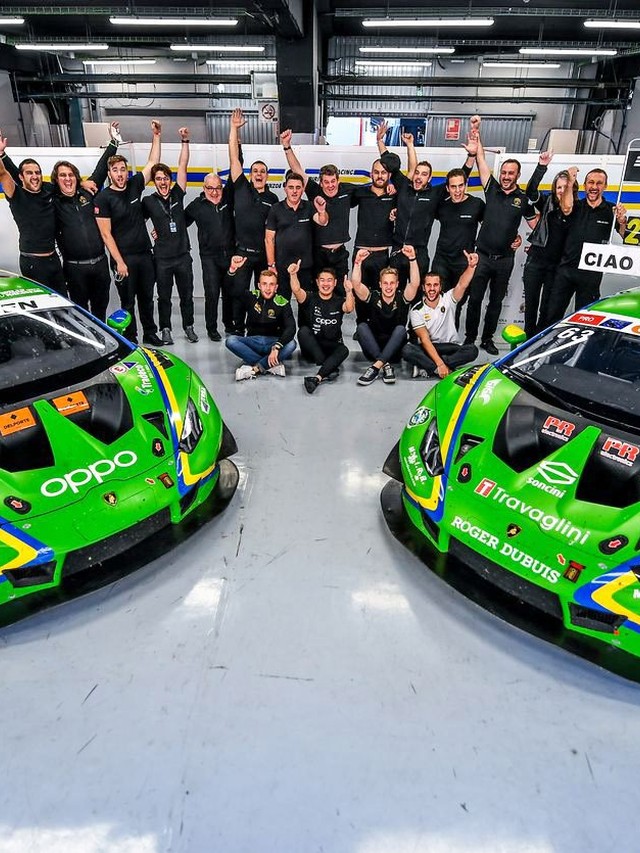
The victorious racing team celebrates with their two Lamborghini Huracan GT3 Evo cars in the pit garage.
From Track to Showroom and Beyond
Lamborghini’s endurance racing history stretches further back than most enthusiasts realize. The brand’s first appearance at a major endurance classic came in 1975, when Paul Rilly attempted to qualify a 1968 Islero for the 24 Hours of Le Mans. That effort was quixotic at best. The gap between a lone Islero at Le Mans and 42 GT championship titles tells you everything about how seriously the modern company takes competition.
The practical question for LamboCars readers is whether this racing pedigree translates into tangible road car value. Lamborghini does not publicly detail the specific engineering transfers from GT3 to production models, so drawing a direct line from, say, the Huracán GT3 EVO’s cooling system to the Huracán STO’s track-day capability requires some inference. What can be said with confidence is that the GT3 program serves as a real-world stress test for components, materials, and design philosophies that share DNA with the road cars. When a Huracán GT3 EVO survives 765 laps at Daytona, the lessons learned about durability, thermal management, and aerodynamic efficiency do not stay locked in a racing department filing cabinet.
As noted by Road & Track, the broader narrative of Lamborghini’s evolution from a company that explicitly avoided racing to one that now treats motorsport as a core brand pillar represents a fundamental philosophical shift. The 2021 results are the most emphatic evidence yet that this shift was the right call.
The Huracán GT3 EVO’s competitive window will eventually close as the road car it derives from gives way to its successor. Lamborghini confirmed the Temerario as the Huracán’s replacement, and a GT3 variant of that platform will inevitably follow, carrying a twin-turbo V8 hybrid powertrain into a category that the naturally aspirated V10 currently owns. That transition raises genuine questions about whether the new car can replicate the EVO’s driver-friendliness and endurance reliability, particularly given the added complexity of turbocharging and electrification in a racing context.
Lamborghini’s competitors face similar transitions. The GT3 grid is shifting toward turbocharged and hybrid architectures across the board, which means the playing field will reset to some degree. The advantage Squadra Corse carries into that reset is institutional: the customer team relationships, the driver development pipeline, the engineering feedback loop, and the operational discipline that produced seven titles in a single season do not disappear when the car changes. The 2021 season will likely be remembered as the high-water mark of the Huracán GT3 EVO era, the year when everything Squadra Corse built since 2013 paid off simultaneously across multiple continents and championships. Whether the next chapter can match it depends on factors that remain unconfirmed, but what 2021 proved beyond debate is that Lamborghini’s racing infrastructure is mature, competitive, and capable of winning at the highest level of GT motorsport.
Gallery


