A Saturday Night at Misano Worth Remembering
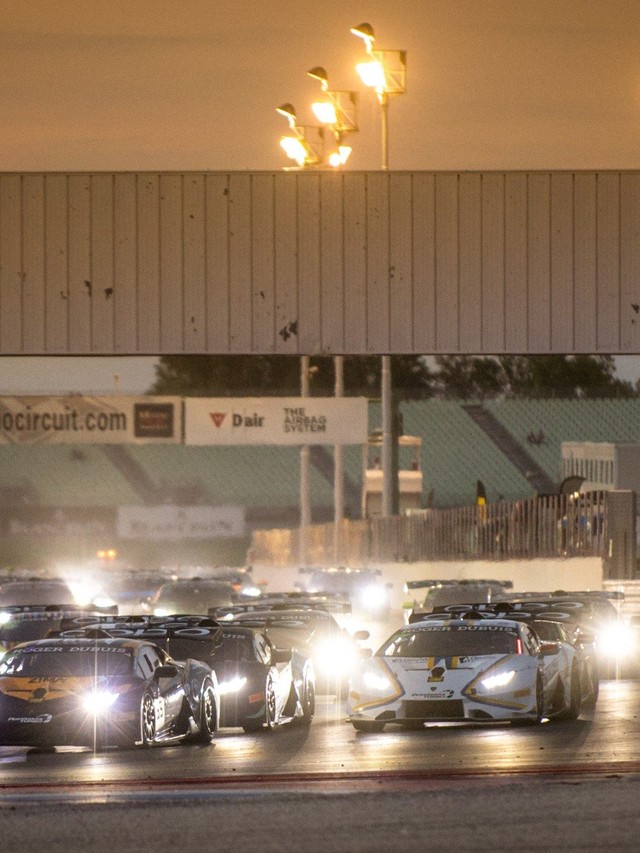
The floodlights at Misano World Circuit switched on for the Lamborghini Super Trofeo Europe‘s third double round of the 2018 season, and the racing that followed produced the kind of results that look better with distance. First-time winners in two classes. A four-peat in another. An early retirement for the poleman. All of it unfolding at a Romagna circuit better known for motorcycle heroics, renamed in honor of local MotoGP star Marco Simoncelli.
The weekend’s two night races rewarded adaptability over raw pace. Braking references shift under artificial light. Depth perception narrows. The V10 howl bounces off grandstands differently when the ambient noise of a summer afternoon is gone. That layer of unpredictability turned Misano into a stage where pit stop strategy and driver composure mattered as much as qualifying speed, and the results bore that out across every class on the grid.
The Huracán Super Trofeo EVO: Built for Close-Quarters Racing
The car at the center of this story deserves its own context. The Lamborghini Super Trofeo is a one-make series dedicated to the Huracán, and in 2018 the platform was the Super Trofeo EVO. Built around the 5.2-liter naturally aspirated V10, the EVO sat on a hybrid carbon and aluminum chassis, ran a sequential six-speed X-Trac gearbox, and existed for one purpose: close-quarters circuit racing where driver skill and team strategy matter more than budget-driven aerodynamic advantages.
The single-make format is the defining characteristic. Every car on the grid runs the same basic package. That constraint produces four-tenths-of-a-second margins in class finishes and lead changes triggered by pit stop execution rather than raw mechanical superiority. The series structure divides competitors into PRO, PRO-AM, AM, and Lamborghini Cup categories, a tiered system that allows gentleman drivers to race competitively against professionals without being overwhelmed. It also creates a natural development ladder: the AM driver who learns racecraft in the Super Trofeo can progress toward GT3 competition, and Lamborghini’s broader Squadra Corse operation benefits from a pipeline of experienced customer teams and drivers who already know how to extract performance from Sant’Agata hardware. That pipeline is exactly what the Misano night race put on display.
Stars Under Lights: How the Race Unfolded Across Four Classes
The PRO class race began with immediate drama. Vito Postiglione of Imperiale Racing, who had qualified on pole, retired during the first lap. Class leader Daniel Zampieri, starting from the front row alongside Postiglione, lost his shot at the victory as well. Into that vacuum stepped Rik Breukers of GDL Racing, who grabbed the early lead before Loris Spinelli of Antonelli Motorsport muscled past.
Spinelli’s pace was formidable. He held the lead through the mandatory pit window, but the driver change told a different story. After Felipe Ortiz handed the VS Racing car over to teammate Tuomas Tujula, the Finnish driver emerged with track position and never relinquished it. Tujula crossed the line first overall, giving the Ortiz/Tujula pairing their inaugural victory in the Lamborghini Super Trofeo Europe. Joffrey De Narda and Kikko Galbiati, also running under the Antonelli Motorsport banner, finished third overall and second in the PRO category. Niels Lagrange and Frederik Schandorff completed the PRO podium.
The PRO-AM result was less surprising but no less impressive. Juan Perez and Loris Spinelli of Antonelli Motorsport secured their fourth consecutive victory in the class. Spinelli’s opening stint put the car in a commanding position, and Perez, despite slipping to second overall after the pit stops, maintained the PRO-AM class lead comfortably. That kind of consistency across four rounds speaks to both driver quality and team preparation. Pavel Lefterov and Jean-Louis Jasper of Leipert Motorsport took second, with Lorenzo Bontempelli and Emanuele Zonzini from Iron Lynx rounding out the class podium in third.
The AM category delivered the closest finish of the evening. Manuel Lauck of Dörr Motorsport started from pole and built a commanding margin during his stint, reportedly exceeding ten seconds at one point. After the driver change, teammate Florian Scholze found himself under increasing pressure from Piero Necchi of VS Racing. Necchi closed relentlessly in the final laps, finishing just four-tenths of a second behind Scholze. That gap gave Lauck and Scholze their first win of the season and moved them to the top of the AM standings. Cedric Leimer of Autovitesse completed the AM podium in third after a strong start that briefly put him as high as second.
In the Lamborghini Cup, Joseph Collado of AGS Events dominated. Fastest in both qualifying sessions, the Frenchman converted that pace into his second victory of the 2018 campaign, following his Race 1 win at Silverstone. He finished seventh overall, a strong result in absolute terms for a Cup-class competitor. Gerard Van der Horst and William Van Deyzen, both running for Van der Horst Motorsport, took second and third.

Lamborghini Huracan Super Trofeo EVO race cars compete under the lights at the Misano Circuit.
What the Drivers Said, and What They Meant
Felipe Ortiz, celebrating his first Super Trofeo Europe victory with VS Racing, described the race as a recovery drive. Lamborghini’s account of the event confirms that the VS Racing car was not leading early and that Tujula inherited the lead only after the pit stop sequence. For a driver pairing collecting their first win in a European championship, the emphasis on the difficulty of the result rather than the celebration itself is telling. These are competitors who understood the depth of the grid.
Manuel Lauck’s comments about the AM battle are equally revealing. He acknowledged a margin of more than ten seconds during the first stint, only to watch it evaporate after the driver change. The closing laps, with Necchi bearing down on Scholze, turned what looked like a comfortable victory into a genuine fight. Lauck framed it as harder than expected, a diplomatic understatement for a race that came down to four-tenths.
Joseph Collado offered the most candid perspective. Misano was his first visit to the circuit and his first night race. Winning under those circumstances, at a track he had never seen in daylight, underscores both his qualifying pace and the leveling effect of the one-make format. When the car is identical, adaptability becomes the differentiator.
Misano’s Place in Lamborghini’s Motorsport Arc
The 2018 Misano round sits at a particular inflection point in the Super Trofeo’s history. The series spans three continental championships (Europe, Asia, and North America) and culminates in a World Finals event that brings all regional champions together. By 2018 it was well into its second decade of operation. The Huracán platform had replaced the Gallardo, and the EVO specification represented the mature, refined version of that transition.
What makes the 2018 season interesting in hindsight is its position relative to what came next. The Super Trofeo continued to evolve, eventually moving to the EVO2 specification, and the series remained Lamborghini’s primary tool for customer engagement at the racing level. The bigger strategic shift, though, was happening upstream. Lamborghini is now actively developing the Temerario GT3, its first competition car to be fully designed, developed, and built in-house by Squadra Corse. That program represents a fundamental change in how Sant’Agata approaches motorsport: from licensing a platform to external constructors, to owning the entire process from wind tunnel to pit lane.
The driver pipeline that events like the 2018 Misano night race fed into becomes more valuable in that context. Teams like Antonelli Motorsport, Iron Lynx, and Imperiale Racing were not just running customer cars; they were building the institutional knowledge and driver relationships that a factory GT3 program requires. Names that appeared on 2018 Super Trofeo entry lists went on to race in GT World Challenge, endurance events, and other international series. The Super Trofeo’s role as a proving ground was always part of the pitch, but the arrival of the Temerario GT3 gives that pathway a destination it previously lacked.
Customer Racing in Context: Where Super Trofeo Fits Against Rivals
Lamborghini’s one-make series operates in a competitive landscape that includes Ferrari’s Challenge series, Porsche’s various Carrera Cup championships, and similar programs from McLaren and Aston Martin. Each manufacturer uses its customer racing platform differently, but the core proposition is the same: give paying drivers access to a structured, well-organized championship using factory-supported race cars.
The Super Trofeo’s distinguishing feature, beyond the obvious appeal of racing a Huracán, is its integration with Lamborghini’s broader motorsport ambitions. The three continental championships feed into the World Finals, creating a genuine global competitive structure rather than a collection of regional events. That organizational depth mirrors what Porsche accomplishes with its Supercup and Carrera Cup hierarchy, though Lamborghini’s grid sizes tend to be smaller and the atmosphere more intimate. Ferrari’s Challenge series offers a similar tiered approach, but Lamborghini’s multi-class format (PRO, PRO-AM, AM, Lamborghini Cup) creates more competitive categories within each race, which means more podiums, more storylines, and more reasons for a gentleman driver to feel the investment is worthwhile.
With Lamborghini building its own GT3 car for the first time, the Super Trofeo becomes even more important as the entry point to a vertically integrated motorsport program. A driver who starts in the Lamborghini Cup can progress through AM and PRO-AM, build a relationship with a Squadra Corse-affiliated team, and eventually step into GT3 competition in a car designed and supported by the same factory. That kind of continuity is a genuine competitive advantage in customer racing, where driver loyalty and team stability matter enormously.
The 2018 Misano night race, viewed from this distance, was one chapter in a much larger story. But the elements that made it compelling, the close finishes, the first-time winners, the relentless pressure in the closing laps, are exactly the elements that keep the Super Trofeo relevant as Lamborghini’s motorsport ambitions grow.


